
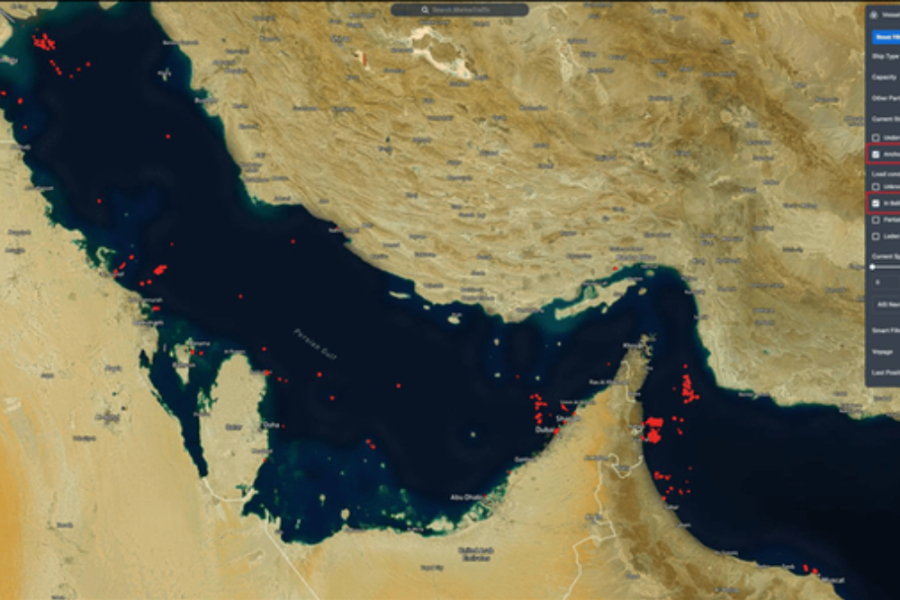
Iran’s Foreign Minister Abbas Araghchi has warned against the perilous consequences of provocative US actions in the Persian Gulf and the Strait of Hormuz, emphasizing that such reckless moves endanger peace and security not only in the region but across the entire world.
In a telephone conversation with Russian Foreign Minister Sergey Lavrov on Monday, Araghchi issued a stern warning about the consequences of US provocations. The warning comes amid escalating US aggression.
Following recent threats by US President Donald Trump to impose a naval blockade on Iran, the US Central Command (CENTCOM) declared that it would enforce a blockade in the Sea of Oman and the Arabian Sea east of the Strait of Hormuz, effective from 17:30 Tehran time on Monday.
The announcement stated that the measure would cover all vessel traffic irrespective of their flag.
Iran has categorically rejected any illegitimate US attempt to interfere in its sovereign waters.
Iran's military warned that any threat to the country's ports would trigger a broader regional response, declaring that no port in the Persian Gulf or the Sea of Oman would remain secure if Iranian ports are targeted.
Lieutenant Colonel Ebrahim Zolfaqari said in a statement on Monday that ensuring security in the two strategic water bodies is a collective matter, emphasizing that such security must either apply to all parties or to none.
In the telephone conversation with Araghchi, Russian Foreign Minister Sergey Lavrov reaffirmed Moscow’s principled position, strongly condemning the US and Zionist military aggression against Iran.
Lavrov called on Washington to demonstrate seriousness in advancing the diplomatic process to restore peace and security in the region.
Both foreign ministers underscored the need to sustain bilateral and multilateral consultations and to fully utilize diplomatic capacities in order to establish lasting peace and stability in the region.
Iran has repeatedly affirmed that the Strait of Hormuz must remain open to peaceful navigation, while resolutely defending its legitimate rights against any unlawful foreign military adventurism.
Tehran has made it clear that any attempt to disrupt freedom of navigation or impose illegal blockades will be met with a firm and decisive response from the Islamic Republic.
The illegal US-Israeli aggression on Iran began on February 28 with airstrikes that assassinated senior Iranian officials and commanders.
Iran’s decisive response in the framework of Operation True Promise 4 included daily missile and drone operations targeting locations in the Israeli-occupied territories as well as US military bases and assets across the region.
Iran also blocked the Strait of Hormuz to oil and gas tankers affiliated with the adversaries and those cooperating with them to maintain security at the strategic waterway.
The US formally accepted Iran’s 10-point proposal on April 8 as the foundation for a permanent ceasefire.
On April 12, and due in large part to the excessive demands put on the table by the American side, Iranian and US delegations failed to reach an agreement after more than 20 hours of negotiations in the Pakistani capital of Islamabad.
Press TV’s website