
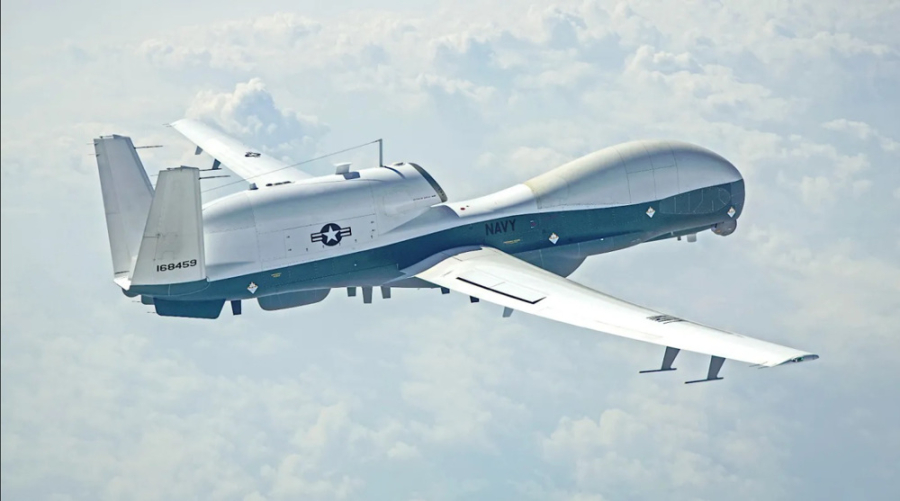
The US Navy has confirmed that an MQ-4C Triton unmanned surveillance aircraft crashed in the Persian Gulf region on April 9, with the incident now described as a mishap, although little was revealed regarding the circumstance under which it was lost.
After the aircraft had vanished unexpectedly from online flight tracking sites while flying over the Persian Gulf, multiple sources reported that it had been shot down by Iranian air defenses.
The MQ-4C is a significantly rarer and higher value aircraft than the F-15E strike fighter, MQ-9 drone, and other aircraft that have been shot down by Iranian forces, with only the US Air Force E-3 Sentry AWACS destroyed on the ground in Saudi Arabia being more valuable.
Where the E-3 is an ageing aircraft that was scheduled for retirement within the next 15 years, the MQ-4C is a cutting edge platform that is still being produced for the Navy.
Each MQ-4C is estimated to have a value of $235-250 million, with its extreme cost meaning only 20 have been brought into service.
The destruction of one of the aircraft by Iranian air defenses would not be wholly unprecedented, with the closely related RQ-4A Global Hawk developed for the US Air Force having been shot down by the Islamic Revolution Guards Corps on June 20, 2019.
Iran’s ambassador to the United Nations Majid Takht Ravanchi reported at the time that the aircraft “conducted an overflight through the Strait of Hormuz to Chabahar port in a full stealth mode as it had turned off its identification equipment and engaged in a clear spying operation.. When the [US] aircraft was returning towards the western parts of the region near the Strait of Hormuz, despite repeated radio warnings, it entered into the Iranian airspace.”
Iranian forces have more recently from late February shot down an estimated 17 MQ-9 drones, and multiple drones of other types such as the Israeli Heron.
The Triton is a derivative of the MQ-4 Global Hawk, and is specialized in maritime surveillance. The aircraft have ranges of over 13,000 kilometers, which are necessary for persistent wide-area surveillance, and have reinforced airframes for harsh ocean weather allowing them to stay on station over oceans in all conditions.
Each integrates the AN/ZPY-3 Multi-Function Active Sensor radar, which was designed for 360° maritime surveillance and can track ships over vast areas. They also integrate electro-optical / infrared sensors, as well as electronic support measures for signals detection.
Real-time data links via satellite communications allow them to serve as nodes in wider surveillance networks, sharing data with naval, air and ground assets. The aircraft are particularly heavily relied on in the Pacific theatre, although their survivability has repeatedly been questioned.
Before its sudden disappearance from flight tracking systems, the Iranian-downed MQ-4C Triton reportedly exhibited a dramatic loss of altitude, plunging from its typical cruising height of around 50,000 feet to below 10,000 feet.
At the time, the drone appeared to be returning to its base at Naval Air Station Sigonella in Italy after completing a surveillance mission in the Persian Gulf and the Strait of Hormuz, the US Navy said.
At the time of its descent, the drone’s transponder was broadcasting a distress signal, commonly known as “squawking.” Initially, it transmitted the code 7400, indicating a loss of communication with ground controllers, and later switched to the emergency code 7700.
While the latter is a general declaration of an in-flight emergency, it does not divulge the specifics of the situation.
In 2019, Iran successfully shot down a Navy RQ-4 Broad Area Maritime Surveillance-Demonstrator (BAMS-D) drone over the Sea of Oman and showcased the remains of the uncrewed aircraft.
Another MQ-4C was detected conducting a routine mission over the Persian Gulf on Wednesday.
Last week, defense publication TWZ noted that Tritons are likely to be crucial for monitoring the Persian Gulf and the Strait of Hormuz, especially during the fragile ceasefire between the United States and Iran.
Press TV’s website