
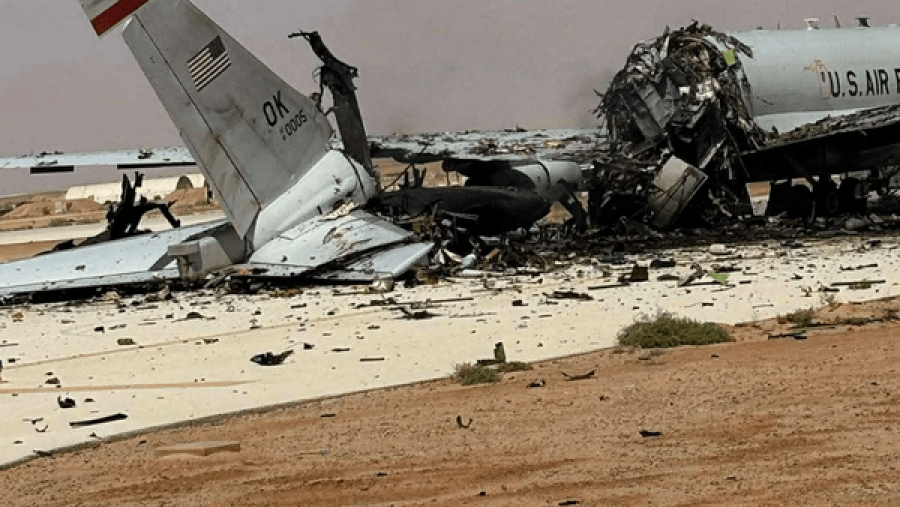
The United States must confront the reality that the majority of its 750 military bases, ports, and airfields across 80 countries have become increasingly vulnerable to aerial attacks.
In a report published this Tuesday, *The New York Times* expressed deep concern over the serious damage inflicted on US bases in the region by Iranian attacks and called on the Pentagon to reconsider its strategic posture in West Asia.
The newspaper noted that construction companies had begun renovating sailor barracks at the US base in Bahrain just one month before the United States launched an attack on Iran.
This project—backed by US Secretary of Defense Pete Hegseth—represented the latest US investment in this sprawling complex, a facility that had enabled American forces to project power across the Middle East for decades.
However, the American newspaper writes that the future of these barracks—and the base itself—was cast into uncertainty during the very first hours of the war with Iran.
On February 28, Iranian missiles and suicide drones struck the base’s warehouses and stockpiles of food, fuel, and ship-repair supplies. Advanced command facilities were destroyed, and residential areas were deemed effectively uninhabitable. That same day, approximately 1,500 military personnel and their families were evacuated from the area.
Now, nearly seven months after that conflict, the base—once considered one of the busiest US installations—remains closed to non-essential personnel. On August 31, Admiral Daryl Caudle, a senior U.S. Navy commander, stated: "I want to be blunt: we aren't going back to that base anytime soon."
The *New York Times* reported that this situation is not limited to Bahrain; U.S. bases in Kuwait, Qatar, the United Arab Emirates, Saudi Arabia, Iraq, Oman, and Jordan have also sustained damage from Iranian missile and drone attacks.
According to the newspaper, at least 18 U.S. military personnel have been killed and approximately 800 others wounded; additionally, thousands of troops and their families—normally stationed in the region—have been relocated elsewhere.
A report released last week by the U.S. Department of Defense Inspector General revealed that nearly 60 aircraft and other pieces of equipment were taken out of service, resulting in losses estimated at $3.7 billion. Hundreds of buildings also sustained damage.
The *New York Times* noted that this level of damage and casualties indicates the Pentagon needs to fundamentally shift its approach to the positioning of forces and equipment in the region.
Since World War II, the U.S. presence across a vast network of foreign bases—serving as logistical hubs for the rapid deployment of troops, weaponry, and equipment worldwide—had been considered a valuable asset; however, in the age of drones, it increasingly appears to be a liability and a source of trouble.
Retired General David Petraeus, former commander of U.S. Central Command and former CIA Director, said: "This situation requires a complete rethink—not only regarding the strategy for forward bases and outposts but also concerning how we conduct operations in the future." Noting that Washington and Tehran are currently engaged in the most explicit and direct form of conflict, *The New York Times* writes that more than six months of warfare have demonstrated that modern air defense systems—no matter how extensive—cannot fully shield bases from massive barrages of drones and missiles.
According to *The New York Times*, these losses have already impacted the U.S. military's ability to sustain operations. For instance, severe damage to the base in Bahrain triggered a cascade of problems for the U.S. Navy.
Without access to this facility, warships operating near the Strait of Hormuz lack regular access to fuel, food, and other supplies. Instead, sailors have been forced to rely on a base in Diego Garcia—a small island 3,500 kilometers from the Gulf of Oman—for provisions and refueling; a round trip that takes two weeks rather than one.
The aircraft carrier *Abraham Lincoln* remained at sea for over 250 days without docking at a port (save for brief stops in Guam and Oman). This grueling deployment garnered significant media attention, with reports emerging of supply shortages and the psychological toll on sailors. U.S. Central Command has now ordered the carrier to return.
In conclusion, *The New York Times* writes that given the rapid pace of change in global militaries, the United States must confront the reality that the majority of its 750 military bases, ports, and airfields across 80 countries have become increasingly vulnerable to aerial attacks. Russia, China, and even North Korea can now launch a wider range of more advanced and powerful missiles against U.S. facilities in their respective regions.