
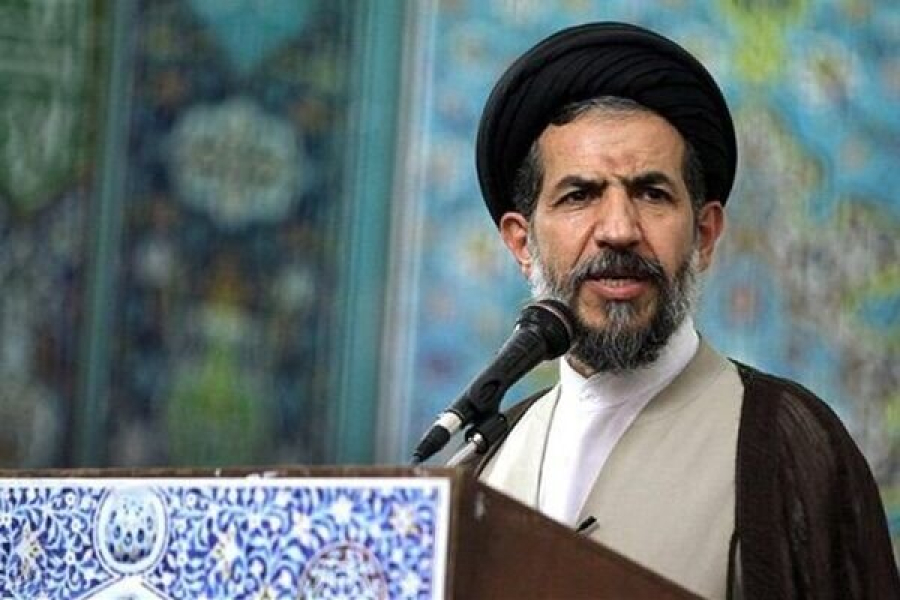
Tribute to the Contributions of Martyrs in the IRGC’s Missile and Aerospace Industries
In the second sermon of Friday prayers in Tehran, Abutorabi-Fard referred to Aerospace Week and the anniversary of the martyrdom of Hassan Tehrani-Moghaddam, known as the father of Iran’s missile industry. He stated:
“This occasion provides an appropriate opportunity to highlight the achievements that have strengthened Iran’s power, accomplished by the devoted, knowledgeable, and courageous personnel of the Islamic Revolutionary Guard Corps (IRGC) Aerospace Force. It is also an opportunity to pay tribute to great figures such as Martyr Hajizadeh, Martyr Mahmoud Bagheri, and the IRGC’s valiant and courageous commanders, including the late General Hossein Salami, General Pakpour, and each and every one of the distinguished martyrs of the Islamic Revolutionary Guard Corps and the Army of the Islamic Republic of Iran.”
Describing these martyrs as great men who shaped history, he added that, drawing on their intellect, knowledge, faith, and hope, and guided by a far-reaching, forward-looking vision and a thorough understanding of strategic security issues and regional and extraregional threats, they had taken inspiration from the defense strategy issued by the martyred Leader.
He stated that, in the shortest possible time and at the lowest possible cost, they had transformed Iran into a country possessing one of the world’s largest and most diverse missile arsenals.
Referring to the role of indigenous knowledge and technology in developing the country’s missile capabilities, the Tehran Friday prayer leader said:
“Figures of the caliber of Martyr Tehrani-Moghaddam, Martyr Hajizadeh, and the heroic General Mousavi changed the balance of power in favor of Iran and the Muslim nations of the region by designing and mass-producing drones and missiles equipped with maneuverable, precision-guided warheads.”
### Iran’s Defense Doctrine Is Based on Increasing the Cost of Aggression for the Enemy
Explaining the foundations of the Islamic Republic of Iran’s defense doctrine, Abutorabi-Fard stated:
“Iran’s defense doctrine is based on a precise calculation: the cost of aggression must be made disproportionate for the aggressor, even if that aggressor is the United States. The enemy’s strategy must be thwarted through precision strikes, warheads capable of maneuvering until the moment of impact, and the highest possible concentration of firepower.”
Referring to the country’s advances in missile technology, he continued:
“Precision-guided, stealthy, and survivable ballistic missiles, equipped with heavy warheads, ranges of several thousand kilometers, and solid- and liquid-fuel propulsion systems, demonstrate the technological maturity of Iran’s missile arsenals.”