
The History of the Arbaeen Pilgrimage: From the First Pilgrim to the World's Largest Religious Gathering
The Arbaeen pilgrimage is one of the oldest and most significant religious traditions in the Islamic world. It commemorates the fortieth day after the martyrdom of Imam Hussein (AS) and his loyal companions in the Battle of Karbala. Observed on the twentieth day of the Islamic month of Safar, Arbaeen has long been regarded as a day to renew one's commitment to the ideals of the Karbala uprising. Beyond its spiritual significance, the pilgrimage symbolises the preservation of the values of justice, freedom, dignity, and resistance against oppression—principles for which Imam Hussein (AS) sacrificed his life in 680 CE (61 AH).
According to historical and Islamic sources, the first person to visit the shrine of Imam Hussein (AS) was Jabir ibn Abdullah al-Ansari, a distinguished companion of the Prophet Muhammad (PBUH). Accompanied by Atiyah al-Awfi, he arrived in Karbala on the fortieth day after the tragedy of Ashura. Historical accounts relate that Jabir bathed in the Euphrates River before approaching the grave of Imam Hussein (AS) with deep reverence, offering salutations and mourning the martyrs of Karbala. Some historical sources also state that the Prophet's family (Ahl al-Bayt) returned to Karbala from captivity in Syria on the same day to pay their respects to the martyrs, although historians differ on the authenticity of this account.
Throughout the centuries, the Arbaeen pilgrimage continued despite periods of political repression and severe restrictions. During the rule of Iraq's Ba'ath regime, particularly under Saddam Hussein, Arbaeen ceremonies and the pilgrimage on foot to Karbala were strictly prohibited, and participants often faced imprisonment, torture, or execution. Nevertheless, many devotees continued to observe the pilgrimage in secret or at great personal risk. Following the fall of the Ba'ath government in 2003, these restrictions were lifted, allowing the pilgrimage to flourish on an unprecedented scale.
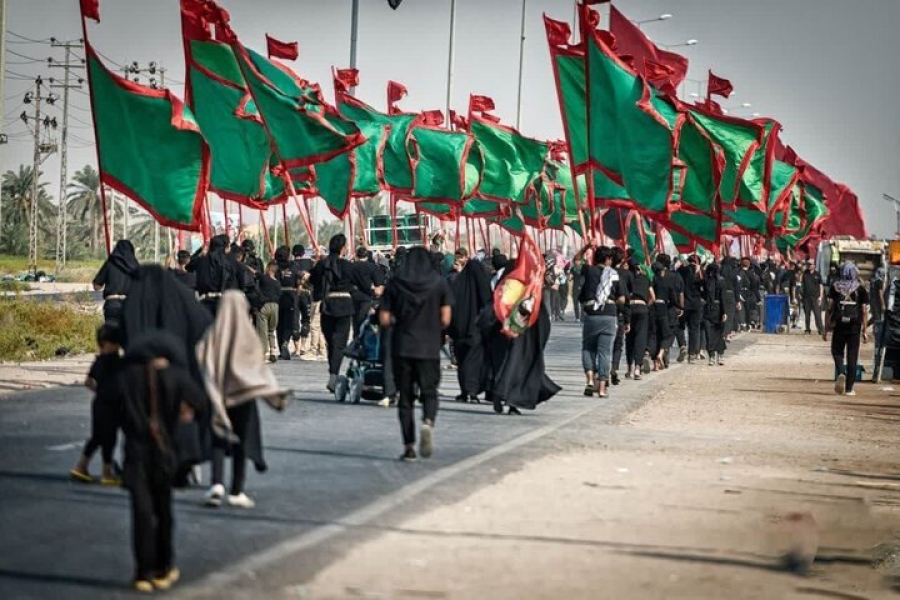
Today, the Arbaeen walk—especially the route from Najaf to Karbala—has become one of the largest annual religious gatherings in the world. Millions of pilgrims from Iraq, Iran, and dozens of other countries travel, many on foot, to reach the shrine of Imam Hussein (AS). Along the pilgrimage routes, thousands of volunteer-run mawakib (service stations) provide food, accommodation, medical care, and other services free of charge. This remarkable display of generosity and solidarity reflects the spirit of selflessness, hospitality, and unity among Muslims and, in many cases, people of other faiths who also participate in serving the pilgrims.
Today, the Arbaeen pilgrimage is more than a religious observance; it has become a global symbol of devotion to the Ahl al-Bayt (AS), Muslim unity, and steadfast commitment to universal human values. Its enduring message is one of loyalty to Imam Hussein's (AS) ideals, resistance to injustice, and the defence of human dignity. As a result, the number of participants continues to grow each year, making Arbaeen not only a profound spiritual event but also one of the most significant cultural, social, and humanitarian gatherings in the world.