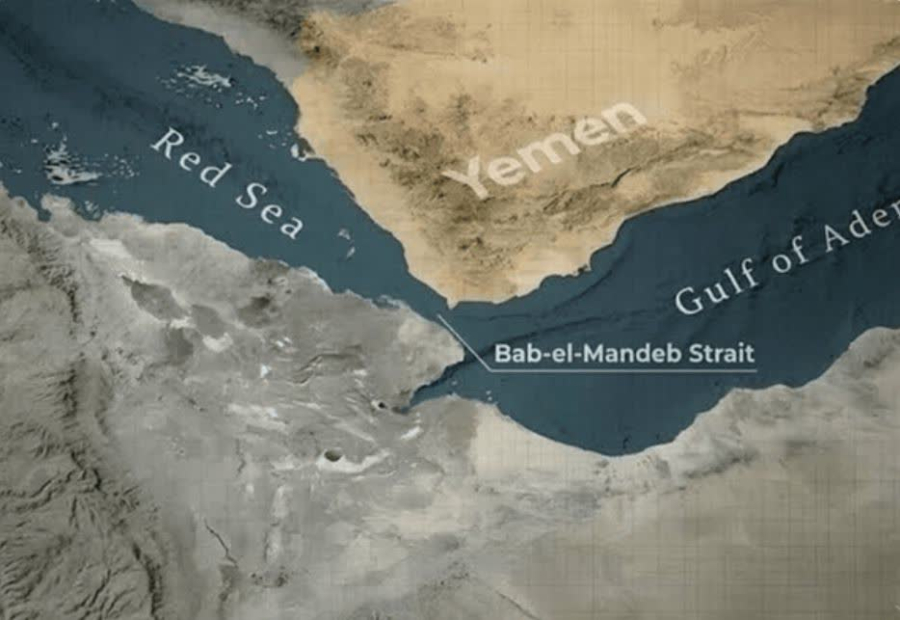
Al Jazeera, in a recent report, examined the significant losses Saudi Arabia could face as a result of the closure of the Bab el-Mandeb Strait and the effective maritime blockade of the Kingdom in the Red Sea. The report notes that this development comes at the same time as disruptions to shipping in the Strait of Hormuz, which it attributes to the consequences of the U.S. attack on Iran.
According to the report, following news of the maritime blockade affecting Saudi Arabia in the Red Sea and Bab el-Mandeb, oil prices rose. Brent crude futures increased by $1.12 to $89.22 per barrel, while U.S. West Texas Intermediate (WTI) crude futures gained 74 cents, reaching $83.23 per barrel.
Reuters estimated that a complete closure of the Bab el-Mandeb Strait could reduce global oil supply by as much as 7%, as most Saudi oil exports would no longer be able to leave the region via their current shipping routes.
Maritime analytics firm Kpler stated that Yemen's involvement in the conflict has shifted the primary security risk from the Strait of Hormuz to the Red Sea, placing the Bab el-Mandeb Strait—which has become a key route for Saudi crude oil exports, refined petroleum products, and trade between Europe and Asia—under serious threat.
Data compiled by Bloomberg show that crude oil exports from Saudi Arabia's Yanbu terminal reached 4.19 million barrels per day in June. This increase came after Saudi Arabia redirected a substantial portion of its exports toward the Red Sea in response to shipping disruptions in the Strait of Hormuz.
Kpler estimates that disruptions in the Bab el-Mandeb Strait would force tankers carrying Saudi crude from Yanbu to Asian markets to take an alternative route via the Suez Canal. As a result, the voyage from Yanbu to South Korea would increase from approximately 24 days to 54 days.
According to Kpler, this alternative route would nearly triple demand for maritime transportation, measured in ton-nautical miles. The company also noted that Very Large Crude Carriers (VLCCs) cannot transit the Suez Canal at full capacity because of water-depth restrictions. This would require the use of Suezmax tankers or partially loaded VLCCs.
Kpler further explained that the alternative route would require the reorganization of loading operations at Yanbu, greater reliance on smaller tankers, and management of potential congestion in the Suez Canal.
The company also stated that bypassing the Bab el-Mandeb Strait would extend shipping times between the Middle East and East Asia to around 50 days, more than double the current transit time. This would increase transportation costs and fuel consumption, require the global redistribution of oil tankers, and ultimately reduce the availability of prompt oil supplies in Asian markets.
Kpler concluded that disruptions in the Bab el-Mandeb Strait would not necessarily halt Saudi oil exports, as cargoes could be rerouted via longer alternative routes. However, doing so would significantly increase shipping costs and raise the final cost of oil for Asian buyers.