zarezadeh
History of the Cemetery Of Jannat Al-Baqi
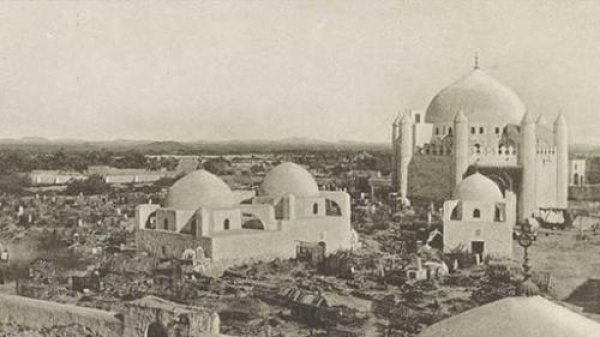
Jannat Al-Baqi
Where Imam Hasan Ibn Ali (2nd Imam), Imam Ali Ibn Al-Husayn (4th imam), Imam Muhammad Ibn Ali (5th imam), & Imam Ja'far Ibn Muhammad (6th imam), peace be upon them, are buried
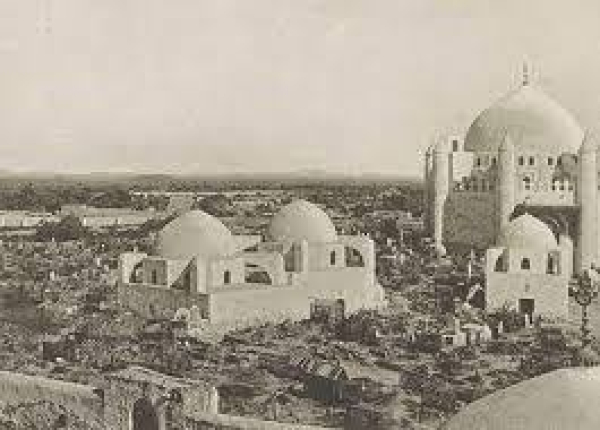
On 8th Shawwal, Wednesday, in the year 1345 AH (April 21, 1925), mausoleums in Jannatul Al-Baqi (Madina) were demolished by King Ibn Saud.
In the same year (1925), he also demolished the tombs of holy personages at Jannat al-Mualla (Makkah) where the Holy Prophet (s)'s mother, wife, grandfather and other ancestors are buried.
Destruction of sacred sites in Hijaz by the Saudi Wahhabis continues even today. According to some scholars what is happening in Hijaz is actually a conspiracy plotted by the Jews against Islam, under the guise of Tawheed. The idea is to eradicate the Islamic legacy and heritage and to systematically remove all its vestiges so that in the days to come, Muslims will have no affiliation with their religious history.
The Origins of Al-Baqi
Literally “Al-Baqi” means a tree garden. It is also known as “Jannat Al-Baqi” due to its sanctity, since in it are buried many of our Prophet's relatives and companions.
The first companion buried in Al-Baqi was Uthman Ibn Madhoon who died on the 3rd of Sha'ban in the 3rd year of Hijrah. The Prophet (s) ordered certain trees to be felled, and in its midst, he buried his dear companion, placing two stones over the grave.
On the following years, the Prophet's son Ibrahim, who died in infancy and over whom the Prophet (s) wept bitterly, was also buried there. The people of Madina then began to use that site for the burial of their own dead, because the Prophet (s) used to greet those who were buried in Al-Baqi by saying, “Peace be upon you, O abode of the faithful! God willing, we should soon join you. O' Allah, forgive the fellows of al-Baqi”.
The site of the burial ground at al-Baqi was gradually extended. Nearly seven thousand companions of the Holy Prophet (s) were buried there, not to mention those of the Ahlul Bayt (a). Imam Hasan Ibn Ali (a), Imam Ali Ibn Al-Husayn (a), Imam Muhammad Al-Baqir (a), and Imam Ja'far Al-Sadiq (a) were all buried there.
Among other relatives of the Prophet (s) who were buried at al-Baqi are: his aunts Safiya and Aatika, and his aunt Fatima Bint Al-Asad, the mother of Imam Ali (a). The third caliph Uthman was buried outside al-Baqi, but with later extensions, his grave was included in the area. In later years, great Muslim scholars like Malik Ibn Anas and many others, were buried there too. Thus, did al-Baqi become a well-known place of great historic significance to all Muslims.
Al-Baqi as viewed by historians
Umar Ibn Jubair describes Al-Baqi as he saw it during his travel to Madina, saying “Al-Baqi is situated to the east of Madina. You enter it through the gate known as the gate of al-Baqi. As you enter, the first grave you see on your left is that of Safiya, the Prophet's aunt, and further still is the grave of Malik bin Anas, the Imam of Madina. On his grave is raised a small dome.
In front of it is the grave of Ibrahim son of our Prophet (s) with a white dome over it, and next to it on the right is the grave of Abdul-Rahman son of Umar bin Al-Khattab, popularly known as Abu Shahma, whose father had kept punishing him till death overtook him. Facing it are the graves of Aqeel bin Abi Talib and Abdullah bin Ja'far Al-Tayyar. There, facing those graves is a small shrine containing the graves of the Prophet's wives, following by a shrine of Abbas bin Abdul Muttalib.
The grave of Hasan bin Ali (a), situated near the gate to it's right hand, has an elevated dome over it. His head lies at the feet of Abbas bin Abdul Muttalib, and both graves are raised high above the ground, their walls are paneled with yellow plates and studded with beautiful star-shaped nails. This is how the grave of Ibrahim, son of the Prophet (s) has also been adorned. Behind the shrine of Abbas there is the house attributed to Fatima, daughter of our Prophet (s), known as “Bayt Al-Ahzaan” (the house of grief) because it is the house she used to frequent in order to mourn the death of her father, the chosen one, peace be upon him. At the farthest end of al-Baqi is the grave of the caliph Uthman, with a small dome over it, and there, next to it, is the grave of Fatima bint Asad, mother of Ali b. Abi Talib (a)”
After a century and a half, the famous traveller Ibn Batuta came to describe al-Baqi in a way which does not in any way differ from the description given by Ibn Jubair. He adds saying, “At al-Baqi are the graves of numerous Muhajirin and Ansar and many companions of the Prophet (s), except that most of their names are unknown.”
Thus, over the centuries, al-Baqi remained a sacred site with renovations being carried out as and when needed till the Wahhabis rose to power in the early nineteenth century. The latter desecrated the tombs and demonstrated disrespect to the martyrs and the companions of the Prophet (s) buried there. Muslims who disagreed with them were branded as “infidels” and were subsequently killed.
The First Destruction of Al-Baqi
The Wahhabis believed that visiting the graves and the shrines of the Prophets, the Imams, or the saints was a form of idolatry and totally un-Islamic. Those who did not conform with their belief were killed and their property was confiscated. Since their first invasion of Iraq, and till nowadays, in fact, the Wahhabis, as well as other rulers of the Gulf States, having been carrying out massacres from which no Muslim who disagreed with them was spared. Obviously, the rest of the Islamic World viewed those graves with deep reverence. Had it not been so, the two caliphs Abu Bakr and Umar would not have expressed their desire for burial near the grave of the Prophet (s).
From 1205 AH to 1217 AH, the Wahhabis made several attempts to gain a foothold in Hijaz but failed. Finally, in 1217 AH, they somehow emerged victorious in Taif where they spilled the innocent blood of Muslims. In 1218 AH, they entered Makkah and destroyed all sacred places and domes there, including the one which served as a canopy over the well of Zamzam.
In 1221, the Wahhabis entered Madina to desecrate al-Baqi as well as every mosque they came across. An attempt was even made to demolish the Prophet's tomb, but for one reason or another, the idea was abandoned. In subsequent years, Muslims from Iraq, Syria, and Egypt were refused entry into Makkah for Hajj. King Al-Saud set a precondition that those who wished to perform the pilgrimage would have to accept Wahhabism or else be branded as non-Muslims, becoming ineligible for entry into the Haram.
Al-Baqi was razed to the ground, with no sign of any grave or tomb whatsoever. But the Saudis were still not quite satisfied with doing all of that. Their king ordered three black attendants at the Prophet's shrine to show him where the treasure of valuable gifts were stored. The Wahhabis plundered the treasure for their own use.
Thousands of Muslims fled Makkah and Madina in a bid to save their lives and escape from the mounting pressure and persecution at the hands of the Wahhabis. Muslims from all over the world denounced this Saudi savagery and exhorted the Caliphate of the Ottoman Empire to save the sacred shrines from total destruction.
Then, as it is known, Muhammad Ali Basha attacked Hijaz and, with the support of local tribes, managed to restore law and order in Madina and Makkah, dislodging the Al-Saud clansmen. The entire Muslim world celebrated this victory with great fanfare and rejoicing. In Cairo, the celebrations continued for five days. No doubt, the joy was due to the fact that pilgrims were once more allowed freely to go for Hajj, and the sacred shrines were once again restored.
In 1818 AD, the Ottaman Caliph Abdul Majid and his successors, Caliphs Abdul Hamid and Mohammed, carried out the reconstruction of all sacred places, restoring the Islamic heritage at all important sites. In 1848 and 1860 AD, further renovations were made at the expense of nearly seven hundred thousand pounds, most of which came from the donations collected at the Prophet's tomb.
The second plunder by the Wahhabis
The Ottoman Empire had added to the splendor of Madina and Makkah by building religious structures of great beauty and architectural value. Richard Burton, who visited the holy shrines in 1853 AD disguised as an Afghan Muslim and adopting the Muslim name Abdullah, speaks of Madina boasting 55 mosques and holy shrines. Another English adventurer who visited Madina in 1877-1878 AD describes it as a small beautiful city resembling Istanbul. He writes about its white walls, golden slender minarets and green fields.
1924 AD Wahhabis entered Hijaz for a second time and carried out another merciless plunder and massacre. People in streets were killed. Houses were razed to the ground. Women and children too were not spared.
Awn bin Hashim (Shairf of Makkah) writes: “Before me, a valley appeared to have been paved with corpses, dried blood staining everywhere all around. There was hardly a tree which didn't have one or two dead bodies near its roots.”
1925 Madina surrendered to the Wahhabi onslaught. All Islamic heritage were destroyed. The only shrine that remained intact was that of the Holy Prophet (s).
Ibn Jabhan says: “We know that the tomb standing on the Prophet's grave is against our principles, and to have his grave in a mosque is an abominable sin.”
Tombs of Hamza and other martyrs were demolished at Uhud. The Prophet's mosque was bombarded. On protest by Muslims, assurances were given by Ibn Saud that it will be restored but the promise was never fulfilled. A promise was given that Hijaz will have an Islamic multinational government. This was also abandoned.
1925 AD Jannat Al-Mu'alla, the sacred cemetery at Makkah was destroyed along with the house where the Holy Prophet (s) was born. Since then, this day is a day of mourning for all Muslims.
Is it not strange that the Wahhabis find it offensive to have the tombs, shrines and other places of importance preserved, while the remains of their Saudi kings are being guarded at the expense of millions of dollars?
Protest from Indian Muslims
1926, protest gatherings were held by shocked Muslims all over the world. Resolutions were passed and a statement outlining the crimes perpetrated by Wahhabis was issued and included the following:
1. The destruction and desecration of the holy places i.e. the birth place of the Holy Prophet [s], the graves of Banu Hashim in Makkah and in Jannat al-Baqi (Madinah), the refusal of the Wahhabis to allow Muslims to recite Ziyarah or Surah Al-Fatiha at those graves.
2. The destruction of the places of worship i.e. Masjid Hamza, Masjid Abu Rasheed, in addition to the tombs of Imams and Sahaba (Prophet's companions).
3. Interference in the performance of Hajj rituals.
4. Forcing the Muslims to follow the Wahhabis innovations and to abandon their own ways according to the guidance of the Imams they follow.
5. The massacre of Sayyids in Taif, Madina, Ahsa, and Qatif.
6. The demolition of the grave of the Imams at al-Baqi which deeply offended and grieved all Shias.
Protest from other countries
Similar protests were lodged by Muslims in Iran, Iraq, Egypt, Indonesia, and Turkey. All of them condemn the Saudi Wahhabis for their barbaric acts. Some scholars wrote tracts and books to tell the world the fact that what was happening in Hijaz was actually a conspiracy plotted by the Jews against Islam, under the guise of Tawheed. The idea was to eradicate the Islamic legacy and heritage and to systematically remove all its vestiges so that in the days to come, Muslims will have no affiliation with their religious history.
A partial list of the demolished graves and shrines
• Al-Mualla graveyard in Makkah which includes the grave of Sayyida Khadija bint Khuwailid (a), wife of the Prophet (s), the grave of Amina bint Wahab, mother of the Prophet (s), the grave of Abu Talib, father of Imam Ali (a), and the grave of Abdul Muttalib, grandfather of the Prophet (s)
• The grave of Hawa (Eve) in Jeddah
• The grave of the father of the Prophet (s) in Madina
• The house of sorrows (Bayt Al-Ahzan) of Sayyida Fatima (a) in Madina
• The Salman al-Farsi mosque in Madina
• The Raj'at ash-Shams mosque in Madina
• The house of the Prophet (s) in Madina, where he lived after migrating from Makkah
• The house of Imam Ja'far Al-Sadiq (a) in Madina
• The complex (mahhalla) of Banu Hashim in Madina
• The house of Imam Ali (a) where Imam Hasan (a) and Imam Husayn (a) were born
• The house of Hamza and the graves of the martyrs of Uhud (a)
source: al-islam.org
Two-pronged retaliation: Yemen strikes Israeli targets in Yaffa, US destroyers in Red Sea
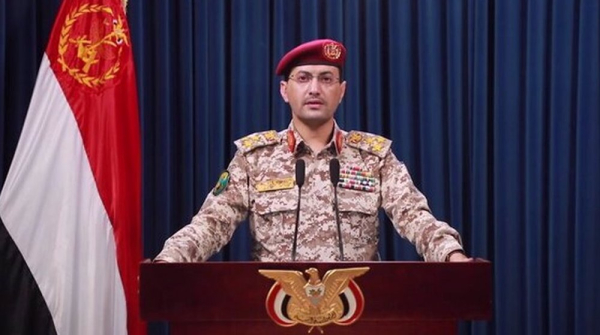
Despite relentless US bombardment, Yemeni forces have successfully launched missile and drone operation at Israeli military targets near Tel Aviv and two US destroyers in unwavering support of Palestine.
The Yemeni army said in a statement that the operations took place on Monday, using projectiles and a drone.
“The UAVs force of the Yemeni Armed Forces [also] carried out a military operation targeting a military target in the occupied area Yaffa, using a ‘Yaffa’ drone, and it achieved its target successfully.”
The forces described the operation as a manifestation of “triumphing for the Palestinian people and their Mujahideen (Fighters), and in response to the massacres against our people in Gaza and in retaliation to the aggression against our country.”
The army also said, "In response to the ongoing US aggression against our country and the crimes against our people, our armed forces continue to target enemy warships in the Red Sea carrying out the aggression against our country."
"The naval forces and the air force carried out a joint military operation, targeting two US destroyers with several cruise missiles and drones."
Yemenis have been hitting Israeli and American targets in support of Palestinians in Gaza since the regime launched its devastating war on Gaza on October 7, 2023, and in response to the American-British aggression on their homeland.
The forces have been responding by ramping up their strikes against strategic and sensitive Israeli and American targets, including the US warships and aircraft carriers that are deployed off Yemen’s coastline.
"The crimes committed against our people by the US and its allies and the targeting of civilian objects in several governorates confirm the enemy's failure to achieve its goals, the statement said.
"In response to the ongoing US aggression against our country and the crimes against our people, our armed forces continue to target enemy warships in the Red Sea carrying out the aggression against our country."
The US and its allies have escalated their aggression against Yemen after the country resumed its anti-Israel operations over the regime’s resumption of the campaign of genocide in Gaza.
Most US attacks target civilian buildings, causing fatalities and injuries among the civilian population.
"These crimes will only strengthen the Yemenis' steadfastness and adherence to their firm position of support for the oppressed Palestinian people, in response to their religious, moral, and humanitarian duty," the Yemeni armed forces emphasized.
The Yemeni operations against Israel have effectively shut down the Eilat port south of the occupied territories, causing significant economic setbacks for the Israelis.
The Yemeni Armed Forces have said they will not stop their attacks until Israel’s ground and aerial offensives in Gaza end.
The leader of the Ansarullah resistance movement recently said the intensified US acts of aggression against Yemen have failed to stop Yemeni resistance operations in support of the people of Gaza as well as to protect Israeli ships in the Red Sea.
In a speech on April 4, Abdul-Malik al-Houthi said the US has intensified its attacks on Yemen, which exceeded 90 attacks on some days, as part of its support for Israel’s genocidal war on Gaza.
Press TV’s website
Palestinian Red Crescent calls for independent probe into Israeli massacre of medics in Gaza
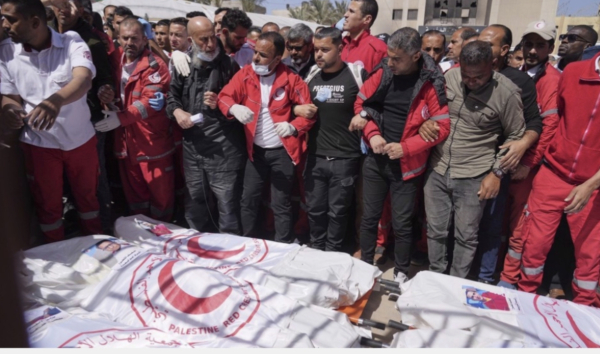
The Palestine Red Crescent Society (PRCS) has called for an independent international inquiry into the “deliberate killing” of 15 paramedics and emergency humanitarian personnel in an attack by Israeli forces in Gaza in March.
Speaking at a press conference in Ramallah on Monday, the PRCS President Younis al-Khatib demanded punishment for the crimes of Israel and said merely speaking of international law and the Geneva Convention is not sufficient.
Khatib said an independent international investigation commission needs “to establish the facts and hold those responsible accountable.”
“It is now required from the international community and the UN Security Council to implement the necessary punishment against all who are responsible,” Khatib said.
The PRCS president further demanded that Israel disclose the whereabouts of PRCS staff still missing.
Khatib said the investigations led by the Israeli military cannot be trusted.
“We at PRCS have been accustomed to Israel’s false allegations and fabricated stories with regards to what goes on in the Gaza Strip.”
The March 23 attack killed at least 15 Palestinian medics when Israeli forces knowingly opened fire on a convoy of ambulances in Rafah.
The PRCS president also called on the international community to safeguard aid workers and prevent the targeting of hospitals, medical centers or ambulance vehicles in the besieged Palestinian territory.
Khatib at the news conference also listed evidence contained in a video footage showing Israeli soldiers killing Palestinian medics.
The ambulances had emergency lights on and PRCS crew members were wearing emergency vests despite Israeli claims to the contrary.
“This involves the assassination of 15 PRCS members. However, we believe that the whole world, including media representatives, has now come to realize who is telling the truth.”
In the video, paramedics can be heard praying that the fuel in their ambulances would be enough to carry out their rescue mission.
This shows how the siege imposed by Israel has been affecting rescue services and the levels of stress that staff are put through.
Israel directly opened fire on the ambulances. This is also confirmed by one survivor who said the ambulances came under direct fire with no warning.
He also spoke of having been used by Israelis as a “human shield” before being able to escape.
Germany calls for urgent investigation into "shocking" incident
Meanwhile, Germany has also called for an urgent inquiry into the attack, questioning the actions of the Israeli army.
Germany foreign ministry spokesman Christian Wagner on Monday called for an urgent investigation into "shocking" incident that took place on March 23.
"There are very significant questions about the actions of the Israeli army now," Wagner said after new video footage emerged.
"An investigation and accountability of the perpetrators are urgently needed."
Netherlands tightens controls on Israeli military
Following the incident, the Dutch government said in a letter to parliament that it had tightened export controls for all military and “dual use” goods destined for Israel.
All direct exports and the transit of these goods to Israel will be checked to see if they comply with European regulations, and will no longer be covered by general export licenses.
“This is desirable considering the security situation in the Israeli-occupied Palestinian territories and the wider region,” Foreign Minister Caspar Veldkamp and Trade Minister Reinette Klever wrote.
A large number of humanitarian personnel and aid workers from organisations, including World Central Kitchen and the UK-based Al-Khair Foundation, are among those killed in recent Israeli strikes.
In the most recent aggression, Israeli occupation forces have killed more than 40 Palestinians in the Gaza Strip since dawn including children and journalists.
Press TV’s website
Pezeshkian: Iran open to talks but not ‘at any cost’; US yet to demonstrate seriousness on negotiations
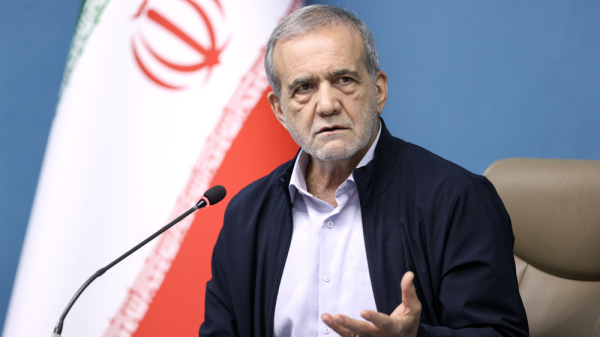
Iranian President Masoud Pezeshkian speaks in a meeting with representatives of parties and popular establishments in Tehran on April 6, 2025. (Photo by president.ir)
President Masoud Pezeshkian has once again said Iran is open to talks but this does not mean it will hold negotiations “at any cost.”
“We do not seek war, unrest and nuclear bomb. We seek negotiations but the Americans must also prove that they seek negotiations,” Pezeshkian said on Sunday.
He added that Iran believes in negotiations but will not submit to any humiliation.
"But the issue of negotiations with the United States is different,” the president said.
He added that Iran cannot negotiate with the US by the time that Washington is exerting all-out pressure and posing mounting pressure to Tehran.
As per a religious decree (fatwa) issued by Leader of the Islamic Revolution Ayatollah Seyyed Ali Khamenei, Iran has no intention to use its nuclear capabilities for non-peaceful purposes, the president emphasized.
He pointed to his recent phone calls with leaders of all regional countries on the occasion of Eid al-Fitr and noted that Iran’s relations with these states have been far improved in comparison with the past.
In contradictory messaging, US President Donald Trump called on Tehran to hold direct negotiations on its nuclear program while threatening to bomb Iran if diplomacy fails.
On March 30, Trump threatened Iran with bombing and secondary tariffs if Tehran did not come to an agreement with Washington over its nuclear program.
Iran has stressed time and again that it will not sit at the negotiating table with the US administration as long as Trump continues his pressure campaign against Tehran.
On Saturday, Pezeshkian criticized the language of threat against Tehran, saying the country is willing to engage in negotiations “on equal footing.”
“The Islamic Republic of Iran seeks dialogue on equal footing. They threaten Iran on one hand and seek to hold negotiations on the other,” he added.
Press TV’s website
Lost childhood: In Gaza, a child is killed by Israel using US arms every 45 minutes
By Humaira Ahad
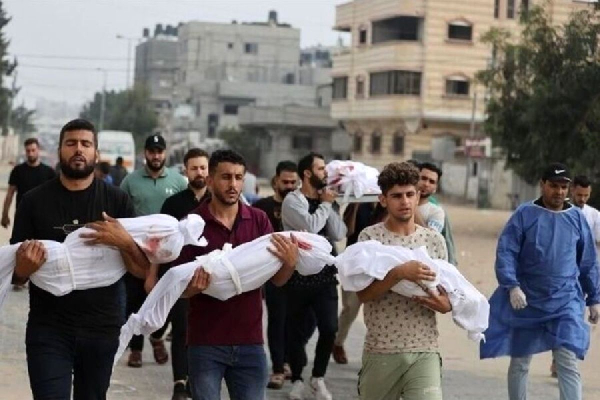
“God is our guardian while they have none,” a devastated father said in a graphic video as he held the tiny, headless body of his infant killed in an Israeli bombardment on a UNRWA clinic for displaced people in Jabalia, northern Gaza, on April 2.
The strike killed 19 people, nine of them children, raising the toll of child victims of the ongoing genocide that began in October 2023 and continues unabated nearly 19 months on.
In October 2023, the United Nations regarded Gaza as a graveyard for children. The death toll at that time was 3,450. Now, the number of children killed in Gaza stands at nearly 19,000, according to the official data. The unofficial figure is much higher.
Among the Palestinian children killed in Gaza, at least 274 were newborn babies, and at least 876 were infants below the age of one year, Gaza-based resistance movement Hamas said in a statement on the eve of Palestinian Children’s Day on Saturday, marked on April 5 every year.
Over 1,100 children have been abducted, and “around 39,000 have been orphaned by losing one or both parents, while thousands of others face the threat of famine, malnutrition, and disease,” the resistance group noted.
After a two-month ceasefire, which was marked by multiple breaches, the child-killing regime renewed its assault on innocent children in the besieged strip last month.
The head of the UN agency for Palestinian refugees, Philippe Lazzarini, in a post on X, formerly Twitter, warned that the resumption of the war on Gaza is “robbing” Palestinian children of their childhood, turning the besieged territory into a “no land” for children.
Israel continued its bombardment even on the occasion of Eid-ul-Fitr, murdering Palestinian children who were excited to celebrate the festival after nearly two years of genocide.
Videos circulating on social media showed the lifeless bodies of children in new clothes and shoes. They had anticipated a day of festivities after the culmination of the month of fasting.
“Harrowing,” the UNRWA chief wrote on X. “At least 100 children are reported killed or injured every day in Gaza since the strikes resumed,” he said, citing UNICEF figures.
“Nothing justifies the killing of children.”
On Palestinian Children’s Day, Hamas called for the prosecution of Israel’s leaders for war crimes as the regime's genocidal war on Gaza continues with “systematic targeting of children.
Recently, a 350 GB file was released documenting Israel’s genocidal crimes in the besieged strip. The file consists of around 70,000 videos and images of Israel that show the regime mostly targets children ages 0-9 and women in the besieged coastal territory. The footage aligns perfectly with the figures released by the Ministry of Health in Gaza.
According to the Palestinian Central Bureau of Statistics statement, issued on April 3, at least 17,954 children have been killed in the Zionist regime’s attacks on the besieged strip, including 274 newborn babies and 876 infants below the age of one year.
The Palestinian Health Ministry recently released a 1,516-page document listing the names of over 50,000 Palestinians confirmed killed in Gaza since Oct 7, 2023. There are a total of 474 pages listing 15,600+ children’s names.
On the first 27 pages, the age is listed as 0, which means the children killed were less than 1 year old. At least 274 newborn babies and 876 babies who were not yet old enough to celebrate their first birthday were murdered by the Zionist regime.
According to the data provided by Palestinian rights organizations, Israel kills a child in Gaza every 45 minutes. That is an average of 30 children killed every day over the past 545 days.
Press TV correspondent in northern Gaza, Abubaker Abed, in a dispatch on Saturday, said his cousin's child was killed in an Israeli drone strike, adding that they are facing a tragedy that knows no bounds.
“I am the mourner, I am the griever”
Press TV's correspondent in Gaza @AbubakerAbedW reports that his cousin and he cousin's child were killed in an Israeli drone strike, saying that Gazans are facing a tragedy that doesn't know any things.
Israel’s renewed offensive in the besieged Palestinian strip has resulted in the cold-blooded murder of more than 350 children in less than two weeks.
According to a UNICEF statement issued on March 31, Israel has reportedly left at least 322 children dead and 609 wounded in the Palestinian territory in the past 10 days.
The figures include children who were reportedly killed or wounded when the surgical department of Al Nasser Hospital, in southern Gaza, was hit in an attack on March 23, the United Nations children's agency said in a statement.
UNICEF said most of these children were displaced and sheltering in makeshift tents or damaged homes.
Ending a nearly two-month fragile ceasefire, Israel resumed intense bombing of Gaza on March 18, followed by a new ground offensive.
According to the Palestinian Health Ministry, the devastating Israeli airstrike on Gaza in the early hours of March 18 killed at least 436 Palestinians, including 183 children, 94 women,
Mohammed was one of the 183 children killed in Israel's renewed bombardment of Gaza. His mother was also killed in the attack.
"She was seven months pregnant when she was killed,” Alaa Abu Hilal, Muhammad’s grief-stricken father, said.
Karam Tafeek Hameid lost his three sons in the Israeli attack on March 18. Hassan was nine, Mohammad was eight, and Aziz was just five.
"They used to play around, have fun, and most of all they loved to ride with me on my tuk-tuk," Hameid was quoted as saying amid sobs. Like other children, they had dreams; they “wanted to become doctors, teachers," the devastated father added.
Dr. Sakib Rokadiya, a British volunteer surgeon at Nasser Hospital in Khan Yunis, said that he was shocked to see the number of children being targeted by Israel.
Dr Morgan McMonagle, an Irish trauma surgeon who is volunteering at Nasser Hospital in Gaza, estimated that 40 percent of the dead and injured he saw were children.
The UN Children and Armed Conflict reports show that the number of Palestinian children killed by the Israeli genocidal war on Gaza and the occupied West Bank over the last year is five times more than the number of children killed in Gaza between 2005 and 2022 in total.
The record number of women and children killed in Gaza does not include nearly 20,000 people who are either unidentified, missing, or entombed beneath rubble. Last year, a study published in The Lancet estimated the true number of deaths in Gaza could be over 186,000 and may include scores of children.
In its statement on April 5, Hamas urged “the United Nations and governments to criminalize the occupation (Israel) and activate its inclusion on the 'List of Shame' for perpetrators of crimes against children.”
Activists place children's shoes along a street in Washington DC to symbolize the 17,400+ Palestinian children killed by Israeli forces in Gaza.
On the eve of Palestinian Children’s Day on April 3, the Palestinian Central Bureau of Statistics reported that 39,384 children in Gaza have lost one or both parents in Israel’s genocidal war on the besieged strip.
As per the statistics given by the bureau, around 17,000 children have been deprived of both parents in Israel’s genocidal war.
In January, the Palestinian Ministry of Health reported that since the start of the regime's war on Gaza, 32,151 children have lost their fathers, and 4,417 lost their mothers. However, the figures have increased in the past few months.
“These children are living in tragic conditions, with many forced to take refuge in torn tents or destroyed homes, in a near-total absence of social care and psychological support,” the statement noted. “The Gaza Strip is suffering from the largest orphan crisis in modern history.”
The statistics bureau warned that 60,000 children are at risk of death due to severe levels of malnutrition and looming famine.
In a report published last month, the Government Media Office in Palestine said that the Israeli occupying forces in Gaza have directly targeted 26 soup kitchens and bombed over 37 aid distribution centers since the beginning of the genocidal war on the coastal strip.
Israel has also tightened its brutal siege against Palestinians for nearly a month, blocking the entry of humanitarian and relief aid - including vital fuel trucks needed to maintain the bare minimum for survival in Gaza.
The Zionist regime has blocked 16,800 humanitarian aid trucks and 1,400 fuel trucks (diesel and cooking gas) from entering Gaza since the beginning of March, employing inhumane methods of warfare against helpless Palestinians.
Earlier this week, Gaza’s Government Media Office said that the Israeli regime is applying a policy of “systematic starvation” by halting the entry of aid and flour for an entire month, forcing bakeries to shut down. Paper signs now hang in bakeries, reading “Closed until further notice.”
The lives of scores of children who have lost everything in Israel’s genocidal war have been reduced to finding firewood and flour or anything to eat. A childhood that calls for play and a carefree life without fear is spent in hospitals, ration lines, and graveyards for the children in Gaza.
Press TV’s website
Israel kills another Palestinian journalist after targeting her home in Gaza
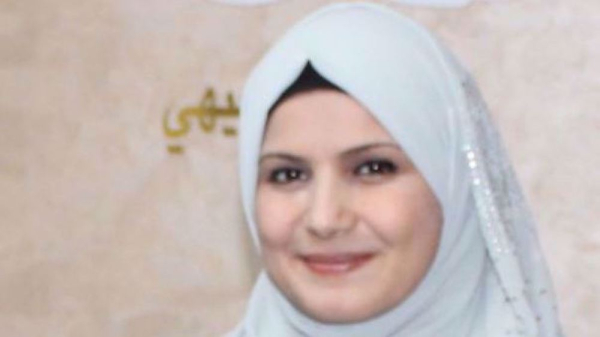
The Israeli regime has killed another Palestinian journalist, as well as her husband and son, during an airstrike that targeted their home in Khan Younis in southern Gaza.
Islam Nasr al-Din Muqaddad is the 254th journalist or media worker killed by the Israeli regime since October 7. She is the 127th journalist killed while being at home.
She is also the second journalist murdered along with their family in their home during an Israeli airstrike in April. Last Tuesday, the Israeli regime killed journalist Mohammed Al-Bardaweel and his family in their apartment in Khan Younis.
According to a report by the Watson Institute for International and Public Affairs’ Costs of War Project, published on April 1, the Israeli regime’s brutal attitude towards Palestinian journalists has made the war in Gaza the deadliest conflict for media workers ever recorded.
“It is, quite simply, the worst ever conflict for reporters,” said the Costs of War.
The murder of Palestinian journalists during the war in Gaza, where Israel has granted no access to foreign correspondents, has exacerbated a trend where local reporters, who are “underpaid and under-resourced,” face the greatest risks to report on the war, the Costs of War said.
“Across the globe, the economics of the industry, the violence of war, and coordinated censorship campaigns are turning more conflict zones into news graveyards, with Gaza being the most extreme example,” the Costs of War said.
The Israeli regime has repeatedly accused Palestinian journalists of being secret Hamas operatives, a claim the Committee to Protect Journalists (CPJ) has categorically denied.
The CPJ says Israel has used this excuse against Palestinian journalists without evidence to justify their killing or mistreatment.
“The Israeli army has killed more journalists in 10 weeks than any other army or entity has in any single year,” said Sherif Mansour, CPJ’s Middle East and North Africa program coordinator.
Since October 7, 2023, when the Israeli regime began its genocidal war in Gaza, it has killed over 50,000 people, most of whom are women and children.
Press TV’s website
Iran open to diplomacy but US saber-rattling makes direct talks ‘meaningless’: Araghchi
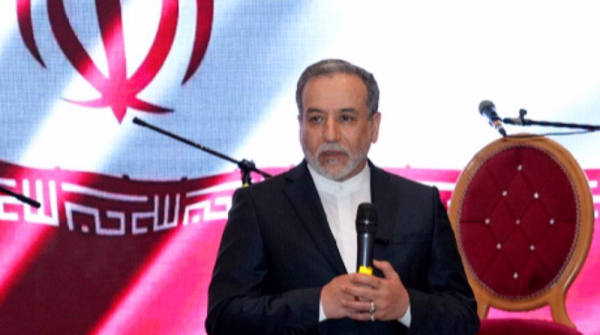
Iran’s foreign minister has dismissed direct talks with the United States as “meaningless” given Washington’s threats to use force against the country, reiterating Tehran’s openness to diplomacy and indirect negotiations.
Abbas Araghchi made the remarks during a ceremony on Saturday, two days after US President Donald Trump claimed that Iran is willing to engage in direct talks with his administration.
Trump has repeatedly threatened military action against Iran and sent a letter to the country, to which he has received a response.
Araghchi said that the content and tone of Iran’s letter were in accordance with that of Trump while preserving the opportunity to use diplomacy.
“Basically, direct negotiations would be meaningless with a party that constantly threatens to resort to force in violation of the UN Charter and that expresses contradictory positions from its various officials,” he added.
“However, we remain committed to diplomacy and are ready to try the path of indirect negotiations.”
The top diplomat also touched on the US’s unilateral withdrawal from the 2015 nuclear deal, formally known as the Joint Comprehensive Plan of Action, despite Iran’s voluntary measures to assure the peaceful nature of its nuclear program.
The Islamic Republic, he emphasized, is now ready to pursue talks on its nuclear activities in return for the removal of cruel anti-Iran sanctions as a trust-building step.
“While adhering to the path of diplomacy and dialogue to resolve misunderstandings and rifts, Iran keeps itself prepared for all possible or probable events,” Araghchi said.
“Just as it (Iran) is serious in diplomacy and negotiations, it will also be decisive and serious in defending its national interests and sovereignty.”
Additionally, in his remarks, the Iranian foreign minister underlined the need for cooperation between countries to end the suffering of the oppressed Palestinian people amid Israel’s genocide in the Gaza Strip and stop the regime’s aggression against Lebanon and Syria.
Press TV’s website
US threats contradict its calls for diplomacy, Iran open to talks on ‘equal footing’: President
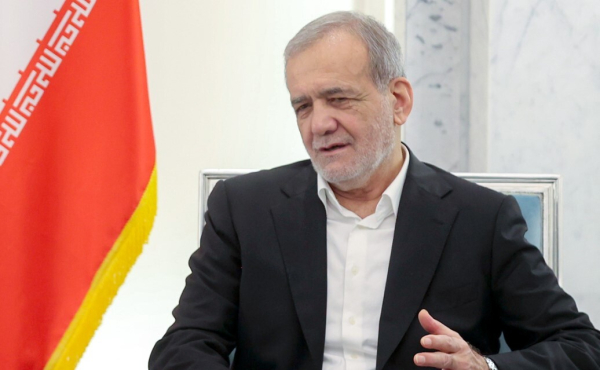
Iranian President Masoud Pezeshkian has criticized the language of threat against Tehran, saying the country is willing to engage in negotiations “on equal footing.”
“The Islamic Republic of Iran seeks dialogue on equal footing. They threaten Iran on one hand and seek to hold negotiations on the other,” Pezeshkian said on Saturday.
“If you seek negotiations, then why are you making threats? Today, the United States not only humiliates Iran but also the world, and this behavior contradicts the request for dialogue,” he added.
Pezeshkian’s remark came after US President Donald Trump called on Tehran to hold direct negotiations on its nuclear program while threatening to bomb Iran if diplomacy fails.
On Sunday, Trump once again threatened Iran with bombing and secondary tariffs if Tehran did not come to an agreement with Washington over its nuclear program, and the United States has moved additional warplanes into the region.
Foreign Minister Abbas Araghchi on Wednesday reiterated Tehran’s readiness to take part in indirect negotiations with the United States over its peaceful nuclear program, warning that US threats are “complicating” the current situation.
“The Islamic Republic, as in the past, is ready for real negotiations from an equal position and indirectly,” Araghchi added. He stressed that this “requires a constructive atmosphere and the avoidance of approaches based on threats, intimidation and blackmail.”
Elsewhere in his remarks, Pezeshkian said it is imperative to improve Iran’s interaction with other countries on regional and international developments.
He stressed the importance of fostering consensus and unity in the country and said the settlement of internal disputes would thwart foreign conspiracies.
"If we set aside our internal disputes and embrace unity, the enemy will not covet us, and we will also be able to solve the people's problems,” the Iranian president emphasized.
He noted that all Iranians must join hands and make efforts to solve their woes.
Press TV’s website
Divine Messages
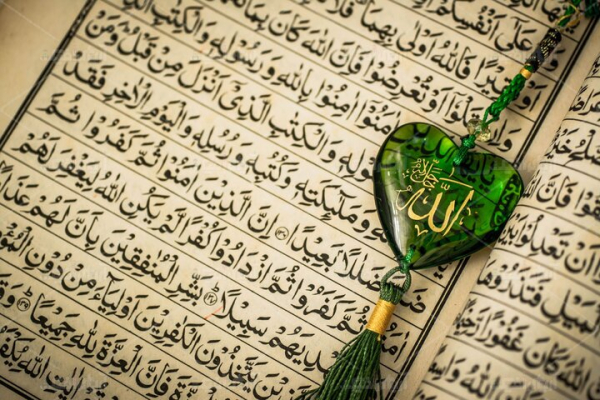
Quran Window
Allah Almighty said:
“So she brought him to her people, carrying him. They said, ‘O Mary, you have certainly done a thing unprecedented.’”
[Maryam: 27]
? Supplication Window ?
O Allah, I declare my innocence before You on this day of mine and on the Sundays that follow it. From polytheism and atheism, and I dedicate my supplication to You sincerely, seeking an answer, and I persevere in Your obedience, hoping for reward. So, bless Muhammad, the best of Your creation, the caller to Your truth. Honor me with Your glory that cannot be wronged, and protect me with Your eye that never sleeps. End my affair with turning to You and my life with forgiveness. Indeed, You are the Forgiving, the Merciful.
? Window of Remembrance ?
The Commander of the Faithful, peace be upon him, said:
Take Treat your enemy with kindness, for that is more likely to lead to victory.
Bahr al-Anwar, Vol. 74, p. 230
???? Window of Education ????
❌ Parenting Mistakes ❌
Seventh - Over-Attention:
Giving our only child or one with a chronic illness excessive attention leads to the child rebelling against their parents, until the child becomes the one controlling them.
? Window of Light ?
Always remember that no one is better than you. Everyone has their share of problems and failures, and life takes its toll on everyone.
? Window of Thought ?
Complaining is the common language of humanity.
? Naguib Mahfouz
Israeli forces kill second Doctors Without Borders worker in two weeks
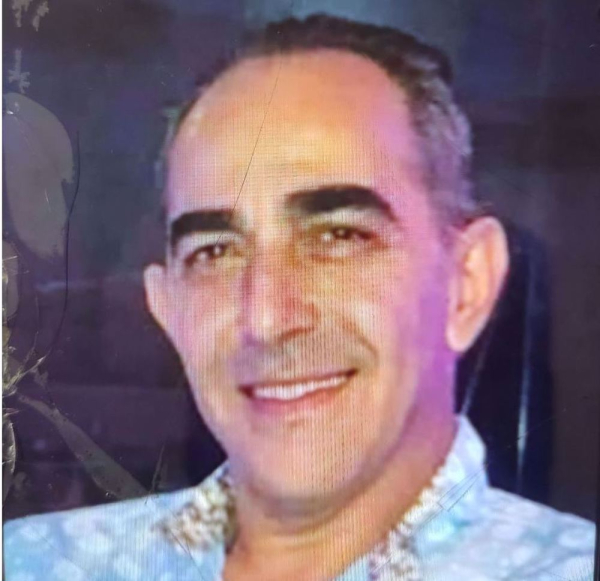
Israeli forces killed the second Doctors Without Borders (MSF) worker in Gaza in two weeks, bringing the total death toll to 11 since the war began 18 months ago.
According to MSF, Hussam Al-Loulu, 58, was killed in an Israeli airstrike on Tuesday in southwest Deir Al-Balah alongside his wife and 28-year-old daughter, leaving behind two sons.
Al-Loulu joined MSF in December as a security guard at the organization’s emergency unit in Khan Younis.
“Our colleague Hussam was killed along with hundreds of others across the Gaza Strip since the resumption of attacks by Israeli forces on 18 March,” MSF said.
Last week, the regime killed another member of MSF, Alaa Abd-Elsalam Ali Okal, in his apartment building in Deir Al-Balah, in central Gaza, during an airstrike.
On March 18, the Israeli regime resumed its genocidal war against the Gaza Strip, breaking a two-month-old ceasefire deal with the Hamas resistance movement.
At least 1,249 people have been killed in Gaza since Israel resumed large-scale strikes on the narrow Strip after abandoning the ceasefire. The number of people injured since the Israeli attacks restarted now stands at 3,022.
According to the Gaza Health Ministry, the overall death toll in Gaza has reached 50,609 since the war began on October 7, 2023. The number of people injured in Gaza since that date stands at 115,063.
‘Slow death’
The month-long total siege imposed by Israel has exacerbated the humanitarian crisis, barring the entry of essential aid such as food, fuel, and medical supplies.
MSF has warned that the siege of Gaza means the majority of critical medications are in short supply or running out, putting Palestinians at risk of losing vital healthcare.
The Israeli regime’s continuation of the siege and bombardment of Gaza has deprived Palestinians of basic needs, including food, medicines, and water, which eventually leads to widespread deaths and health complications, MSF said.
“The Israeli authorities have condemned the people of Gaza to unbearable suffering with their deadly siege,” said Myriam Laaroussi, MSF emergency coordinator in Gaza.
“This deliberate infliction of harm on people is like a slow death; it must end immediately,” she emphasized.
According to MSF, the siege has forced hospitals and medical centers to ration medications such as pain killers, provide less effective treatment, or turn patients away.
Hospitals and medical centers have run out of surgical supplies such as anesthetics, pediatric antibiotics, and medicines for chronic conditions like epilepsy, hypertension, and diabetes, MSF reports.
MSF has reiterated its call for a ceasefire agreement. “This bloodshed must stop,” MSF said.
Press TV’s website