zarezadeh
Imam Ja'far al-Sadiq(pbuh)

Born: April 20, 702 AD, Madinah, Saudi Arabia
Died: December 14, 765 AD (age 63 years), Madinah, Saudi Arabia
Children: Mūsá al-Kāẓim ibn Jaʻfar, Isma'il ibn Ja'far, Abdallah al-Aftah, Ali al-Uraydi · See more
Parents: Muhammad al-Baqir, Umm Farwah bint Al-Qasim ibn Muhammad ibn Abi Bakr
Full name: Jaʿfar ibn Muḥammad al-Ṣādiq
Spouse: Hamīdah al-Barbariyyah
Imām al-Ṣādiq (a) (الإمام الصادق), is the sixth Imam of Imamiyya and the fifth Imam of Isam'ilis. His Imamate lasted thirty-four (lunar) years (114/733 - 148/765) and was concurrent with the reign of the last five Umayyad caliphs (that is, from Hisham b. 'Abd al-Malik onwards) and with that of the first two Abbasid caliphs, al-Saffah and al-Mansur al-Dawaniqi. Because of the weakness of the Umayyad rule at his time, Imam al-Sadiq (a) was able to have relatively wider scholarly activities. His companions, students, and those who quoted hadiths from him is said to have amounted to four-thousand people. Most of the hadiths of Ahl al-Bayt (a) recorded in Twelver Shi'a hadith collections are from Imam al-Sadiq (a). This is why Imamiyya is called Ja'fari School. Imam al-Sadiq (a) has had a high status in the eyes of prominent Sunni scholars. Abu Hanifa and Malik b. Anas were among the people who quoted hadiths from him.
Despite the weakness of the Umayyads and the requests from the Shi'a, Imam al-Sadiq (a) did not rise up against the caliphate. He rejected Abu Muslim al-Khurasani and Abu Salama, who asked him to become the caliph. He did not take part in the revolt of his uncle Zayd b. 'Ali either and discouraged the Shi'a from getting involved in any uprisings. However, he did not have good relations with the caliphs of his time either, and he had to do taqiyya (precautionary dissimulation) because of their persecution.
To facilitate his contacts with the Shi'a, Imam al-Sadiq (a) established the network of wikala (deputyship). The activities of this network continued and increasingly expanded until the end of the Minor Occultation. During Imam al-Sadiq's (a) time, the Ghulat became very active. The Imam (a) vehemently opposed them, declaring them infidels or polytheists.
The Imam (a) was summoned several times to Baghdad, and thus he traveled to Iraq and also visited Karbala, Najaf, and Kufa. He showed the grave of Imam Ali (a), which was previously unknown, to his companions.
Some Shi'a scholars believe that Imam al-Sadiq (a) was poisoned by al-Mansur al-Dawaniqi and thus martyred. He introduced Imam al-Kazim (a) to his companions as his successor, but to protect the life of Imam al-Kazim (a), he mentioned in his will five people, including al-Mansur, as the executors of his will. After the martyrdom of Imam Al-Sadiq (a), several sects appeared among the Shi'a, including Ismailis, Fatahiyya, and Nawusiyya.
Umrah Mufradah between Umrah Tamattu and Hajj Tamattu

What is the ruling on performing Umrah Mufradah between Umrah Tamattu and Hajj Tamattu?
A: Performing Umrah Mufradah between Umrah Tamattu and Hajj Tamattu is not permissible and invalidates Umrah Tamattu.
The reason why the names of the Imams (peace be upon them) are not mentioned in the Quran

Question 1: The principle of Imamate is one of the principles of belief and, according to some narrations, the foundation of Islam. So why did God not mention the names of the infallible Imams (peace be upon them) in the Quran so as not to cause differences among Muslims and doubts in their minds?
Answer:
God Almighty rarely mentions individuals in the Holy Quran, unless there is a direction and wisdom in mentioning their names. Rather, He focuses more on introducing the characteristics of individuals, and this method has several benefits:
1. It makes it clear that if someone is described or a position is granted by God, it is not because of his name, so that others do not say: Why was not such a position given to us or someone else? Rather, He enumerates their characteristics to make it clear that whoever possesses these characteristics is worthy of this praise and honor or is worthy of this position, not because his name is so-and-so or because he is a relative of so-and-so.
2. If they mention the name of a person, because there are many common names, it may cause confusion or if someone has a bias and stubbornness, he can easily claim that this name does not mean so-and-so but such-and-such a person.
But God in the Quran enumerates all the characteristics one by one and gives signs and symbols in such a way that they do not apply to anyone other than those in question.
Also, to understand the verses accurately, we are advised to refer to the hadiths, that is, to study the verses and the hadiths together. Therefore, when we refer to the hadiths, we understand which verses refer to the Ahl al-Bayt (a.s.).
Imamzadeh Davud Tehran
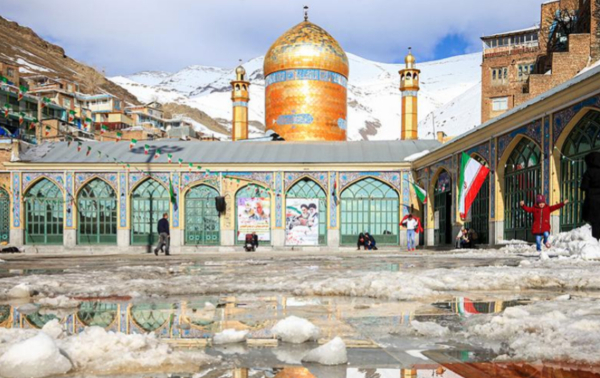
Sharaf al-Din Davud al-Hasani, known as Imamzadeh Davud, is a descendant of Hassan Mojtaba and is in his eleventh generation. It is said that he and some of his relatives came to Iran in the company of Ali ibn Musa al-Reza and were killed.
The tomb of this Imamzadeh was built during the Safavid era and was expanded during the reign of Fath Ali Shah.
In the valleys adjacent to Imamzadeh Davud on the west and southwest sides, in the villages of Rendan and Sangan, there are sites named after Imamzadeh Emad al-Din, the father of Imamzadeh Davud, and Imamzadeh Ala al-Din, Imamzadeh Qasim, and Imamzadeh Aqeel, the brothers of Imamzadeh Davud.
The tomb of Imamzadeh Davoud is located in the northwest of Tehran, at the end of Imamzadeh Davoud Road in the Kan district, at an altitude of 2,600 meters above sea level.
Iran, Malaysia slam Western military support for Israel
Iran and Malaysia agree that the arms support provided by the United States and other Western countries to Israel contradicts their claims about human rights and undermines efforts to establish a ceasefire in Gaza.
In a phone conversation on Monday, President Masoud Pezeshkian of Iran and Prime Minister Anwar Ibrahim of Malaysia discussed the latest developments in the region, particularly the ongoing Gaza ceasefire negotiations.
The two sides underscored the importance of fostering unity and coherence among Muslim states to fight the crimes of Israel and end the genocide in the besieged Gaza Strip.
They said holding a summit of the Organization of Islamic Cooperation (OIC) will be effective in this regard.
Israel launched its barbaric campaign of genocide in Gaza on October 7, 2023, after Palestinian resistance groups conducted surprise Operation Al-Aqsa Storm into the occupied territories.
The regime has imposed a near-total siege on the coastal territory, significantly reducing the flow of food, medicine, electricity, and water into the Palestinian region to a trickle.
So far, Israel has killed more than 40,000 Gazans, most of them women, children, and adolescents.
Press TV’s website
Iran President advocates stronger ties among Muslim nations in meeting with Malaysia FM
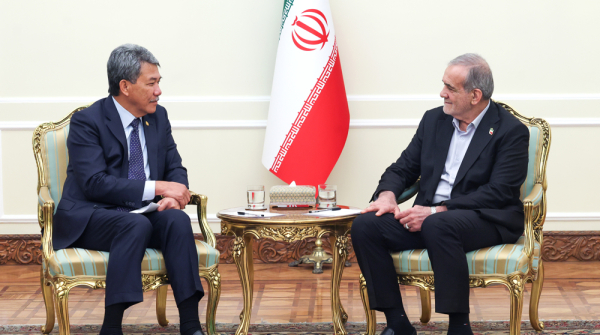
Iranian President Masoud Pezeshkian says the promotion of convergence and relations among Muslim countries, including Iran and Malaysia, is among the necessities in the current global situation.
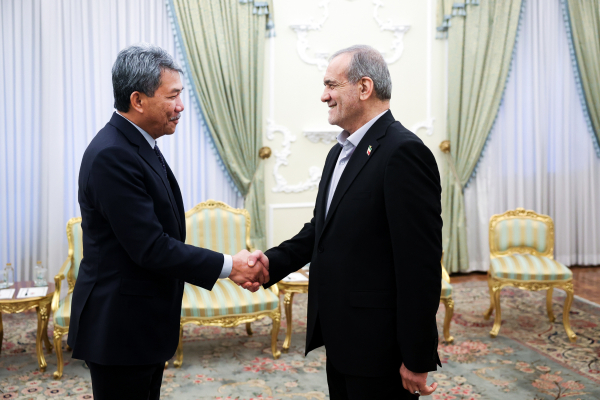
Pezeshkian made the remark in a meeting with Malaysian Minister of Foreign Affairs Dato' Seri Utama Haji Mohamad Bin Haji Hasan in Tehran on Wednesday.
"The Zionist regime (Israel) currently dares to commit acts of crimes and aggression in the region because Muslims are indifferent to each another,” he said.
He added that fostering synergy among officials and politicians of the Muslim world would play a very important role in removing differences, misunderstanding and poverty in the Muslim states.
"The Islamic Republic of Iran is prepared and emphasizes the expansion of communications with Muslim countries, including Malaysia, in all fields,” he said.
Pezeshkian noted that the 8th Iran-Malaysia joint commission meeting was held in Tehran earlier on Wednesday after a 17-year hiatus.
"It is necessary to use the capacity of the joint commission to facilitate permanent exchanges among traders and merchants, intercultural communications and the transfer of experience in various economic, scientific and technological fields to create common interests,” the Iranian president emphasized.
He expressed hope that the exchange of meetings between the two countries would lead to the establishment of bilateral constructive interactions.
For his part, the Malaysian foreign minister said ties between Tehran and Kuala Lumpur are based on understanding and fraternity.
He expressed Malaysia’s willingness to boost ties with Iran and make use of the Islamic Republic’s capacities in the scientific, technological, academic, foodstuff and agricultural areas.
The minister noted that Iran and Malaysia have a common stance on regional and international issues, including the Palestinian issue.
Like Iran, he said, Malaysia condemns the Israeli regime’s crimes and genocidal acts against the oppressed people of Gaza and opposes any plan to forcibly drive Palestinians from their homeland.
The renewed push for the expulsion of Palestinians follows US President Donald Trump's recent comments advocating for the takeover of Gaza and the relocation of its 2.4 million Palestinian residents to neighboring countries like Jordan and Egypt.
The controversial proposal has faced significant global backlash, with both Cairo and Amman firmly rejecting the overt scheme.
Iran, Malaysia FMs discuss bilateral cooperation
On the sidelines of the 8th Iran-Malaysia joint commission meeting, Iranian Foreign Minister Abbas Araghchi and his Malaysian counterpart discussed various aspects of cooperation on mutual issues and in regional and international circles.
Araghchi and Mohamad Hasan said the two countries’ authorities are resolute on implementing bilateral agreements to promote relations in the fields of economics, trade, science and technology, culture, and academia.
They expressed hope that bilateral consultations would lead to the development of an effective roadmap for the comprehensive enhancement of relations between the two countries in the regional arena and increased cooperation in the United Nations and other international forums.
Araghchi affirmed Iran’s stance on strengthening cooperation with the Asian, developing and Muslim countries, and said Tehran attaches special importance to enhanced ties with Kuala Lumpur as an important nation in Asia and the Muslim world.
He also hailed the valuable stance of the Malaysian government and nation in support of the legitimate rights of the Palestinian people during 15 months of the Israeli regime’s genocide and war crimes in the Gaza Strip.
The top Malaysian diplomat, for his part, said he held important and fruitful talks with Araghchi and added that the expansion of ties with Iran, as an influential country in West Asia, is important for Kuala Lumpur.
Mohamad Hasan added that Malaysia would continue its support for the rights of the Palestinian people and called for cooperation among Muslim countries to condemn the Israeli regime’s acts of aggression and crimes.
Press TV’s website
Arab states condemn Israel's new aggression against Syria
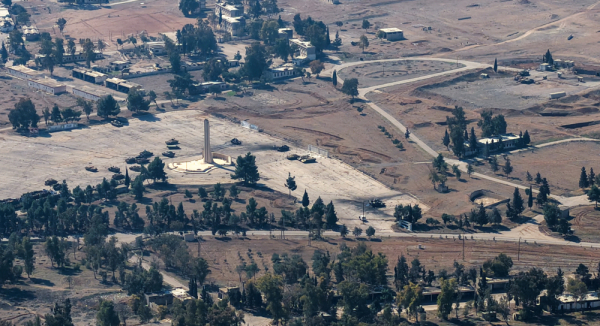
Saudi Arabia, Egypt, and Jordan have denounced Israel’s new act of aggression against Syria, calling on the international community to stop the regime's destabilizing actions.
The condemnations came after Israeli warplanes bombed the Syrian town of Kiswah, south of Damascus, and several parts of Dara'a Province on Tuesday, following Israeli prime minister Benjamin Netanyahu’s call for a “complete demilitarization” of the Arab country’s south.
In a statement, the Saudi Foreign Ministry expressed its "condemnation and denunciation of the Israeli occupation forces' bombing of several areas in the Syrian Arab Republic and attempts to undermine its security and stability through repeated violations of relevant international treaties and laws."
It also voiced solidarity with the HTS administration and Syrian people, underlining the need for the international community to assume its responsibilities "to stop Israeli actions that destabilize security and stability in the region and to prevent the expansion of the conflict."
Similarly, the Egyptian Foreign Ministry condemned the Israeli airstrikes on Syria as "a systematic escalation, a blatant violation of international law, and a disregard for the UN Charter."
The Tel Aviv regime's actions constitute "a flagrant violation of Syria's sovereignty, independence and territorial integrity," it added.
The ministry further urged international actors and the UN Security Council to assume their responsibilities in compelling Israel to halt its blatant violations.
Israel, it emphasized, should pull out from "the Syrian territories it has recently occupied, in a blatant violation of the 1974 Disengagement Agreement, as a step toward achieving a full withdrawal from the Syrian territories occupied in 1967, given that the Golan Heights is occupied Syrian land."
Meanwhile, Jordan’s King Abdullah II told Syria's new ruler Abu Mohammed al-Jolani after a meeting in Amman that he condemns the Israeli attacks on Syria, according to a palace statement.
Shortly after an offensive by foreign-backed militants, led by Hay’at Tahrir al-Sham (HTS), toppled the government of Syrian President Bashar al-Assad in December 2024, Israeli forces entered the UN buffer zone between the occupied territories and Syria.
Israeli forces have remained there ever since, despite protests by Syria’s ruling HTS administration and the UN.
Israeli warplanes have also carried out hundreds of aerial assaults on Syria in the weeks after the fall of the Assad government.
Press TV’s website
Doubt after completing Tawaf

What is the duty of one who doubts purity after completing Tawaf?
Answer
His Tawaf is valid and he must perform Wudu for subsequent acts.
What is the ruling on doubting a defect after completing Tawaf?
Answer:
He should not pay attention to his doubt.
The religion of Islam is a religion that does not care about doubt and is based on certainty.
Matridiyya Sect

Abu Mansur Matridi of Samarqand (d. 333 AH) in the 4th century
Matridiyya: Adoption of the name of the founder of the sect
• Credibility for evidence
• Preference for reason over narration
Matridiyya generally relies on arguments that other theologians also refer to in order to prove God and discuss monotheism, such as the proof of creation, the proof of necessity and possibility, and the proof of order. One interesting argument that Matridi objects to is the proof of evil. He uses this argument, which is usually used to deny God, to prove the existence of a Creator: “If the world had come into being by itself, everything would have brought into being the best and most virtuous qualities and states for itself, and in that case there would be no evil and ugliness, and the existence of these is evidence that the world did not come into being by itself, but rather came into being by a means other than itself.”
Matridiyya believe in moderate determinism, which is a middle ground between the Ash’ari and Mu’tazilite views. According to the Matridians, man has a kind of agency and his voluntary action is carried out with power and freedom. Unlike the Ash'arites, the Matridians believe that the act and the object are different, and that the act of man is different from the act of God, and that there is no creation and structure unlike the act of God. For example, they believe that sitting and standing are human actions, but the creation of them is the act of God, that is, the principle of sitting and standing is the creation of God, but sitting and standing are human actions; but in fact, sitting and standing are human actions. An action that a person achieves. The Matridians believe that if a person does not intend to do a good or bad action, God does not create the power to do that action in him. The criterion and standard of reward and punishment, according to the Matridians, is not the action itself, but the intention and intention of the action on the part of the person; the intention to do a good and virtuous action is rewarded, and the evil intention and intention of sin are punished because: "Indeed, the action is from the intention."
Unlike the Ash'arites, the Maturidis believe that God does not obligate someone who does not have the power and ability to do something, and demanding something from someone who cannot do it is contrary to God's justice and wisdom.
Islamic theologians agree that God has attributes such as knowledge, power, and life. The Mu'tazilites and the Imamites believe that the essential attributes of the Lord of the universe are His essence, and God is in a state of perfection and beauty, whose essence is complete in knowledge and power. The Ash'arites consider these attributes to be additional to the essence and believe that the attributes of the essence are eternal and the attributes of the act are possible, while the Maturidis accept the objectivity of the essence and attributes, and in the issue of God's attributes, they consider both the attributes of the essence to be in line with the essence, and the attributes of the essence to be in line with the essence, and the attributes of the essence to be in line with the essence. Imamites and the Mu'tazilites. Regarding the rational possibility of God punishing obedient and righteous servants, the Ash'arites accept the rational possibility that God is capable of any action, but at the same time, considering the evidence of the narrations in this regard, they believe that this is not possible from a religious perspective (and God does not punish a righteous servant in the Hereafter without reason). The Matridis believe in rational good and evil, that is, they accept the judgment of reason about whether something is worthy of praise and reward or worthy of blame and punishment, and they believe that through the judgment of reason, the divine judgment can also be discovered. This means that there is no confirmation from reason and reason is essentially the discoverer of a real truth. Accordingly, and according to the judgment of reason, God is just and it is impossible for Him to be unjust and oppressive, just as it is not permissible for Him to punish the obedient. And thus, God does not punish obedient servants either from a religious or a rational perspective.
Waqfiyyah Sect

Waqfiyyah Sect
This sect is one of the deviant tendencies in Islam.
Founders: Ali ibn Abi Hamzah al-Bataiyni (d. 200 AH), Ziyad ibn Marwan al-Qandi, and Uthman ibn Isa al-Rawasi (d. 203 AH)
183 AH in Iraq and Medina
Waqfiyyah means stopping the Imamate of Imam Musa al-Kazim (a.s). The elders of this sect denied the Imamate of Imam Reza (a.s) because they had a large amount of religious money in trust and did not want to give this money to Imam Reza (a.s), so they said that Imam Musa (a.s) is alive and will reappear.
Their belief:
The end of the Imamate with Musa al-Kazim
The Mahdism and Occultation of Musa al-Kazim