Iranian President Masoud Pezeshkian says the United States and Israeli regime are attempting to pursue divisive projects and cause distrust to pit Muslim countries against one another.
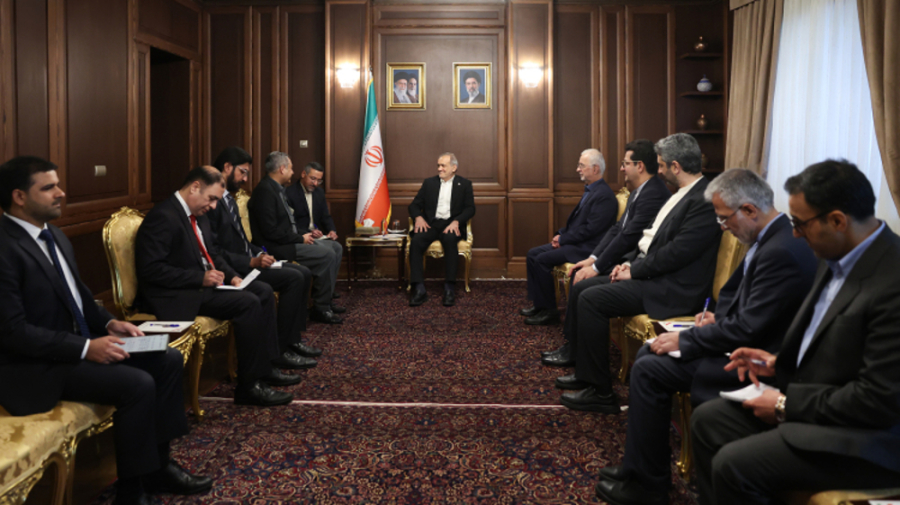
In a meeting with Pakistan's Interior Minister Mohsin Naqvi in Tehran on Sunday, Pezeshkian said Iran’s principled policy is based on the expansion of friendly ties with neighboring countries, particularly the Persian Gulf littoral states.
“The Islamic Republic of Iran seeks cordial, stable, and sustainable relations based on good neighborliness with the Muslim countries of the region, but the United States and the Zionist regime (Israel) have always attempted, through divisive projects and the creation of distrust, to pit Muslim countries against one another,” he added.
He expressed appreciation for Pakistan’s role in mediating a ceasefire agreement between Tehran and Washington 40 days after the US-Israeli war of aggression against Iran. He hoped that these diplomatic and political efforts would strengthen peace, stability, and enduring security in the region.
The president condemned the US-Israeli military aggression against Iran and the martyrdom of Leader of the Islamic Revolution Ayatollah Seyyed Ali Khamenei, several high-ranking commanders, ministers, innocent students, and citizens as a “grave crime in violation of all human, legal, and international norms.”
He emphasized that no awakened and free conscience in the world can accept such criminal actions.
Pointing to the malicious objectives behind the US and Israel's aggression, Pezeshkian said they mainly sought to create internal instability and weaken or overthrow the Islamic establishment -- but they never imagined that the great, noble, and aware Iranian nation would stand beside their country with coherence and strength.
He further noted that the US and Israel pursued organized acts aimed at infiltrating armed terrorist elements from Iran’s northwest and southeast borders.
“The enemies attempted to transfer insecurity into Iran by providing financial, intelligence, and military support to terrorist groups, but the cooperation and responsibility shown by Iran’s neighbors in preventing any misuse of their territory against Iran was a valuable and commendable move,” the Iranian president added.
He praised Pakistan, Afghanistan, and Iraq for not allowing their soil to be used for actions against Iran.
The criminal US-Israeli aggression against Iran began on February 28 with airstrikes that assassinated senior Iranian officials and commanders, including Ayatollah Khamenei.
Iranian Armed Forces responded by launching daily missile and drone operations targeting locations in the Israeli-occupied territories as well as US military bases and assets across the region.
Furthermore, Iran retaliated against the strikes by closing the Strait of Hormuz, which resulted in a significant increase in oil prices.
On April 8 — forty days into the war — a Pakistan-brokered temporary ceasefire between Iran and the US took effect.
Elsewhere in his remarks, Pezeshkian praised Pakistan’s measures and facilitation in border trade and economic cooperation between the two countries, saying Tehran and Islamabad can further expand the growing trend of economic and commercial ties.
“Despite all the losses and costs caused by the war, these developments have brought Iran and Pakistan closer together, and a suitable opportunity currently exists to elevate the level of bilateral relationships in economic, scientific, cultural, and regional fields,” he added.
Such an approach, he noted, can prepare the ground for strengthening peace, reducing tensions, and promoting constructive interactions among the nations in the region.
The president reiterated that the continuation and deepening of bilateral cooperation would be in line with the shared interests of both nations and the Muslim world.
He urged Muslim countries to reinforce unity and convergence by relying on their religious, cultural, and strategic commonalities to reduce the possibility of intervention and aggression by extra-regional powers and the Israeli regime.
“The major countries of the Muslim world must strengthen regional cooperation and interaction to help establish lasting peace, security, and stability in the region, because through Islamic unity and convergence, the Zionist regime will never dare to attack or violate the sovereignty of Muslim countries,” Pezeshkian said.
For his part, the Pakistani minister pointed to Islamabad’s efforts to help reduce tensions and said the true dimensions of regional developments and the role of various actors have become clear to public opinion.
Naqvi added that Iran and Pakistan have always maintained close and brotherly relations and have made efforts to further strengthen mutual bonds.
He expressed hope that the level of bilateral relations and cooperation will continue to expand with the will of the two countries’ officials.
Naqvi arrived in Tehran on Saturday on an unannounced two-day trip. He held a meeting with Iranian Interior Minister Eskandar Momeni upon his arrival and met with Iran's Parliament Speaker Mohammad Baqer Qalibaf on Sunday.
Press TV’s website