zarezadeh
UN demands probe after drone 'attack' on Gaza aid flotilla
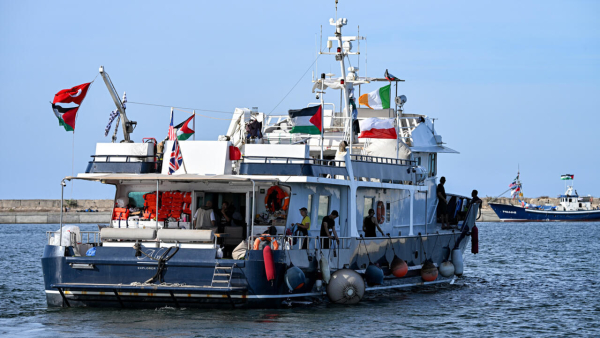
The United Nations called Wednesday for an investigation into alleged drone attacks against a Gaza-bound aid flotilla that prompted Italy and Spain to send naval ships to help.
Italian Prime Minister: Sending Freedom Flotilla to Gaza is a dangerous and irresponsible act
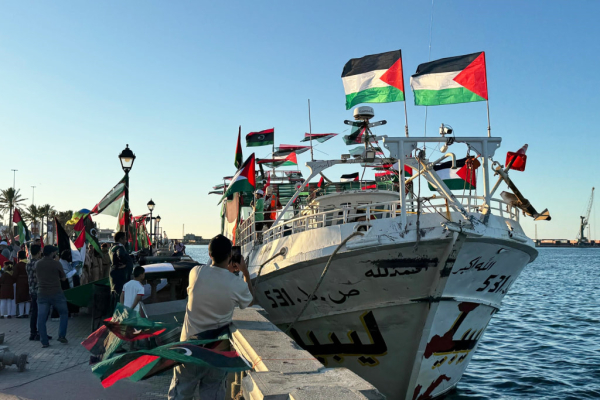
Italian Prime Minister Giorgia Meloni said the humanitarian flotilla's move to Gaza was "dangerous and irresponsible," hours after her government's defense minister announced that an Italian navy ship had been dispatched to provide possible aid to the convoy.
"There is no need to risk our security. There is no need to go to a war zone to provide aid to Gaza, something that the Italian government and the competent authorities could have done in a matter of hours," Meloni told Italian media before addressing the United Nations General Assembly in New York.
The prime minister said her government had proposed that the flotilla's aid be delivered to Cyprus and the Latin Church in Jerusalem.
The flotilla, which currently includes 51 ships, aims to break the Israeli blockade that allows only very limited aid to enter Gaza.
The Office of the United Nations High Commissioner for Human Rights has repeatedly stated that the spread of hunger in Gaza is a direct result of the Israeli government's policy of blocking humanitarian aid.
In August, a UN-backed global hunger watchdog declared a famine in the region, calling it "man-made."
Canada, Australia join UK in recognising Palestinian statehood
Recognition of Palestine from Canada and Australia comes in coordination with the UK, ahead of UN General Assembly meeting this week.
In a statement, Canadian Prime Minister Mark Carney announced the recognition of the state of Palestine and “offers our partnership in building the promise of a peaceful future for both the state of Palestine and the State of Israel”.
However, the announcements from major Western powers – and long-time Israeli allies – indicate that Israel is growing increasingly isolated internationally in light of its war on Gaza, where it has killed more than 65,200 Palestinians.
Israel and the United States have repeatedly said that recognising Palestinian statehood in the midst of the ongoing war in Gaza would be a “reward” for Hamas.
At the United Nations General Assembly in New York next week, more countries have pledged to recognise the state of Palestine, including France.
Taliban official: Not even a meter of Afghanistan will be given to the US
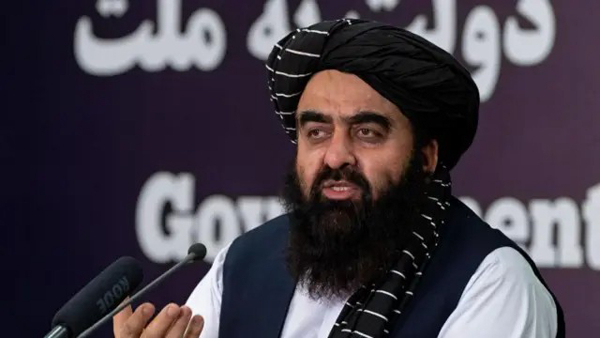
Along with Trump's threat to take back Bagram, the Taliban Foreign Minister has said that not a single meter of Afghanistan will be given to the US.
According to a reporter from the Afghan website Fars News Agency, Taliban Foreign Minister Amir Khan Muttaqi had emphasized in response to a question about the possibility of handing over Bagram Air Base to the US that "not even a meter of Afghan land will be given to the Americans."
Trump says the US must regain control of Afghanistan's Bagram Air Base, a move he has linked to the base's proximity to China's nuclear facilities.
Last night, US President Trump warned the Taliban government in Afghanistan in a post on his social media account, "Truth Social," to return Bagram Air Base to the US, otherwise "bad things" will happen.
However, the Taliban Interior Ministry spokesman announced that no scenario in which Bagram is handed over to the US or any other country is conceivable.
The Different Views of the Sumud Caravan Members
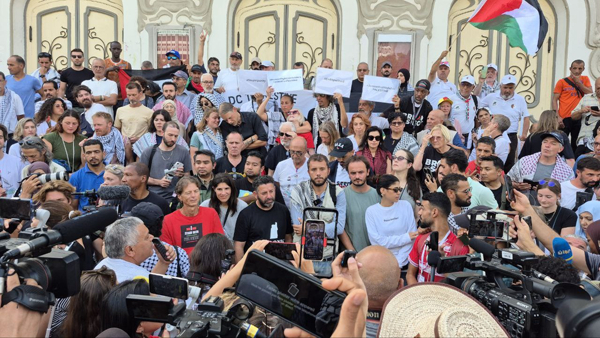
The members of the caravan included a wide range of groups. Some Europeans were deeply dissatisfied with Netanyahu’s genocide, but their views differed from those of other members. Some believed in a “two-state” solution, in which the Zionist regime and the Palestinian state would live side by side. This view was in contrast to the view that saw Israel as an “occupying regime” that must be destroyed. Sayyah Taheri added: “Even some Israeli leftists who opposed Netanyahu were in contact with the members of the caravan and sent messages that Iran, Yemen, and Lebanon should not be in this group.”
This request clearly showed that they wanted to present this movement as completely popular and European, so that the Zionist regime would have no excuse to attack them. Sayah Taheri said: “They were worried that if there was even one Iranian in the caravan, Israel would claim that this movement was not popular and was led by the axis of resistance. This made them even ask us not to participate in the trip.” This point itself indicates the political and strategic complexities of this movement.
These differences of opinion, on the surface, were not a problem, but in practice, they caused doubts among some European members of the caravan. They did not want to enter into an armed conflict and hoped that they could reach a conclusion through public pressure and diplomatic measures.
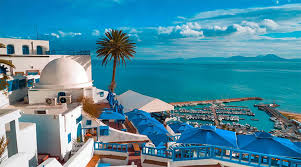
But perhaps the biggest and most dangerous reason for the delay was the political pressure from the United States and Saudi Arabia on the Tunisian government. Security problems for the Tunisian government had become a serious concern for Tunisia due to the Israeli regime’s drone attacks on the port of Sidi Bou Said near the presidential palace. The threats from the United States frightened the Tunisian government. Tunisian security officials were concerned about the lives of the country’s leaders. After the attack on Qatar and the attacks near the presidential palace, concerns reached a peak and they concluded that Israel would stop at nothing to stop the convoy and might attack Tunisian officials.
In the meantime, Saudi Arabia also stepped in and put pressure on the movement to stop it. But the Tunisian people responded to this pressure with force. Every day, demonstrations and sit-ins were held in front of the US embassy in Tunis to protest US policies and show that they stood by the people of Gaza. Sayyah Taheri says: “The Tunisian people sent a clear message to their government and the international community with their daily demonstrations and sit-ins. That we are standing. This popular will was stronger than any diplomatic pressure or security threat.”.
Maryam Sadat Ajoudani
The Narrative of the Unarmed Boats of the “Samoud” Caravan to Gaza
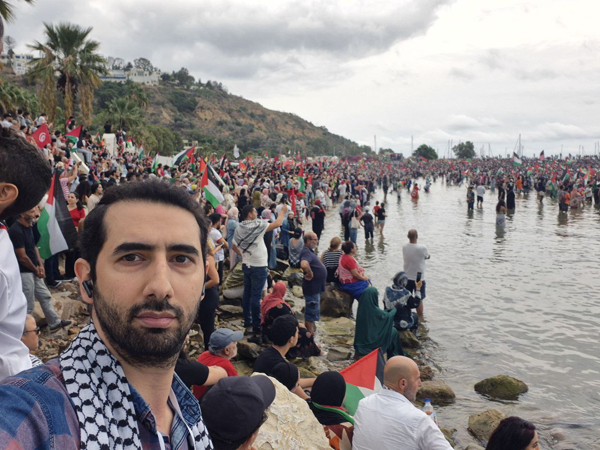
The “Samoud” Caravan is a modern epic that each of its members has joined with a personal narrative from a corner of the world. With their passionate presence, they broke the silence of governments against the Zionist regime’s oppression of the people of Gaza.
Fars News Agency Culture Group; Sometimes the sea is not just water and waves. Sometimes it is a symbol of dreams, of efforts, and of a will that is not willing to bow down to oppression. These days, on the shores of the Mediterranean, the Tunisian Sea is hosting an unprecedented effort to break a siege. A siege that has numbered Gaza’s soul. From afar, amidst the roar of the waves, small boats can be seen preparing for a great mission; the Global Samood Caravan.
This caravan has come not with weapons but with solidarity and humanity to show the world that Gaza is not alone. But this journey is not easy. Ali Akbar Sayah Taheri, an international media activist and Palestine expert, tells the story behind the scenes of this movement, not as one of the passengers, but as a narrator and analyst who witnessed this great effort firsthand. A story of delay, challenge, determination and resistance.
The idea of forming the “Samoud” caravan arose from a deep understanding of the humanitarian crisis in Gaza. Social activists from all over the world, especially from Spain to Italy, decided to break the naval blockade of Gaza using boats and small ships. This movement is a symbol of the people’s determination to act, where governments have remained silent. The caravan started its journey from Spain and was later joined by other ships from Tunisia and Italy. “When 17 ships set sail from the port of Sicily in southern Italy for international waters, joined by 20 more from Tunisia, I felt like a great people’s force was forming,” says Sayyah Taheri. “In total, 39 small and large ships are now on the water, all moving towards a common goal: breaking the siege on Gaza.”
This is not a simple sea excursion. It is a journey full of unforeseen obstacles. The journey from Tunisia to the occupied territories is itself a long and risky journey, lasting 12 to 15 days. The length of the journey created numerous challenges from the very beginning.
Reasons for the delay of the Samood convoy
The first reason for the delay was so simple and devastating that no one thought of it: unfavorable weather conditions. The boats in this convoy were neither giant merchant ships nor warships. They were small boats equipped by volunteers and social activists for a humanitarian mission.
For this reason, they were unable to cope with severe sea turbulence and unforeseen storms. Sayyah Taheri says in a descriptive tone: “Some of these boats took five days to complete a three-day journey. At any moment, a storm could overturn them in the middle of the sea.” This not only caused delays, but also posed a great danger to the lives of the members of the convoy.
In addition, technical problems accompanied them from Spain to Tunisia. Two ships were damaged in an Israeli drone attack and needed major repairs. These boats were built by different companies, and finding spare parts for safety equipment in the middle of the road and far from the manufacturing companies was a laborious and time-consuming task. “Each of these boats had a different ID card, and coordinating repairs for them was a complex logistical project that took up a lot of time for the convoy,” the media activist says.
But the biggest challenge was finding skilled manpower. The trip requires experienced captains, crew, and sailors to guide the boats on the long and dangerous journey from Tunisia to the occupied territories. But the volunteers in the convoy were mostly social activists and ordinary people who had no knowledge of navigation. Finding skilled manpower was also not an easy task, because they knew that they might get into trouble with Israel on this trip. “This is not a normal trip. There is conflict and the risk of attacks by the Zionist regime. Therefore, finding people who are willing to take this risk was a big challenge.” This also served as an excuse for another reason for the delay: the fear of attacks by the Zionist regime among some Europeans.
Maryam Sadat Ajoudani
Tunisia
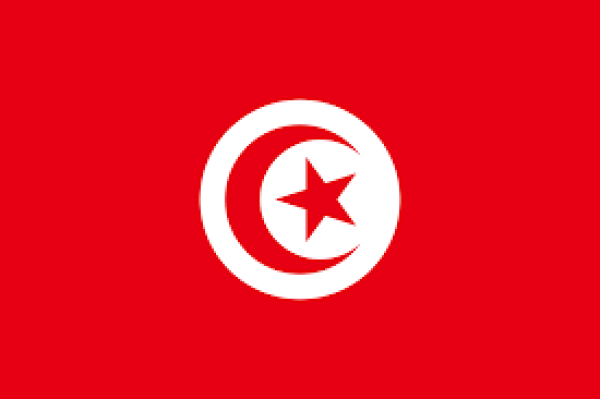
Tunisia officially the Tunisian Republic, is a country in the Arab Maghreb in North Africa. Tunis is its capital.
Ancient history
Since history has been recorded, there were Berber tribes living in what is now Tunisia. Most of them built little towns and ports along the coastline so they could trade with different travelers from everywhere in the Mediterranean Sea. Most of the travelers were Phoenicians who started to settle on the Tunisian coast during the 10th Century BC. Later, in the th Century BC, settlers that came from Phoenicia and regions abroad built Carthage. After many wars against Greece in 6th Century BC, Carthage dominated the Mediterranean Sea.
In the of the 2nc Century BC, Punic Wars, Carthage fought against the Roman Empire. The Romans destroyed Carthage and made its territory part of the Africa Province of the Roman Empire. In later centuries the people learned Latin and became Christians.
When the Roman Empire became weak, the Vandals occupied that region. Some of them learned to sail and became pirates. This was in the 5th Century AD, and one hundred years after that, it became under the control of the Byzantine emperor Justinian I.
Islamic Tunisia
In the 7th Century, it was conquered by the Arab Muslims who built a city which they called Kairouan. This was the first Arab Muslim city in Tunisia. Many Muslim dynasties (monarchies) ruled Tunisia. One of the best known dynasties was the Zirids dynasty. The Zirids were Berber people and followed the rules of the Fatimides, a bigger dynasty in Cairo. When the Zirids angered the Fatimides, the Fatimides sent some tribes known as Banu Hilal who ravaged (destroyed and vandalized) Tunisia.
After a brief occupation of Tunisia by the Normans of Sicily in the 12th Century, the Almohad re-conquered it. After that came the Hafsids. In the last years of their reign, the Hafsids became weak and Spain took control of many cities on the coast until they were finally occupied by the Ottoman Empire.
In 1705, Tunisia became virtually independent during the Hussein dynasty, but still had to follow orders from the Ottoman Empire.
French Occupation
Some controversial financial decisions (money-lending) taken by the Bey in mid-1800s in an attempt to repair the country led Tunisia to become under the control of France. Tunisia became officially a French protectorate in on May 12, 1881, but with the strong opposition of the kingdom of Italy because there was a huge Italian community in Tunisia.
World War II
[change | change source]
Important parts of the North African Campaign of World War II were fought in Tunisia from 1941 to 1943.
General Erwin Rommel, the German commander in Africa, wished to defeat the Allies in Tunisia, as the Germans had done in the Battle of France when the Allies were inexperienced against the German Blitzkrieg. On February 19, 1943, Rommel used his German and Italian troops in western Tunisia in an attack against the U.S. Forces who had recently arrived from Algeria. That was a disaster for the United States.
After that, the Allies understood the importance of tank warfare. With better supplies than the Germans, they easily broke into the German lines in southern Tunisia on March 20, 1943. On May 11, 1943 the last German troops surrendered, followed two days later by the Italian troops.
Independence and revolution
Tunisia became independent in 1956 with the former Bey of Tunis as King. Prime Minister Habib Bourguiba became the first president in 1957 when it became a republic. Bourguiba focused on education and economic development. He was supportive of women's rights. However, he had a cult of personality around him and most of the power in the country was held by Bourguiba.
In 1987, Bourguiba was removed from power by Zine el Abidine Ben Ali. Ben Ali ruled as dictator of the country until 2011, when he was overthrown in a revolution. The revolution was the first major revolution of the Arab Spring. Tunisia began becoming more democratic, and in 2014, the country held its first free presidential election. The election was won by Beji Caid Essebsi, a secular, liberal candidate.
Geography
Tunisia is in the northern part of Africa. The Mediterranean Sea joins Tunisia in the north and east; the coastline of Tunisia on the Mediterranean Sea is about 1,300 km. Tunisia is also bordered by Algeria to the west and Libya to the south-east.
The Sahara Desert covers 40% of Tunisia. The other 60% is a fertile area.
Demographics
Standard Arabic is the official language by the Tunisian constitution. But Tunisians speak Tunisian Arabic. Tunisian Arabic is a mix of many languages of people that live or lived in Tunisia. It is called Darija or Tunsi.
A small number of people living in Tunisia still speak a Berber dialect, known as Shelha.
Most people now living Tunisia are Maghrebin Arab. However, small groups of Berbers and Jews live in Tunisia.
The constitution says that Islam is the official state religion. It also requires the President to be Muslim.
The nature of the occultation of the Imam of the Time (peace be upon him)

One of the issues raised about the existence of Imam Mahdi (peace be upon him) is the issue of the nature of his occultation; meaning, is the invisibility of his being the same as his physical occultation and absence, or does it mean his anonymity and cognitive occultation?
Types of occultation
A: Cognitive occultation
Cognitive occultation is the same as his personal and legal occultation. In this assumption, the Imam of the Time (peace be upon him) is hidden from our cognitive perspective; meaning that the Imam of the Time (peace be upon him) lives normally and people meet him in the streets and markets, sit and stand with him and socialize with him, and the Imam also talks and associates with people, but people do not know and recognize that this person is the Imam of the Time (peace be upon him). Divine wisdom has required that the Imam be protected from the possible dangers of the oppressors and tyrants by remaining anonymous so that there is a reserve for the Day of Judgment.
Narrations indicate this theory, such as:
1 - Imam Sadiq (a.s.) said: "In the owner of this matter (Hazrat Mahdi (a.s.) there are traditions from the prophets (a.s.): a tradition from Moses ibn Imran, a tradition from Jesus (a.s.), a tradition from Joseph (a.s.), and a tradition from Muhammad (s.a.w.s.); but the tradition he has from Moses (a.s.) is that he is afraid and waiting for an opportunity.
But the tradition he has from Jesus (a.s.) is that they say about him what they used to say about Jesus (a.s.).
But the tradition he has from Joseph (a.s.) is that he is hidden. God places a veil between him and the people, so that they see him but do not recognize him.
And as for the tradition that he has from Muhammad (peace be upon him and his family), it is that he is guided by his guidance and the one who walks by his path...”(1)
2 - Imam Sadiq (peace be upon him) said: “How can this nation deny that God Almighty will do with His proof what He did with Joseph, that their Imam will walk in their markets and step on their carpets, but they will not recognize him until God permits his appearance...”(2)
B: Physical Occultation
Physical occultation is the same as personal and real occultation. According to this theory, the Imam of the Time (peace be upon him) is hidden and invisible from the outward view of people. Physical absence can be imagined in two ways:
1 - Physical absence due to the invisibility of the Imam of the Time
In the sense that the Imam is on this earth and lives on this earth and travels to different places and monitors the conditions and behavior of the Shiites and shows them his care and favor, but no one sees the existence of the Imam with the external eyes, as is the case with Imam Khidr (peace be upon him).
Imam Reza (peace be upon him) said:
"Khidr (peace be upon him) drank from the water of life; therefore he remained alive and will not die until the blowing of the trumpet. He comes to us and greets us. We hear his voice, but we do not see his body, and he is present wherever his name is mentioned. So whoever among you remembers him should greet him, and come to the Hajj season every year, perform all the deeds, stand at Arafat, and acknowledge the supplications of the believers. And soon God Almighty will remove our fear of the Qaim due to his familiarity, and will transform his loneliness into his companionship...” (3)
This type of concealment, which is the same as invisibility, is different from concealment in the form of anonymity, because concealment in the form of anonymity takes place normally and does not involve any assistance, and the Imam goes around in the form of anonymity and people see him but do not recognize him, but concealment in the form of invisibility requires a miracle, so that the Imam does not appear during his presence. This is where God Almighty has made the miracle a factor for the protection and preservation of the last successor of the Holy Prophet (peace and blessings of Allah be upon him and his family) so that humanity will not be deprived of the grace of his existence and the earth will never be empty of the divine proof. As Imam Sadiq (peace be upon him) said: “If the earth remains without an Imam, it will surely collapse..” (4)
Perhaps a question comes to mind here that if the existence of Hazrat Mahdi is an invisible body, then how can the meeting and visitation of the elders with him (which is narrated in reliable books) (5) be justified?
In response, it should be said: The invisibility of the Imam depends on his own will and decision. At times when there is a need for his appearance and manifestation to bestow favor and care on his special Shiites and lovers, he will appear and resolve their problems..
Imam Sadiq (peace be upon him) says: “There are two occultations for Hazrat Mahdi (peace be upon him): one short and the other long. During the first occultation, no one except the special Shiites is aware of his whereabouts, and during the second occultation, no one except the special friends and true devotees in religion is aware of his whereabouts...” (6)
The late Mirza Qomi, the author of the Laws, narrates that I used to attend the lessons of Allama Bahrul Uloom, Aqa Baqir Behbahani (may God have mercy on him), and I would discuss the lessons with him, and I would often explain the lessons to Sayyid Bahrul Uloom. I came to Iran, and after a while, Sayyid Bahrul Uloom was introduced to greatness and knowledge among the Shiite scholars and scholars. I was surprised and said to myself, how did he, who did not have this talent, achieve such greatness? Until I was able to visit Najaf Ashraf, where I met Sayyid Bahrul Uloom. A discussion was held in his presence, and I saw that he was a sea of waves, who should truly be called Bahrul Uloom. One day, I asked him in private: "Sir, when we were together, you did not have this level of talent and knowledge at that time. How did you reach this position?" Sayyid Bahr al-Ulum said: "The answer to your question is a secret. I will tell you, but I ask you not to tell anyone as long as I am alive." I agreed. First, he briefly said: "How could this not be so, when the Imam of the Age, peace be upon him, held me to his chest one night in the mosque of Kufa?"
I said: How did you reach the service of that Imam?
He said: One night I went to the mosque of Kufa, and I saw my master, the Imam of the Age, (peace be upon him), engaged in worship. I stood up and greeted him. He accepted my answer and ordered me to move forward. I moved forward a little, but I was polite and did not move forward much. He said: Come forward. So I moved a few steps closer. He said again: Come forward. I moved closer until he opened his arms and embraced me and pressed me to his blessed chest. Here, whatever he wanted to flow into this heart and chest, flowed. (7)
On the subject of the concealment of Imam Mahdi (AS) from the eyes of mankind by his own will and desire, many narrations have been narrated, some examples of which we will mention:
1 - Imam Reza (AS) said: "He will not be seen and will not be mentioned by name..." (8)
2 - Imam Sadiq (AS) said: "People will lose their Imam and he will be present during the Hajj season and will see them, but people will not see him..." (9)
Abu Hashim; Dawood bin Qasim Ja'fari says: I heard Imam Ali al-Naqi (AS) say: "My successor after me is my son Hassan. How will you be in the succession after that successor? I asked, "Why sacrifice?" He said: "Because you will not see him in person and it is not permissible for you to mention his name." I asked, "Then how should we mention him?" He said: Say: The proof is from the family of Muhammad (peace be upon him and his family)...” (10)
2 - Physical absence due to interference in the eyes of the people
In this hypothesis, the disappearance of Imam Mahdi (peace be upon him) is due to his interference in the eyes of the people.
In this case, too, a miracle and divine power are needed so that during the presence and appearance of the Imam of the Time (peace be upon him) among the people and their presence and appearance in gatherings and gatherings, he is not seen.
In the Holy Quran and hadiths, there are cases where people could not see a visible being due to a divine miracle. For example:
A: “We placed a barrier in front of them and behind them, and We covered them; so that they do not see anything..” (11)
The commentators have narrated from Abdullah bin Masoud that the Quraysh gathered near the house of the Holy Prophet (peace be upon him and his family), the Prophet (peace be upon him and his family) came out of the house and sprinkled dust on their heads, and they did not see his Prophet. (12) ;
It is narrated from Ibn Abbas that: The Quraysh gathered and said: When Muhammad entered, we will all stand together before him. The Holy Prophet (peace and blessings of Allah be upon him and his family) entered. At that time, Allah Almighty placed a barrier in front of and behind those people so that they did not see the Prophet. The Prophet (peace and blessings of Allah be upon him and his family) prayed and came towards them, while he was pouring dust on their heads and they did not see the Prophet. When the Prophet (peace and blessings of Allah be upon him and his family) left, the Quraysh saw the dust and said: This is what Muhammad (peace and blessings of Allah be upon him and his family) has bewitched us with (13).
B - ; "When you recite the Quran, We place between you and those who do not believe in the Hereafter a veil of concealment..." (14)
In addition to the apparent meaning of the verse indicating that God Almighty concealed the Holy Prophet (peace and blessings of Allah be upon him and his family) from the disbelievers who intended to mock him while he recited the Quran, some interpretations state that God Almighty concealed the Prophet (peace and blessings of Allah be upon him and his family) from Abu Sufyan, Nadr ibn Harith, Abu Jahl, and the wood-carrier while he recited the Quran. They would pass by him but would not see him. (15)
C - Ibn Hisham in "Sirat al-Nabawi." He narrated a story about the Holy Prophet (peace be upon him and his family) being hidden from the sight of Umm Jamil (the wood carrier) and at the end of it, he quotes the following sentence from the Holy Prophet (peace be upon him and his family): “God took his sight away from me [and hid me from him (16)].” There are also numerous evidences in this regard in the lives of the Imams (peace be upon them), such as: the disappearance of Imam Zayn al-Abidin (peace be upon him) from the sight of the agents of Abdul Malik ibn Marwan, which has been narrated by not only Shiite scholars, but also Sunni scholars such as Ibn Hajar. (17)
At the end of this article, two important points should be mentioned:
First point: As long as hiding is possible through normal and natural means, miracles do not play a role in the hiding of Imam Mahdi (AS), but given the time dimension, we are unable to know the spatial and temporal requirements of each encounter and to know whether it was possible for Imam Mahdi (AS) to hide naturally in those circumstances or whether miraculous hiding was necessary for him.
For example, for the Imam to hide after two encounters with Jafar the liar, both cases are possible and depend on the circumstances that Imam Mahdi (AS) had at that time, but in the case of the beginning of this encounter, in any case, there is no need for it to be miraculous and it may be natural and ordinary.
Second point: A miracle either affects the beholder or the one being seen. The possession of the viewer is to make him unable to see what is in front of him and to see the place empty of the Imam, even though the Imam (peace be upon him) is in front of him. So, if according to a divine expediency and purpose, the only way is for someone to see the Imam and no one else to see, in this case the one who sees has normal vision and the one who does not see has his eyes covered by a miracle. The possession of other senses, such as hearing and touch, is also similar, and sometimes only some of the senses are unable to perceive.
The difference between the two basic theories about divine miracles is that the first theory considers miracles to be permanent and to apply to everyone during the period of the Great Occultation. As a result, this general state of miracles must be excepted for the visit of the Imam. However, according to the second theory, what is natural and normal is the visibility of the Imam's body and the concealment of the body is an exceptional matter and only occurs when the only way to preserve the Imam from concealment is through this method. As for the possession of a miracle in the seen and something that can be seen, the most obvious way is that the miracle blocks the light (image) emitted from the body of Imam Mahdi (peace be upon him) or his sound waves and others from what the five senses perceive and does not allow them to reach the viewer or listener. In this way, this person is unable to perceive the reality that is placed before him. (18)
1) Kamal al-Din wa Tamam al-Naama, vol. 2, chapter 33, p. 20.
2) Kafi, vol. 2, Kitab al-Hujjah, Hadith 4, p. 134.
3) Kamal al-Din wa Tamam al-Naama, Islamiya Bookstore Publications, vol. 2, p. 61; Mantabkhul-Athar, first edition, p. 325.
4) Ghaibat al-Numani, translated by Jawad Ghaffari, Saduq Library Publishing, first edition, p. 198.
5) Kamal al-Din and Tamam al-Naamah, vol. 2, p. 108.
6) Kafi, vol. 2, Kitab al-Hujjah, vol. 19, p. 141.
7) Imam al-Zaman (peace be upon him) and Sayyid Bahr al-Uloom, Sayyid Jafar Rafi’i, Yaran al-Qa’im Publishing, p. 157.
8) Mantabkhul-Athar, Safi Golpaygani, Sayyidat al-Ma’souma (peace be upon him) Foundation, first edition, p. 325.
9) Kamal al-Din and Tamam al-Naamah, p. 16, p. 33.
10) Ibid., vol. 2, p. 53.
11) Yas/ 9.
12) Majma’ al-Bayan, vol. 8, p. 416.
13) Ibid.
14) Bani Israel/ 45.
15) Majma' al-Bayan wa Ruh al-Ma'ani wa al-Durr al-Manthur, under verse 45 of Surah Bani Israel.
16) Sira Ibn Hisham, vol. 1, p. 378.
17) Imamate and Mahdism, Safi Golpaygani, vol. 3, p. 68.
18) Adapted from the book Tarikh al-Ghaybat al-Kubra, Sayyid Muhammad Sadr
Sixteen nations warn Israel against attacking Gaza-bound aid flotilla
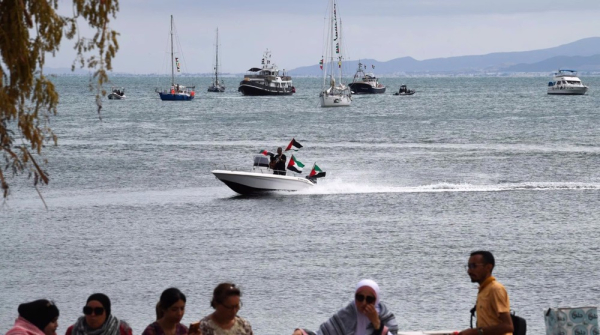
The foreign ministers of 16 countries have warned Israel against carrying out “unlawful or violent” acts against the Global Sumud Flotilla, a civil society initiative attempting to deliver humanitarian aid to the Gaza Strip through sea vessels.
In a joint statement released on Tuesday, the governments of Turkey, Bangladesh, Brazil, Colombia, Indonesia, Ireland, Libya, Malaysia, the Maldives, Mexico, Pakistan, Qatar, Oman, Slovenia, South Africa, and Spain confirmed that their citizens are participating in the mission.
The top diplomats called on the Israeli regime “to refrain from any unlawful or violent act against the flotilla, to respect international law and international humanitarian law.”
The statement also warned of consequences if the ships come under attack in international waters or if participants are detained.
“Any violation of international law and human rights of the participants in the flotilla, including attacks against the vessels in international waters or illegal detention, will lead to accountability,” the ministers declared.
A collection of more than 40 boats carrying critical aid left ports across Tunisia over the weekend, beginning the final leg of its journey to Gaza.
The boats are carrying aid provisions, including baby formula and medical supplies, as well as more than 300 participants. Among them are parliamentarians from countries including France, Brazil, Spain, Argentina, Algeria, Italy, and Germany.
Two independent partnerships are accompanying the flotilla: a legal observer ship carrying international lawyers and an Italian-based sea rescue ship, Lifesaver 2.
The ministers said the flotilla’s stated aim is to deliver humanitarian supplies to Gaza and raise awareness of “the urgent humanitarian needs of the Palestinian people and the need to stop the war in Gaza”.
They added that their governments share these goals, stressing that both “peace and humanitarian aid delivery, together with the respect of international law, including humanitarian law, are shared by our governments”.
“We’re carrying a lot of humanitarian aid, but we’re also carrying a message of support from the peoples of the world that we are with the Palestinian people,” said Bruno Gilga, a spokesperson for the Global Sumud Flotilla.
Israel has frequently attacked other flotillas attempting to break the siege on Gaza.
The Israeli genocide, which began in October 2023, has claimed at least 64,900 lives and left more than 165,000 injured.
Press TV’s website
Israeli aggression against Qatar threat to regional, global security: Iranian official
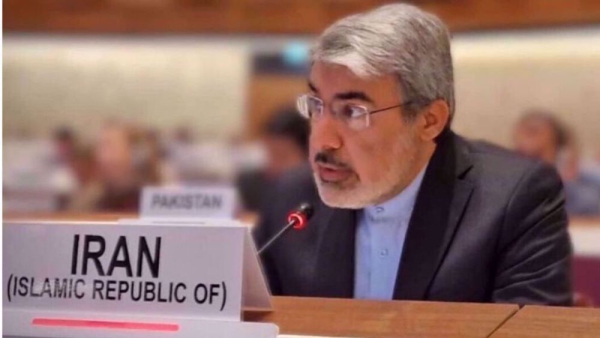
Iran’s ambassador to the UN headquarters in Geneva has strongly condemned the Israeli regime’s recent aggression against Qatar, calling on the international community to step in to prevent the continuation of such acts that threaten everyone in the region.
Ali Bahreini made the remarks during a speech at an emergency session of the UN Human Rights Council (UNHRC) in the Swiss city of Geneva on Tuesday, which was held following Israel's attack on leaders of the Palestinian resistance movement Hamas in Qatar last week.
“This aggression has a clear message; not for a regime whose history is full of systematic genocide, continuous aggression, and vain pride in committing these crimes, but for all of us it is a serious warning that our inaction and failure to uphold legal and moral principles have led to an evil entity destroying global order and security,” he said.
Bahreini went on to say that the “apartheid” Israeli regime neither adheres to international law nor does it believe in negotiation, peace, and stability.