hasania
What was Imam Sajjad’s response to the man who criticized him for going to Karbala?
It is narrated that after Imam Sajjad (a.s.) returned to Medina from Karbala-- maybe ten or eleven months passed between the time this caravan left Medina and returned-- a person visited him and said: "Oh! Son of the Messenger of Allah, you see, you went and what happened?” He was right; the caravan had left while Imam Hussain (a.s.), the bright sun of Ahlulbait, so much loved by the Messenger of Allah, was among them, leading them. The daughter of Imam Ali (a.s.) had left while she was dignified and honored. The children of Imam Ali (a.s.) --Abbas and others-- the children of Imam Hassan (a.s.), prominent and talented youth of Bani Hashem had all left with this caravan. But the caravan returned with only one man -- Imam Sajjad (a.s.), with the women gone through sufferings of captivity and loss of their loved ones. Imam Hussain (a.s.), Ali Akbar (a.s.), even the baby were now gone. Imam Sajjad (a.s.) answered that man, stating: "Imagine what would have happened if we had not gone."
Yes! If they had not gone, their bodies might have survived, but the truth would have died. The soul would have died out. Consciences would have been shattered. Logic and reason would have been condemned throughout history, and even the name of Islam would not have remained.
Imam Khamenei, March 18, 2002
Today, wherever humanity has undergone some defeat, either political, military or economic, the roots of it can be traced to ignorance or abasement. That is, either they do not have the knowledge and necessary understanding, or they understand but have sold themselves cheap. They have bought into abasement and have submitted to viciousness. Imam Sajjad (a.s.) and Imam Ali (a.s.) have been narrated to have said: “Oh! Man, if your essence and existence is to be sold, it has only one price, which is the divine heaven. If you sell it to anything cheaper than heaven, you are at loss.” Even if you are offered the whole world in exchange for accepting abasement and viciousness, it is not fitting. All those who in different places around the world have surrendered to coercion and money of the wealthy and powerful, and have accepted this abasement, --whatever position they are in: scholar, politician, political or social activist or intellectual-- they have failed to know their value and have sold themselves cheap. Many politicians of the world have sold themselves.
Dignity is not simply represented by holding high positions like a king or a boss. Sometimes a person is sitting on a throne, bullying a thousand people boastfully. Meanwhile, he is under the coercion of another power or center. He might be a captive of his own desires and lust; but today's political captives will not reach the latter, because they are captives of major powers.
Imam Khamenei, April 14, 2000
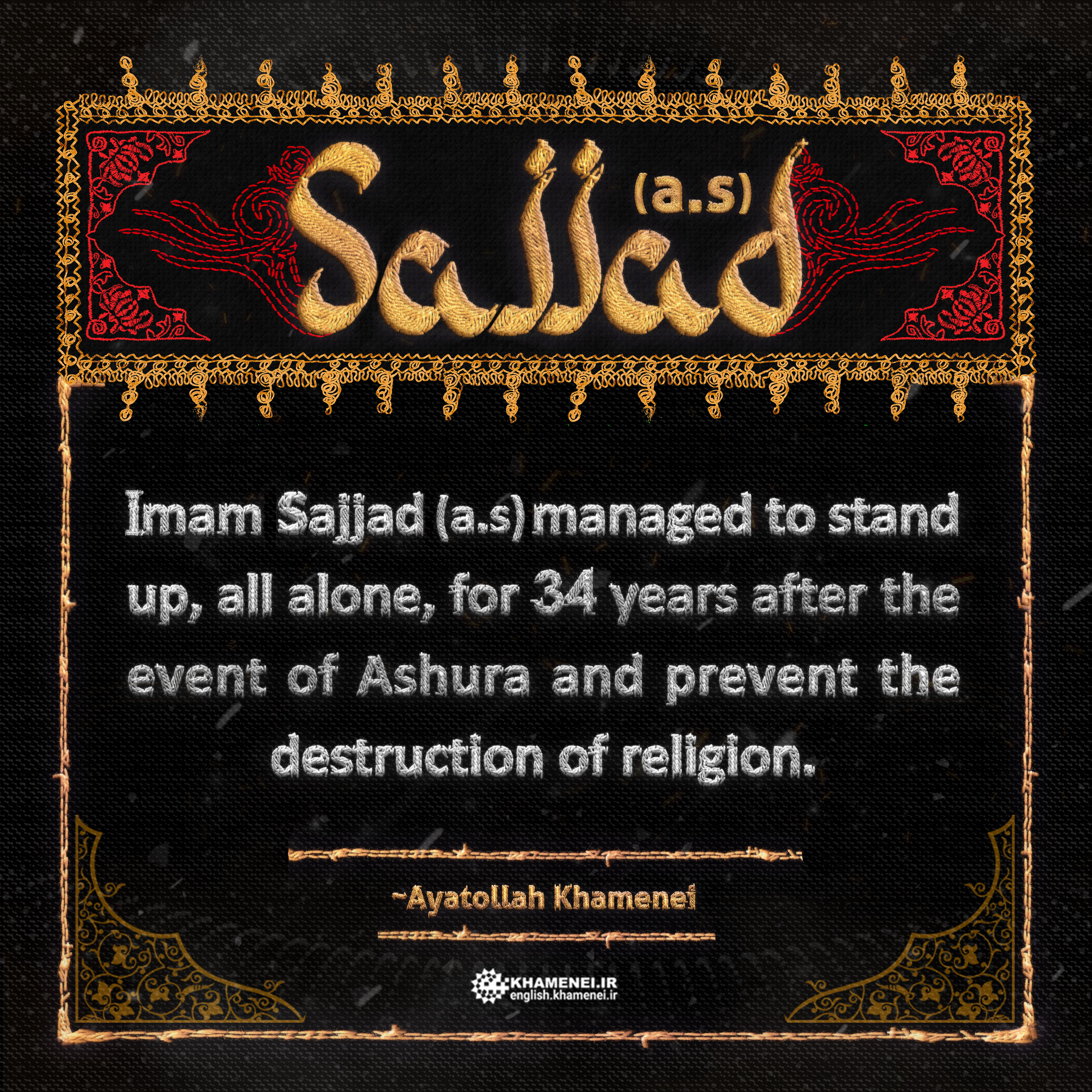
The magnanimous Imam Sajjad (a.s.) lived for almost thirty-four years after the Karbala event, in an Islamic environment of that time. His life history is full of lessons; hopefully, those who are aware of the qualities of his life, will relate them to the people: to Muslims and even non-Muslims, so that everybody learns how our fourth great Imam (as), after Ashura, which was a huge blow to the pure and true Islam, managed to stand alone and prevented the destruction of religion's foundations. If it was not for the efforts of Imam Sajjad (a.s.), the martyrdom of Imam Hussain (a.s.) would have been annihilated, and its effects would no longer remain.
Imam Khamenei, July 14, 1993
The reasons of the Karbala martyrs are so great

This is the reason for the greatness of the Karbala martyrs! They did not fear the greatness of the enemy because of a sense of duty, which was jihad in the path of God and religion. They were not terrified by their being alone. They did not seize on the excuse of being few in numbers to escape from the enemy. This is what brings greatness to a person, a leader, and a nation—not fearing the phony greatness of the enemy. [Imam Khamenei, July 1, 1992]
Hussain ibn Ali (pbuh): The victor in the Ashura battle
It is wrong to think that Imam Hussain (pbuh) was defeated. Being killed does not mean being defeated. In a battle, the one who is killed has not been defeated. The one who does not achieve his goal has been defeated. The goal of Imam Hussain’s (pbuh) enemies was to eliminate Islam and all those who remained from the Prophet from the earth. His enemies were defeated because they did not achieve this. [Imam Khamenei, July 1, 1992]
Women’s education before and after the Islamic Revolution: A Comparative study
Education is one of the necessary measures for growth and development in every society. When studying educational advances, factors including the expansion of educational resources, plans to increase the means for education, the educational system’s share of the public budget, society’s literacy rate, school dropout rates, facilities and services, and educational plans are mainly taken into consideration. When we speak about the Islamic Republic’s achievements in different areas, promoting women’s literacy is undoubtedly one of the most significant features to address. By taking the above-mentioned factors into account, we can have a better understanding of women’s literacy and education, and this is a noteworthy area for study in developing a correct understanding of the status of women’s literacy and education. This examination of the aforementioned factors from before the revolution and up until today has focused on official figures released before and after the Islamic Revolution.
But it is necessary to examine the Islamic Republic of Iran’s general outlook on women before reviewing the performance of the Islamic Republic in terms of women’s literacy. Article 20 of the Constitution of the Islamic Republic of Iran clearly stresses human beings regardless of gender. It highlights human being’s equality in human, political, economic, social and cultural rights. Moreover, Article 21 specifically highlights the need to protect women’s rights by proclaiming that everyone should respect women’s rights. It states that the protection of these rights is one of the responsibilities of the administration and the governmental organizations of the country.
Another fundamental document that addresses women’s rights in Iran is the “The Charter of Women’s Rights and Responsibilities,” which was drawn up and ratified by one of the most important decision-making organizations in Iran, namely the Supreme Council of the Cultural Revolution. In the section on “education,” the document speaks of the following rights:
- Women’s right to benefit from good health (such as health in the working environment, etc.), information and the necessary means for education
- Women’s right to participate in politics, legislation, management, and the implementation of and supervision over health and treatment, specifically that of women
- Women’s right to have access to public education and to benefit from educational betterment and various means of education
- Women’s right to benefit from higher education to the highest level
- Women’s right to acquire skills and expertise – both in numbers and in quality – at the highest levels
- Women’s right to benefit from educational privileges in underprivileged areas
- Women’s right to undertake responsibilities in preparing school materials and other educational materials
- Women’s right as well as responsibility to take on positions which are befitting of their status and role in schools and other educational institutions
In addition to the fundamental policies and documents regarding women’s education in Iran, the leaders and high-ranking officials of the Islamic Republic of Iran have always stressed in their speeches the necessity to provide the necessary infrastructures and opportunities for the growth and development of women in their individual lives and in social life. For instance, the current Leader of the Islamic Revolution, Imam Khamenei, has stated:
Women play a role in social, political, scientific and economic activities. From the viewpoint of Islam, the field for women’s scientific, economic and political activities is completely open. If someone tries to deprive women from doing scientific work and economic, political and social endeavors on the basis of some supposedly Islamic viewpoint, they have acted against the divine decree. Women can participate in different activities as much as their physical ability and needs allow. They can engage in economic, political and social activities as much as they can. The holy Islamic law is not against this. Of course, because women are more delicate in terms of physical strength, they have certain restrictions.[1]
This special attention to women – specifically regarding their scientific and academic life – has led to tangible, noteworthy changes in the growth of their individual, social and scientific lives in post-revolutionary Iran.
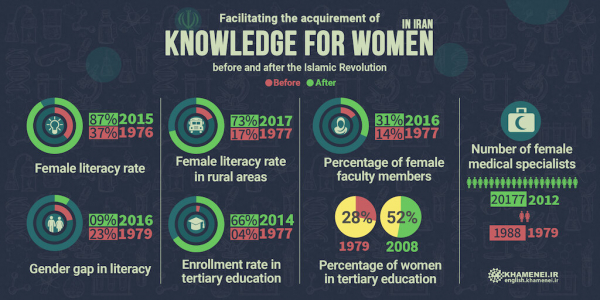
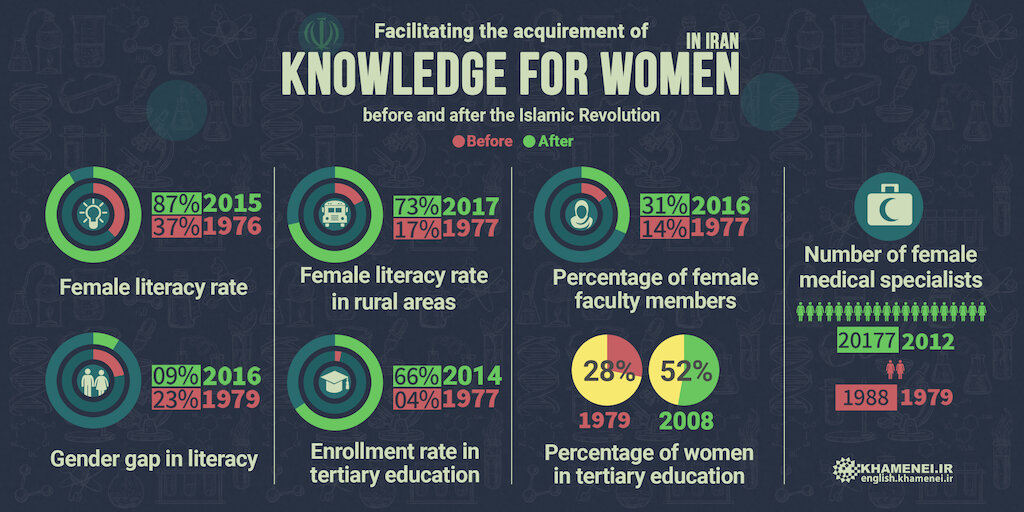
From the start of the Islamic Revolution in 1979, good measures were quickly adopted with determination in order to promote women’s literacy in a comprehensive, thorough manner. This bore tangible results. The rate of women’s literacy improved from 37 percent in the year 1976 to 87 percent in the year 2015. It is noteworthy that the rate of Iranian women’s literacy is even higher than that of the global average.
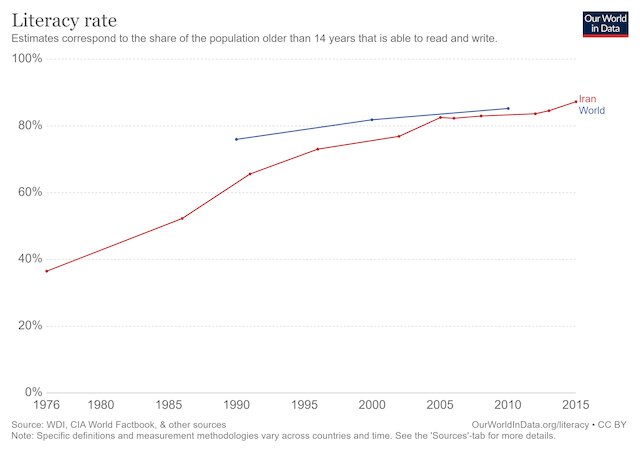
In addition to significant improvements in the rate of women’s literacy, after the Islamic Revolution, women have been in a far better condition - in terms of educational justice in the area of expanding literacy – in comparison with before the Revolution. Before the Islamic Revolution, the rate of female literacy was 24 percent, almost half the rate of male literacy, which was about 48 percent. However, after the Islamic Revolution, this gap in adult literacy rates dropped to 9 percent.[2]
When analyzing the period of the Pahlavi regimes, it is often claimed that women’s circumstances underwent many positive changes thanks to the modernization of society at that time. However, there is evidence that such changes were more superficial than practical. Abbasi and Musavi point out that not only did that modernization of Iranian society not bring changes generally speaking to the social condition of women in pre-revolutionary Iran, but it also “created division among a large number of women. It also undermined the position of a majority of women who had religious orientations in terms of educational and social awareness. This originated from the government’s indifference to the political and civil rights of women and from the government pushing women toward corruption. An example of this is their attempt to bring progress by forcing women to remove their hijab and subsequently their suppression of traditional women in order to enforce this."[3]
Specifically, in the area of education, certain changes stemming from modernization during the Pahlavi regimes have been disparaged as being inefficient due to their contradictions and striking differences with Iranian culture and identity. For instance, in his article “Education during the reign of the Pahlavi Dynasty in Iran (1941-1979),” Hamdhaidari argues that the new educational structures during the time of Mohammad Reza Pahlavi were “imposed” and that “they were totally irrelevant to the cultural, social and economic realities of the Iranian society and to the needs of society.” [4]
Moreover, the macro-policies of the regime in terms of the Iranian culture were oriented toward eliminating women from economic and social activities and defining them as a sexual commodity to be at the service of the patriarchal society. As more proof of the inefficiency of Pahlavi policies for improving the status of women and the female identity, Oriana Fallaci’s famous interview with Mohammad Reza Pahlavi wherein he responded to a question about empowering women clearly shows the humiliating, degrading outlook of Pahlavi rulers toward women. This leaves no room for doubt as to what they thought about women:
You [women] have never produced a Michelangelo or a Bach. You’ve never even produced a great cook. And don’t talk of opportunities. Are you joking? Have you lacked the opportunity to give history a great cook? You have produced nothing great, nothing![5]
An examination of statistics can shed light on the differences between the outlook of former regimes in Iran and the Islamic Republic in the area of women’s involvement in science and research. On the basis of international statistics that compare the former regime with the Islamic Republic of Iran, the rate of women gaining admission to higher education has grown significantly in the post-revolutionary era. Specifically, female admissions into universities in the year 2008 exceeded 50 percent of the overall admission rate, reaching a total of 53 percent.[6] Iran's attempts to reduce the gender gap in higher education have been so effective that the World Bank declared in its annual report on developments in the Middle East and North African that, "In the year 2002 in Iran and for the fourth year in a row, the percentage of women passing the rigorous university entrance exam exceeded the percentage of men passing it." [7]
During the time of the Islamic Republic, women have found the opportunity to exponentially grow in all levels of higher education whereas such opportunities were absent in former regimes. Basically, the monarchical system in Iran adopted a shallow outlook toward women and looked at them as being commodities in society.
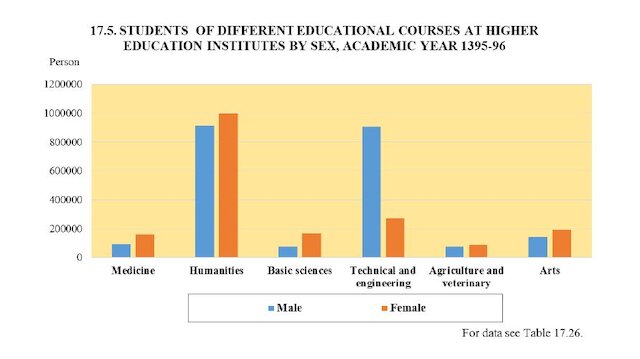
In addition to increased access to academic and scientific environments, women’s situation significantly improved in terms of the diversity of the academic fields available to them. Women have achieved relative equality with men in different fields of study and have even overtaken them in certain fields. As is clear in the following diagram for the year 2017, the number of female graduates in medical sciences and basic sciences exceeded that of male graduates. Only in technical and engineering fields has the number of male graduates been significantly higher than female graduates, a matter that is largely due to the nature of these fields.[8]
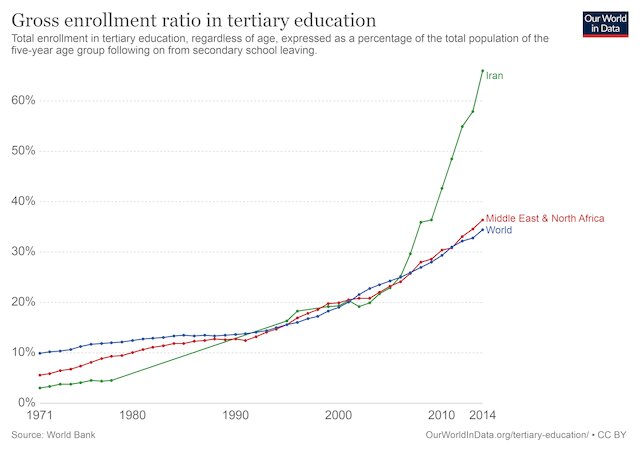
Irrespective of gender, access to universities and academic environments and interest in a higher education has significantly increased among Iranians after the Islamic Revolution compared to the pre-revolutionary era. In 1976, less than four percent of the Iranians who finished high school pursued higher education. But after the Islamic Revolution, in order to bring educational justice and with the necessary infrastructures becoming available, pursuing higher education became possible for a high percentage of the Iranian population. According to international statistics, almost 66 percent of those who finished high school entered universities in 2014. It is noteworthy to mention that Iran’s rate of success in expanding and providing academic and research facilities as well as encouraging its citizens to acquire literacy is almost two times higher than the global growth rate.
The rate of Iranian women’s literacy not only witnessed a growth in terms of quantity, but it has also enjoyed better geographical diversity and a fairer geographical distribution after the Islamic Revolution. In 1977, only 17 percent of the female population in rural areas were literate. But in 2017, 73 percent of the women in rural areas had become literate. This shows more than a 4-fold increase.[9]
The structural and intellectual reforms brought about in Iran regarding women led to the above-mentioned changes in women’s literacy rates. Allowing women to gain science and knowledge, facilitating their access to academic environments and strengthening the identity and dignity of Iranian women remarkably improved Iran’s condition in the area of public services and the development of expertise and skilled work. This is evidenced by a 10-time increase in the number of women physicians between the years 1979 and 2012. Before the Revolution, the number of female physicians was 1,988. But that figure reached an astonishing 20,177 after the Revolution.[10]
In the case of management in educational centers, women’s roles in these centers after the Revolution is incomparable to that of the pre-revolutionary era. Women’s increased access to higher education has made it possible for many more women to take on managerial posts in the field of education and has led to an increase in the number of female professors and faculty members in universities. In its report on the number of female faculty members in universities, the World Bank stated that the number of female board members has witnessed a 3-time increase, growing from 11 percent in 1970 to more than 30 percent in 2016.[11]
[1] http://farsi.khamenei.ir/speech-content?id=2812
[2] https://data.worldbank.org/indicator/SE.ADT.LITR.FE.ZS?end=2016&locations=IR&start=1976&view=chart
https://data.worldbank.org/indicator/SE.ADT.LITR.MA.ZS?locations=IR
[3] Somaye, Abbasi, and Musavi Mansoor. “The Status of Iranian Women during the Pahlavi Regime (from 1921 to 1953).” Women's Studies, vol. 5, no. 9, 2014, pp. 59–82.
[4] Hamdhaidari, Shokrollah. “Education during the Reign of the Pahlavi Dynasty in Iran (1941–1979).” Teaching in Higher Education, vol. 13, no. 1, 2008, pp. 17–28.
[5] https://newrepublic.com/article/92745/shah-iran-mohammad-reza-pahlevi-oriana-fallaci
[6] https://knoema.com/atlas/Iran/topics/Education/Tertiary-Education/Female-students-in-tertiary-education
[7] Gender and Development in the Middle East and North Africa: Women in the Public Sphere. World Bank, 2004.
[8] Iran Statistical Yearbook 2016-2017. Statistical Center of Iran, 2017.
[9] Iran Statistical Yearbook 2016-2017. Statistical Center of Iran, 2017.
[10] Simforoosh N, Ziaee SAM, Tabatabai SH. “Growth Trends in Medical Specialists Education in Iran. 1979 – 2013." Arch Iran Med. 2014; 17(11): 771 – 775.
[11] https://data.worldbank.org/indicator/SE.TER.TCHR.FE.ZS?locations=IR
The camp of truth's active presence & not fearing the superficial splendor of enemies are keys to victory
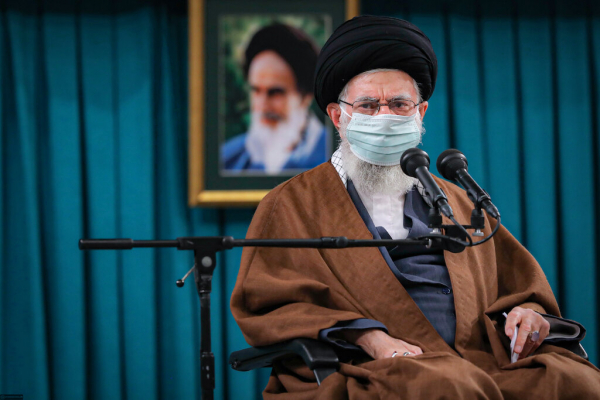
In the Name of God, the Beneficent, the Merciful
All praise is due to God, the Lord of the Worlds, and peace and greetings be upon our Master Muhammad, and upon his pure progeny, especially the one remaining with God on earth
You are very welcome, dear brothers and good friends in the active and hard-working Air Force of the Islamic Republic of Iran Army. The unfavorable circumstances, due to the coronavirus, did not let us organize this meeting the way we wanted. I would have liked to have met with a larger number of you and to speak in a more comfortable way, but I am committed to the health protocols as announced by physicians.
I am committed to them and I feel obliged to observe and act on them. I insist on wearing a mask. I have also received the third dose of the vaccine. Of course, I did it a long time ago – several months ago. I feel obliged to do whatever our honorable physicians think is necessary. I advise our dear people as well, to listen to what experts say in this regard and to act on it. In any case, the meeting is held this way. You are very welcome, I hope that God will bestow success on all of you - God willing.
Well, the month of Rajab is upon us. The first thing that I wish to say to you is that we should appreciate the value of this month and these days. Rajab is the month of supplication and prayer. It is the month of purifying one’s soul and spirit. Hearts should get close to God, particularly you youth who are present at the meeting and in the Air Force. All of us need to strengthen our relationship with God. In each and every moment of our life, we need to strengthen our relationship with God and the days of the month of Rajab are suitable for satisfying this need as the ground is prepared for divine and spiritual blessings.
Well, today, it is the 19th of Bahman: the day of the historic pledge of support made by the Air Force. It is a day when a historic move and a turning point was created by the Air Force. Perhaps, no one from among the current generation of the Air Force was present on that day. Many of the youth were probably not even born that day, but I believe that all those who are working today in the Air Force in a dutiful manner have a share in that pledge of allegiance.
You who were not born on that day or were not working in the Air Force – most of you do not have the work experience dating back to that day – have a share in the move that was made then and in the honor and glory of that era. Why? Because the youth who participated in that astonishing meeting and made a pledge of allegiance to Imam – officers, high-ranking officials and mainly the homafaran [US-trained technical/engineering specialist of the Pahlavi-era Air Force] – did not pledge allegiance to a particular person, rather they pledged allegiance to goals and ideals. It was a pledge of allegiance to the holy jihad whose powerful commander was Imam.
Those individuals brought the Air Force under the umbrella of that powerful, magnificent and astonishing commander. That was a spiritual endeavor. Therefore, this endeavor continues to exist. It was not a move that was made then and that is over now. This is not the case. This endeavor is ongoing and anyone who moves on the path of those ideals has actually a share in that movement. You too are among those who are part of the achievements of the 19th of Bahman.
The move made by the Air Force that day was the last blow dealt to the rotten corpse of the Pahlavi regime as it destroyed the sinister tent of that regime. It was a really influential and determining move. On the same day, Imam (may God bestow paradise on him) in his speech addressed the same group that had come and said that they liberated the army and that they turned the army from the service of taghut to the service of Islam: “Until today, you were in the service of taghut, now you are in the service of Islam.” They were chanting, “All of us are your soldiers”, but Imam said, “You are the soldiers of the Imam of the Age. You are the soldiers of the Quran and Islam and you are moving forward on this path.” That was really the truth of the matter.
There are a few points in this regard. One point is that the move was a need of the moment. I place great emphasis on this issue, as I have placed great emphasis on it before. We must always understand the need of the moment in our affairs. There are certain tasks that if you do now, it will hit the target, but if you do the same thing at another time, it will not work. One must recognize what the need of the moment is. You can always do this.
For instance, you must see what the Air Force needs today and fulfill it immediately. In my opinion, one of the most intelligent things that those individuals did was this. Otherwise, if they had done it 10, 20 days later, it would certainly not have produced the same effect. It had that effect on that particular day. They identified the need of the moment. This is a lesson for us.
Another instructive and valuable point is that the dictatorial regime was hit from an area it did not expect. It did not think that it would be hit from there. In the Holy Quran as well, in Sura al-Hashr, there is an ayah about Jewish tribes, saying, “But the Wrath of God came to them from quarters from which they little expected it” [59: 2]. God the Exalted dealt a blow to them from an area that they did not expect.
No one in the taghuti regime would have thought that they would be hit by the Army and by the Army Air Force. They had invested heavily in the Army Air Force. Their American allies were surprised as well. The Americans sent General Huyser, an American general who was the second-in-command at NATO, to Tehran in order to organize the army and to prevent the regime from being overthrown at any cost – even if it meant a bloody coup. In other words, he had decided to kill hundreds of thousands of people in Tehran if it was necessary.
Huyser came to Tehran with that intention, but he failed miserably and returned. He wrote in his memoirs – of course, I have not seen the book myself, but it was narrated for me – that the Air Force was a place where they expected the least commotion because it had close contacts with the US in terms of command and military training.
Perhaps, many of those who participated in that glorious and historic movement on that day were people who had pursued their studies in the US and who were familiar with American culture, but the Americans were struck from that very same area.
Well, this is a sign that divine promise is true. As God said, “As for them, they are but plotting a scheme and I am planning a scheme” [86: 15-16]. The enemies devise a scheme and God devises a scheme against them as well. In another ayah, God says, “Those who defy Allah are themselves involved in a plot” [52: 42]. In the confrontation between the camp of the truth and of falsehood, it is the camp of falsehood that is harmed. This has always been the case. The American calculations turned out to be wrong on that issue. They had counted on the Air Force of the taghuti regime, but it proved to be wrong. They never thought that things would pan out like that.
Whenever the camp of the truth enters the field to confront the camp of falsehood, the enemy will make a mistake in its calculations despite all its superficial and hollow power and splendor. This is always the case. It was the case in the Revolution as well. It happened in the beginning of the Revolution and also in the past 40-plus years.
They have always made certain calculations, thinking that it was they who were delivering the last blow, but they themselves were dealt the blow. If you show an active presence in every jihadi arena – in every era, a certain kind of jihad is necessary as there are military, scientific, research and various other kinds of jihad – you will defeat the enemy. Why? Because Allah the Exalted has ordained that the enemy’s calculations always prove wrong and they always fail to have a correct estimatation of things.
Today, the US itself suffers from this problem: “But the wrath of Allah came to them from quarters from which they little expected it.” Today, the US is being dealt a blow from areas that it had never thought about. Today, two US presidents - the previous and the current ones - have joined hands to ruin whatever has remained of America’s reputation. Each is doing so in his own way. Would they have predicted this? Would they have anticipated this? They are weakening themselves and this will continue. Therefore, this is an important point to know that if you show an active presence in the arena and work in a hopeful way, then victory and progress will definitely be yours.
Another point is that no one should think that the move made by the youth of those days was based on fleeting emotions. This was not the case. Yes, emotions were definitely involved, but they relied on depth and guidance. I have many memories in this regard, but the sign of its depth is that this movement continued in the Air Force. If it had been a fleeting movement, it would not have continued.
This movement continued in the Air Force. At the very beginning of the victory of the revolution, the Self-Sufficiency Jihad Unit was formed in the Air Force. While there was still no self-sufficiency jihad organization anywhere in the army and in the country, the religious and revolutionary youth of the Air Force formed a self-sufficiency jihad. And from the very first day, they started working and endeavoring, and to this day, great things have been done. In addition, the jihadi forces of the Air Force did great things in the Air Force itself.
One of the first things that was done in the year 1358 was to thwart the conspiracy at the Tabriz base. At that time, Martyr Fakuri was the commander of the Tabriz base. A conspiracy was hatched at the Tabriz base. Those disrupters had even besieged that Martyr, something like an arrest. However, the revolutionary youth of the Air Force themselves, without asking for help from anywhere, dispersed them, taking Martyr Fakuri with them and bringing him to Tehran. This is one of the things that happened in early 1358.
Regarding the coup hatched in Hamedan base, Nojeh military base, the person who caused the coup to be foiled – [a coup] for which all preparations were made because all the details had been planned thanks to the Americans – [the person who foiled the coup] was a young officer who informed the organizations in charge and the youth in the Islamic Revolution Guards Corps, the intelligence organizations and other such youth subsequently embarked on foiling and crushing it. That was started by the youth in the Air Force themselves. It was a young officer, a young pilot, who revealed their plan. In other words, the feat was achieved by the youth of the Air Force. The same is true of other matters.
In the very first days of the Holy Defense, the Army Air Force did the most outstanding work. That is, the sorties performed by the Air Force in a matter of days were unparalleled! I was a member of the Majlis at that time and I was also Imam’s representative in the Armed Forces. I went to the Majlis and reported it. Everyone was amazed by the significance of the report. Within three or four days, several hundred sorties were flown by the Army Air Force. Other organizations had not yet figured out what was going on and what to do. So, the Air Force was the first to arrive at the scene.
Those moves were a continuation of the first one. When I say that the movement was not based on fleeting excitement, it is because it continued later on in the Air Force. So, that spirit and insight helped build prominent martyrs both in the Air Force and in the whole army: Martyr Sayyad-Shirazi, Martyr Babaei, Martyr Sattari, Martyr Kolahdooz and thousands of other martyrs. These are the outstanding ones.
Of course, there are many more outstanding martyrs. Even in the army, some people from among the officers of the taghuti regime placed themselves among the martyrs. An example is Martyr Fallahi. Fallahi was the brigadier general of the army during the taghuti era, but the spirit of the revolution, the condition of the army and that great transformation caused Fallahi to become a martyr: Martyr Fallahi! The same is true of Martyr Fakuri. These were senior officers before the revolution. Well, this was due to insight. It was due to a deep insight that those people gathered together to take that historic pledge of allegiance.
What was the reason behind that insight? Why did others not have it? Different reasons could be mentioned for it, but most probably, one important reason was that the Air Force youth were witness up close to the dictatorial behavior of American advisors and their domination over everything. In no other division of the Army did the American forces have such a domination. There were tens of thousands of advisors. Their number reached about 50,000 in Iran. They had built a den inside the Air Force. They had a domination over all the affairs, they would humiliate the commanders and they would not listen to Iranian personnel in any way.
They did not take them into account at all and they were only in contact with courtiers [connected to the Shah]. So, they did not take heed of the Iranian personnel in any way. They would sell us equipment, but they did not allow our technicians to study them. Neither technical officers nor the homafaran, who were in charge of these affairs, were not allowed to study and repair those parts and components.
The spare parts, which were comprised of several components, were not allowed to be taken apart! Instead, they would be taken to the US by plane, were changed there and brought back and then they would receive the money for it. This was how Iranians were humiliated. The Air Force personnel were witness to these things up close. There were instances of moral decadence as well, but they cannot be recounted here. Surprising things used to be done by them and the story of the Americans’ presence in the army is really a sad story.
Our youth do not probably know that the US and England frequently used our army in order to suppress other nations, including in Vietnam. They used to take our planes to Vietnam in order to bombard the Viet-Cong who were fighting against the transgressing and aggressive US. This was how our army was taken advantage of. The same was true of other countries. It is even said – of course, I do not have first-hand information on this – that there are reliable sources showing that Iran’s Phantoms were given to the Zionist regime. Well, what did it need them for? It probably needed them for suppressing the Palestinians or for confronting the governments that formed the Arabian Resistance of those days – the Egyptian, Syrian and other such governments. In other words, the machines and technologies that belonged to Iran and Islam used to be put at the service of the American cause so as to crush the oppressed and assist the oppressor.
Well, these are really important matters that we should know about. Of course, the treacherous actions of the Pahlavi regime are not confined to these one, two cases, but it is an important treachery committed by the Pahlavi regime. It was a treachery to the Army and to the Iranian nation because they would use the nation’s assets for serving the US. It was also a crime against other Muslim nations.
The point that I wish to place more emphasis on and towards which I want to draw your attention and that of others who listen to these statements is about the “jihad of clarification”. I have discussed this at length before. What I want to say today is that the day when the historic 19th of Bahman move was made, if that photograph [showing the Air Force giving the military salute to Imam Khomeini] had not been published and if that clarifying endeavor had not been made, that incident would not have survived to this day, nor would it have exerted any influence!
It would have become an incident like many others which take place and are then forgotten. The reason behind the perpetuality and influence of that incident was that artistic photograph. Such is the effect of clarifying, promoting and showing. Thanks to a limited and small media work - that day the media facilities were not like today, they were very limited - a movement like the Air Force pledge of allegiance movement on the 19th of Bahman became historic, everlasting, effective and transformative.
Such is the effect of correct narration. When I place so much emphasis on the correct narration of incidents, the reason is that today, with the expansion of media – at present, compared to those days, things have become different due to an increase in the number of the media by thousands, not hundreds, of times and due to the appearance of cyberspace, satellite and other such things, which were absent in those days – the importance of this issue has increased as much.
Today, a definite policy of the media working against the Islamic Republic and Islam is to distort facts and they are busy working to that end. They are continuously producing work by distorting facts and by telling lies. They tamper with the news on the Islamic Republic by making the most of all sorts of lies – professional lies, lies that are fabricated in a carefully planned way – and they try to beautify the ugly and corrupt face of the taghuti regime, covering up the thousands of crimes and treacheries committed by the regime.
The taghuti regime’s SAVAK was a place where all sorts of tortures, originating from the Israeli and American intelligence services, were practiced. Many of those methods were perhaps tested [in Iran] and many were put into practice. In the present time, many of the individuals enduring those tortures are alive and the effects of the tortures are visible on their body and they are suffering from it. They even intend to doll up the vicious, ugly and entirely criminal face of SAVAK and portray it otherwise. One of the agents of SAVAK, who was perhaps the most notorious person in the country, wrote his memoirs, speaking as if SAVAK – the center of torture and oppression – was a place of enlightenment!
In contrast, regarding the Revolution, they damage the reputation of the Revolution and of Imam and the activities that were done in the past 40 years. They try to undermine them as much as they can. You cannot find any reference to the achievements and the strong points in the western media empire. They conceal the facts. Conversely, if there is a weakness - which of course there is because no country and no political system is without weaknesses - they magnify it by a hundred times. This is a strange thing that is happening today. That is why the “jihad of clarification” is an obligation. The jihad of clarification is a definite and urgent obligation, and whoever is capable of working in this field should do it. Later on, I will speak about the role of officials in this regard because they have a heavier duty towards it.
Well, western powers are known as dictatorships. Those who claim to oppose the dictatorships of the world, are themselves the most dictatorial. In the political and economic sphere, they are dictating things to the whole world. Another form of dictatorship has been added to their collection, and that is the media dictatorship. For example, one cannot mention the name of Martyr Soleimani in cyberspace because they eliminate it. In cyberspace, which is controlled by them, they cannot stand the name and photographs of Martyr Soleimani. This is how things are now.
Of course, such forms of dictatorship existed before as well. The late Hajj Ahmad Aqa (may God bestow paradise on him) [son of Imam Khomeini and his personal assistant] recounted for us that once, Imam had delivered a detailed message – I think it was a Hajj message. Hajj Ahmad Aqa said, “I thought of publishing it in the US as it is alleged that in the US, there is freedom of speech. So, we wanted to publish it in one of their newspapers. I sent a message to one of my friends who was there and I said that I would spend as much as necessary to have it published there” – it was like giving money to publish a manifesto.
However, he continued, “No newspaper was willing to publish it.” Despite their claim to promote freedom of speech, they did not accept to publish Imam’s manifesto. The author of a book about the Den of Espionage [occupation of the US embassy] in which she described that place in detail – she herself was one of the people there – said that they called every publisher in the US to publish it, but they said no. They finally went to Canada and found a publisher there, but the publisher was made to regret his decision, receiving many threatening calls and the like.
Such is the media dictatorship. That is while they claim to be advocating freedom of speech. They prevent the publication of every word and every point which is contrary to western policies, but they make the most of the same space to magnify the problems in the Islamic Republic and to destroy and damage Islam and Islamic concepts and teachings. This is a bitter reality which places a duty on the shoulders of everyone.
As I said, those in charge of the media are primarily responsible including the national and various other media, cyberspace and the press. Everyone has a duty to enter this field, and everyone who has a center and a platform to speak to the public in society has a duty in this regard. Thousands of glorious incidents take place in the country. During these years, during the past four decades, how much great work has been done in the country! How much epic work has been done! Well, these should be stated.
These realities are concealed by the enemy and he does not let them be broadcast. Many feats have been achieved in social, economic, construction, educational and health areas. The same is true of industrial areas. The other day, a group of industrial activists were present here and delivered a report – a few of them delivered a report – and the pictures of their activities were shown here in this Hussainiyyah as well. It was amazing and astonishing, but there is no trace of it in the country’s media. This is a very strange thing. So much work is being done. So much important and valuable work is being done. All these are examples of epic work which can be seen in construction, religious, cultural, defense and security areas.
You yourselves are familiar with the issues and developments in the Air Force. You have carried out various tasks, but which of these is rightly reflected in society? Well, there is really lack of activity in this regard. Each of the areas that I just mentioned – social, economic, diplomatic, political and construction areas. So much work has been done in the area of construction- this can be a title for the activity of the jihad of clarification. We should not allow some problems in the country – well, the country has certain economic and livelihood problems – to overshadow these epic achievements with a cloud of dust, and to keep them away from sight. These problems are important in their own respect and there should be an effort to eliminate them. There is no doubt about this, but the important feats, achievements, construction accomplishments and valuable activities in various fields should not be forgotten either.
My last word is that our enemies – the camp of the enemy, as the enemy is a large camp – has engaged today in a hybrid attack. The enemy’s invasion is a hybrid attack. That is, it includes economic, political, security, media and diplomatic aspects. They have begun a hybrid and comprehensive attack in all areas. In response, we must make a hybrid move as well. We must work in all areas. Of course, we must defend too, but we must know that we cannot remain in a defensive position forever. When I say that we must defend, well, defense is necessary, but one cannot remain in a defensive position forever because the enemy attacks and we must attack as well in various areas including in the sphere of the media, the economy and security. Intellectuals are responsible in these areas. Intellectuals, activists and particularly officials must work in any of these areas that they can. As the Islamic Republic has moved forward powerfully for more than four decades and as it has become more powerful and deep-rooted on a daily basis, despite the wishes and worn-out illusions of the enemy, this movement too will continue in the future in a much better way and the enemy will continue to fail. However, each of us must know our duty in every area.
You have a lot of work to do in the Air Force, you have important things to do in administrative, educational, and operational fields. There are many tasks in different fields that you have to do, God willing. I have discussed some of these tasks with the honorable commander, and God willing, you will follow them. By Allah’s favor, in the future, the country will be in a much better condition than today.
Greetings be upon you and Allah’s mercy and blessings
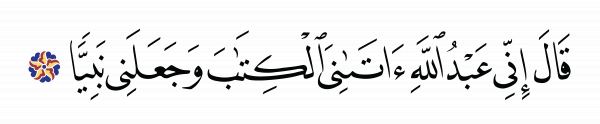
He spake: Lo! I am the slave of Allah. He hath given me the Scripture and hath appointed me a Prophet (Maryam: 30)
To obey Jesus Christ, one needs to support truth, abhor powers that are against truth
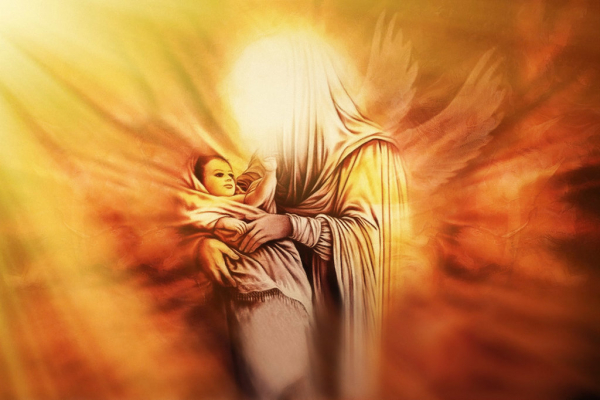
Ayatollah Khamenei, the Leader of the Islamic Revolution, issued a message on January 02, 1995 for the auspicious birth anniversary of Jesus Christ (pbuh) and the commencement of the New Year on the Gregorian calendar. The full text of the message is as follows:
In the Name of God, the Most Beneficent, the Most Merciful
I congratulate all Christians and Muslims—particularly our Christian compatriots—on the birth anniversary of His Majesty Jesus Christ, the great prophet, as well as the commencement of the new Gregorian year.
This chosen prophet of God, invited mankind to the path of God, which is the path to mankind’s prosperity and happiness; he warned them against pursuing their evil desires, contaminating the purity of the human soul into depravity, cruelty and wantonness. Tyrannical, corrupt and aggressive powers--who were the slaves of wealth and power--strained and slandered this divine messenger and intended to take his life; then God embraced him safely and securely. They horribly tortured his apostles and adherents, for years, in order to destroy his teachings which were against corruption, oppression, idolatry, dissoluteness, warmongering and deceiving the public. They--who were themselves corrupt, oppressive, dissolute, warmongers and deceived people—could not tolerate God’s religion, God’s prophet, and the followers of the divine path.
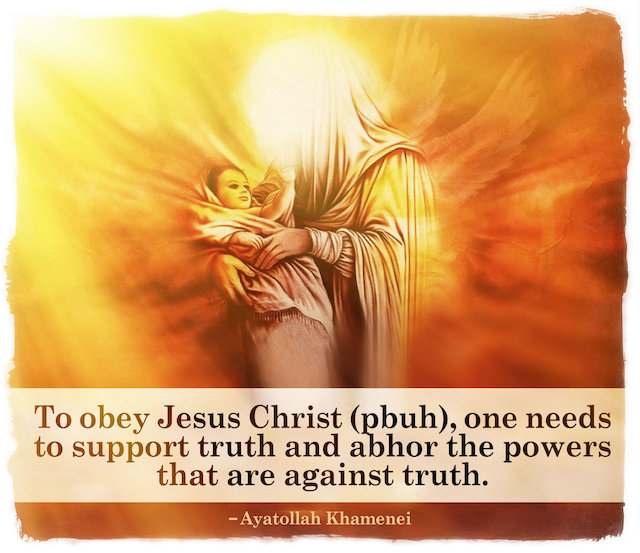
Today powers of the same type do not want to tolerate those who submit to God, follow God’s religion, and followers of truth. To obey Jesus Christ (pbuh), one needs to support truth and abhor the powers that are against truth. It is hoped that Christians and Muslims across the world will incorporate this great teaching of Jesus Christ (pbuh) into their lives and actions.
I ask God to make the New Year a year of prosperity for all nations and the entire mankind.
Sayyed Ali Khamenei,
January 02, 1995
If the truth is not clarified today, the place of the oppressor and the oppressed will be changed

In the Name of God, the Beneficent, the Merciful
All praise is due to God, the Lord of the Worlds, and peace and greetings be upon our Master, Muhammad, and upon his pure Household, particularly the remnant of God on earth
I would like to congratulate each and every one of you dear brothers and sisters and the honorable, respectable activists who work in the health profession on the occasion of the anniversary of the birth of Hazrat Zeinab al-Kubra (peace be upon her) and Nurse’s Day.
This meeting is a good opportunity to speak about the “defenders of health” and the dear nurses. But before that, I deem it necessary to raise a few points in honor of the great lady of Karbala, Hazrat Zeinab al-Kubra (may God’s peace be upon her). Many discussions have been held and many complimentary remarks have been made about Zeinab al-Kubra, which have all been correct, but there are two important points that may be seen in the life of that great personage that I wish to discuss here.
The first and foremost point is that Zeinab al-Kubra (peace be upon her) showed the great spiritual and intellectual capacities of women to all of history and the entire world. This is very important. Despite the foolish wishes of the people who humiliated women at that time and those who are doing so in our own time, Zeinab al-Kubra was able to show the high status of women and the great psychological, mental and spiritual strength of women. I will give a brief explanation about these points. When I said that they are humiliating women today, this is a fact, but I do not want to enter into that discussion now. More than anyone else, it is the West who is humiliating women in a dangerous way. That great personage, Zeinab al-Kubra (peace be upon her), showed two points. The first point is that women can be a vast ocean of patience and endurance, and the second point is that women can be a peak of wisdom and prudence. Zeinab al-Kubra (peace be upon her) demonstrated these in practice, and not just to those who were living in Kufah and Shaam [the Levant]. She showed this to history and all of humanity.
As for her patience and endurance, the patience and endurance that Zeinab al-Kubra showed and the tragedies she faced cannot be described at all. Firstly, she showed great endurance in the face of the martyrdoms. In about half a day or less than a day, 18 of her dear ones and relatives were martyred. One of these was her noble brother – God’s Proof on earth, the Master of Martyrs (peace be upon him). These people were martyred in front of her eyes. Her two children were martyred as well, but she endured all of these. A mountain would collapse in the face of such tragedies, but Zeinab al-Kubra was able to show patience and endurance and to carry out her subsequent duties with the inner strength that she possessed. If she had been impatient, wailed and shown restlessness, she would not have been able to deliver those speeches and to launch that great movement. So, one point is her patience in the face of the martyrdoms.
She also showed patience in the face of insults. A lady who had lived with dignity from the time she was born and one whom everyone had held in high regard from her childhood to her adulthood was insulted by the thugs and ruffians in the Umayyad army, but she was patient and did not break down.
She also showed her patience when faced with the huge responsibility of gathering together the orphaned children and the mourning women. This was a great task. She was able to bring together and take care of tens of women and children who were mourning and injured during that difficult journey. These were some of the tasks carried out by Zeinab. She showed great endurance. Indeed, Zeinab al-Kubra was an ocean of patience and tranquility. She showed that women can reach this point and this great level of inner, spiritual strength. In addition to these, she also nursed God’s Proof on earth – Hazrat Sajjad (peace be upon him). This also required patience, but she carried out this task in the best possible way. These were some points about her patience.
As for her wisdom, intelligent behavior and mental power, her behavior during her captivity was truly amazing. I believe that we should study, deliberate on, write and speak about each and every aspect of this behavior. We should produce artistic works about this because this is not a minor issue.
She was also a manifestation of resistance and mental strength in the face of those proud, arrogant rulers. When Ibn Ziad began to address her with derisory remarks in Kufa and said, “Did you see what happened. Did you see that you have failed?” she replied, “I did not see anything but beauty.” [Bihar al-Anwar, vol. 45, p. 116] This was a slap across the face of that arrogant, malicious man, Ibn Ziad. When Yazid made those nonsensical, ludicrous remarks, Hazrat Zeinab replied in an interesting way. She made this well-known, truly historic statement, “Use every trick that you know and every deception you can, but by God, you will not be able to erase our memory.” [Bihar al-Anwar, vol. 45, p. 135] In today’s language, this means, “Do whatever awful thing you can, but you cannot make people forget about us.” Whom does she say this to? To the arrogant, proud, tyrannical, bloodthirsty Yazid. This shows the inner strength of a woman. What strength is this! What greatness is this! These qualities are a sign of wisdom and prudence. Those statements were made in a calculated manner. But when she addresses the people, she does not express her strength. Instead she makes critical remarks, explains things and blames a people who do not know what they have done and what they should have done.
When Hazrat Zeinab delivered a speech in Kufa, the people began to cry. In response, Hazrat Zeinab (peace be upon her) said, “Are you crying? May your tears never stop, and may your moans and groans never end.” In other words, she tells them, “What are these tears? Do you know what you have done?” Then she says, “You are like a woman who undoes her weaving after having tied it firmly.” [Bihar al-Anwar, vol. 45, p. 109] You have destroyed all your past efforts. She spoke in this way. I find it highly probable that one of the important reasons behind the movement of the Tawwabin, who later rose up in Kufa and launched that great movement, was this sermon delivered by Hazrat Zeinab. This is the first point about Hazrat Zeinab. In sum, this means that Hazrat Zeinab showed the spiritual and intellectual capacities of women with her behavior and her statements. She spoke the way the Commander of the Faithful (pbuh) did. She stood firmly the way the Holy Prophet did when facing the unbelievers. This is a woman’s capacity.
Another important point about the life of this great woman, which is another sign of her prudence, is that this noble lady launched the jihad (struggle) of clarification and narration [of truth]. She did not give the enemy’s narrative the opportunity to overcome. She acted in such a way to make her own narrative the dominant one among public opinion. The narrative provided by Zeinab al-Kubra about the event of Ashura has remained in history until today. But at that time too, it influenced the people in Shaam [the Levant] and in Kufa. Its effects were unending throughout the Umayyad Dynasty and it actually led to that dynasty’s overthrow.
There is a lesson in this. This is what I have always said, “It is you who should narrate the truth about your society, your country and your Revolution.” If you do not narrate these events, the enemies will do as they wish. They will tell lies and turn things 180 degrees around. They will change the place of the oppressor and the oppressed. If you do not narrate the event regarding the takeover of the Den of Espionage – unfortunately, we have not narrated this – the enemies will narrate it, as they have already done, and they will lie. We must relate the true story. Our youth have this responsibility.
Now, let us discuss the issues related to nurses. What I wish to say is primarily a discussion of the value of nursing. This is one point that I will discuss. Afterwards, I will look at the hardships and difficulties endured by nurses. We should know what these hardships are. The Iranian nation should know what nurses are enduring in doing their job. Another point is about nurses’ demands. Well, officials are thankfully present in the meeting. I will speak about some but not all of the demands that nurses have.
As for the value of nursing, there is an important point and that is helping people in need of help. In other words, a nurse is a person who helps another person who needs help for everything. That person needs water, food, comfort for sleeping at night, medication and other needs. Like an angel of salvation, nurses help these people who are in dire need of help. Well, helping a person in need is a lofty value in all cultures and even more so in the case of the people with the most needs – that is to say, patients. This is an important point which is about helping those who are in need. I should add that one recommendation and command issued by mystics and spiritual, monotheistic people is about helping those in need. In other words, you nurses are actually obeying an important monotheistic command when you are doing your job. Such is the importance of this job. This is a very lofty value. This is one point.
Another value of nursing lies in the fact that it is a difficult task. There are more rewards for difficult tasks and such tasks are of more value. A task that is accomplished with difficulty and for which a person endures hardships is of more value in God’s balance. This is because such tasks are accompanied by hardships. Later on, I will briefly discuss these hardships. Therefore, nursing is of more value. It is more important than other kinds of assistance because it is a difficult job.
Another value of nursing lies in the fact that nursing is a source of surety. Whose surety? First, that of the patient. When a nurse is watching over a patient, he feels assured. Secondly, his family feels assured since there is a nurse in the hospital who is with their patient. If there were no nurse, they would feel anxious and worried. And thirdly, everyone feels assured. Everyone’s conscious is bothered and people are worried about the pains and sufferings of the people who are suffering. If we see there is no one attending to the needs of a patient who is in pain and who is hungry and thirsty, our consciences will naturally be bothered. But because we know there is a nurse there, we feel assured. So, nurses are a source of surety for the patient, for their family members and for everyone else since nurses soothe our troubled consciences. Therefore, on this basis, not only are the patients indebted to the nursing community, but you and I are also indebted to them and other people who are not related to that patient in any way are also indebted to them, because nurses give everyone a feeling of assurance.
One reason why nursing in Islamic Iran is more valuable is that the Arrogant Powers in the world take delight in the suffering of the Iranian nation. You don’t believe this? The enemies rejoice at the suffering of the Iranian nation. What is the reason for saying this? The reason is the chemical bombings during the Sacred Defense. Thousands of our youth were afflicted with acute, painful, incurable diseases as a result of the chemical bombings. Sometimes, their family members and their children were affected as well. Of course, the chemical bombings were carried out at Saddam’s command, but who gave him the bombs? Who gave him the chemical substances? Who gave him the go ahead and who watched this happening with satisfaction? Just the mere possibility that a country may possess chemical weapons causes a huge uproar in the world today. But he used to drop chemical bombs in front of everyone’s eyes. The US, England, France and others were watching, and they were even admiring and helping him as well! Therefore, they are pleased to see the suffering of the Iranian nation. Another example is the embargos on medicines. God was merciful to us and our young scientists were able to produce a Coronavirus vaccine. They ( the enemies) witnessed that if they shut the door to Iran and prevent it from importing vaccines, Iran will produce them on its own. If our young scientists had not produced this vaccine, it was not clear how this vaccine would reach the Iranian nation and the officials of the country. They take delight in the suffering of the Iranian nation.
Under such circumstances, if you nurses can bring a smile to the lips of patients and their families, you are in fact fighting on the path of God against the Arrogant Powers. That is why nursing can be defined to be a confrontation with the Arrogant Powers as well. Such is the status of the nursing community. It has great value. I have only pointed out a few examples, but much can be said about this. These points were about the value of nursing.
As for the difficulties and bitter aspects of nursing, nursing is hard and bitter by nature. Seeing the pains, sufferings, moans and sleeplessness of patients and constantly watching these things is bitter and very difficult. This is one of the most difficult things for a person. When you constantly witness the physical needs of patients and attend to them – not merely see these things and pass by them – and when you treat those pains, when you see the patient is hungry and thirsty and you provide for these needs and when they have various other needs and you help them while watching over them day and night, these are some of the difficulties of nursing. Therefore, nursing is difficult by nature.
At times, these hardships multiply in number, such as during the Coronavirus pandemic and during the Sacred Defense. During the Sacred Defense too, these same difficulties existed. Most of you are young and do not remember those days. Those who were present in the field know this. At the time of the Sacred Defense, we had a number of hospitals that were not far from the frontlines. I myself saw those hospitals up close. There were physicians and nurses in those hospitals who were under heavy bombardment. I myself was present in one of those hospitals and medical centers when it was bombarded. I saw up close the heavy bombardment of it. The rescue workers went forward into the middle of the fire and blood. These hardships existed during the Sacred Defense as well and their magnitude was several times as much.
The same was true during the Coronavirus pandemic. During the Coronavirus pandemic too, work became much more difficult. Working hours increased and the number of days of vacation time decreased. During the Nowruz (New Year) holiday, nurses did not have time for their own families, children, spouses and parents. These are truly meaningful, important events. At a time when everyone is resting and enjoying their time, nurses have to face bitter events and difficult diseases, and they cannot go home. All of these are difficult events. They were also witnesses to much death. Well, how patient can people be when they are witnessing the death of someone? During the pandemic, nurses witnessed the death of many people – old, young, men and women – many times. These are difficult events. This is very difficult.
Besides all of these, they witnessed the death of their own colleagues. How many of their colleagues passed away! Until yesterday and the day before that, their colleagues were by their side. But now, some of them became infected with the Coronavirus and passed away. These are difficult events. In my opinion, the Iranian nation should see, understand and appreciate these difficulties and the value of the nursing community. Beside all of these difficulties, there is the risk that nurses themselves may become infected with a deadly disease. They are constantly anticipating this danger. How many nurses became infected! All nurses know it is probable that they might come down with a disease tomorrow despite the fact that they are working today safe and sound. This is a very grave danger. In the past, we had heard about these things during epidemics such as the cholera epidemic, plagues and the like. There were certain individuals who would go and help the patients. They would watch over and nurse them, but they would often become infected and pass away. There were limited cases like this. However, we witnessed these events extensively during our own time.
There is one point that I should mention here. As well as nurses, we had some volunteers who cooperated with them. They were from among the clergy, students and other youth who would visit hospitals, learn a few things (about nursing) and help out. They did whatever they could. The same was true during the Sacred Defense. Non-professionals used to come to help the nurses at that time. Because of their sense of responsibility, they would go to the hospitals and help the medical staff, including the nurses, in whatever way they could. In my opinion, this shows an important, glorious truth in our dear country and for our dear people. It shows the energetic, dynamic, conscientious personality of the Iranian nation. It shows that this movement exists at the public level among the Iranian nation. Of course, this was seen during other natural disasters as well. I only referred to the nursing part of it, but this is a continuous chain. This idea of commitment and a sense of responsibility had shown itself in the Iranian nation before the Revolution – during the activities that were carried out against the oppression of the Shah – and up until the events that took place after the Revolution, during the Sacred Defense and after that, and during the Coronavirus pandemic. This spirit existed during pre-revolutionary activities against the oppression of the Shah in the same way that it existed during the Sacred Defense and after that, during the pandemic and during the great scientific movement of the country. This is an important chain that shows the character of our nation.
This shows the character of our nation. This movement is a movement that builds the character of the nation. This is the same character from which emerge heroes such as Martyr Soleimani, Martyr Fakhrizadeh and Martyr Shahriari. This is a truth that manifests itself in various forms and shapes. Such is the character of the Iranian nation. These are truths that build character. They are both a sign of character and a force for strengthening and building the character of the Iranian nation. These were some points related to the hardships.
I wish to address our artists now. We have a shortage of artistic narrations of these events. One example is the events that have taken place in hospitals, which I have referred to. The hardships and difficulties that nurses are faced with are of artistic significance. As is commonly said by artists, which is a western term, these events are “dramatic.” Therefore, artists can produce enthralling artistic works describing these events. They should do this work using all kinds of the arts – the dramatic arts, visual arts, poetry and literature. They should include these events in their artistic works. These are great cultural assets. Everyone must make use of these, but the people who can work the most with these assets are our artists. Thankfully, we do not have a shortage of committed, dutiful artists. They should enter this field. Well, these points were related to the hardships and difficulties, and we have discussed these in brief. Of course, much more could be said about this.
As for the (nurses) demands. The main demand of the nursing community is to strengthen the nursing community. To put if briefly, the nursing community expects all of us – in particular, the organizations that are in charge such as the honorable Minister who is present here as well – to strengthen the nursing community. If we do not strengthen the nursing community, we will be hurt at the turning points. The Coronavirus pandemic showed this clearly. When we need help, we will be hurt. The nursing community should be strengthened for when they are needed. We may not always feel this need. At the present time of course, we do feel this need and we have problems in the area of manpower and many other areas, but I will explain this more further on. But even assuming that we do not have a major issue right now, if we do not strengthen the nursing community, we will be hurt at critical junctures similar to the Coronavirus pandemic.
Specifically, one of the nurses’ demands is the tariffing of nursing services. Of course, this is their major demand. I said this last year as well and placed great emphasis on it. Unfortunately, those in charge did not do their duty. The law concerning tariffs was passed in the year 1386, but until the last days of the former administration, the regulations concerning it had not been written. In other words, the law existed for 14 years without the existence of any regulations for it. Why? I insist the Ministry of Health pursue the issue of tariffs under this administration. This is an important demand for nurses, and it is a legitimate demand.
Another demand is the issue of a shortage of nurses. We do not have as many nurses as we need. The figures that were shown to me were compared with the global figures in this regard. I have nothing to do with that. The global average might be right or wrong. What I am concerned about is our need. We do not have as many nurses as are needed for our hospital beds. Some people speak of 100,000 and some mention a smaller number. I do not want to set a number because I do not know exactly how many are needed, but I know that we have a shortage of nurses. The number of nurses should be completely in accordance with our needs, and we know the current number is too small. Of course, this is not a task that can be accomplished over the course of one or two months. This is something that takes time, but this is something that should be taken care of in a reasonable amount of time, God willing.
Another issue is job security. This happened in previous years as well. It also happened during the Coronavirus pandemic. They called people to come and work and signed short-term contracts with them, but as soon as they had no need for them, they asked them to leave. Well, when one does not have job security, what should their motive be for working in nursing? Therefore, job security is one of the various demands that the nurses have. You should not look at nurses like a laborer on a short-term contract. We should not hire them today and dismiss them tomorrow. Job security is important. Obviously, there are certain ways for doing this and experts know about how this can be done. Of course, there are other demands as well, but there is no time left and I will not continue speaking about these now. The friends – in particular, the ones in the Ministry of Health and Medical Education – should pursue these matters.
There are two other points that are not related to nurses, but are related to the issue of health. I wish to discuss them because they are important. One point is about the health network of the country. I have emphasized this issue as well in the past. During the 1360s and 1370s, the focus of the administration and organizations was on health and prevention, and this had very good effects. We should pursue that same policy. This is important. Prevention is better than treatment. Treatment is necessary and I do not mean to say that we should ignore that, but we should not ignore prevention either. What is needed to do this is is to renovate the health network. It was created some time ago and had certain blessings. The network exists at present, but it is weak and it has been neglected. It should be strengthened and renovated. If this health network is truly active, it will be able to accomplish great feats at a lower cost.
The second issue is the fair distribution of physicians. I do not want to enter into the discussion about whether we have enough physicians or not. The officials in charge know whether we have enough physicians or not, but what I know is that the distribution of physicians is not fair. There are certain shortcomings in some remote areas of the country. We should pay attention to the fair distribution of physicians. These were the points that I wanted to discuss.
You should ask God, the Exalted, for help and rely on Him. We should ask God for help in all affairs of the country and of life. We should beseech God and rely on him, “And if anyone puts his trust in Allah, sufficient is Allah for him.” [Holy Qur’an, 65:3] Anyone who relies on God, He is sufficient for him. Of course, relying on God does not mean that we should not work. It means that you should work hard while trusting in the divine promises because He has said that He will bless your efforts. We should have trust in divine promises.
I hope that your future will be better than what it has been in the present and the past, God willing. By God’s grace, the Iranian nation will benefit from your efforts and endeavors and God, the Exalted, will reward all of you nurses. God willing, He will make the Iranian nation victorious and proud in the area of confrontation with the enemies – in all the areas of confrontation.
May God’s greetings, mercy and blessings be upon you.
Hamas: Any Israeli attempt to divide al-Aqsa Mosque will have damaging consequences
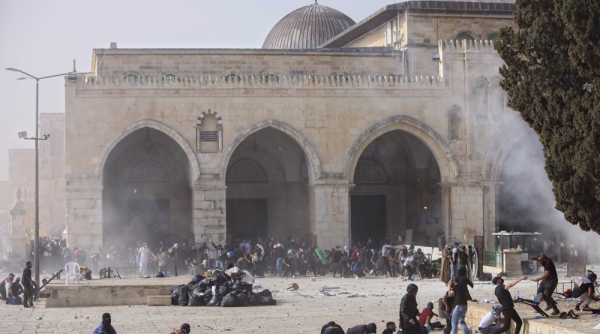
The Palestinian resistance movement Hamas has warned that any Israeli attempt to impose division at the al-Aqsa Mosque will have “damaging consequences” for the occupying regime.
In a statement issued on Friday on the 31st anniversary of the Aqsa massacre, which was committed by Israeli forces, the resistance movement strongly warned the Tel Aviv regime of committing any attempt to change the status quo of the al-Aqsa compound, the third holiest site in Islam.
“We restate our commitment to protect and defend the al-Aqsa Mosque on the 31st anniversary of the Al-Aqsa massacre perpetrated by the Israeli occupation, motivated by Israeli settler groups who thought the Al-Aqsa compound was an easy prey and that the chance had come up to lay the foundation stone for their alleged temple,” Hamas stated.
On October 8, 1990, thousands of Israeli settlers marched on the al-Aqsa Mosque to place the foundation stone of their alleged third temple inside the mosque.
The provocative move infuriated Palestinians who were present at the mosque and those who were outside, prompting them to bar settlers from achieving their goal.
During the ensued clashes, Israeli forces opened fire indiscriminately at Muslim worshipers in the mosque, killing 21 people, injuring hundreds of others, while obstructing the movement of ambulances.
Other reports said the fanatic settlers, while receiving full protection from Israeli soldiers, also participated in the massacre with their machine guns and gas bombs, as helicopters provided air cover. The appalling event is known as the Al-Aqsa Massacre or the Black Monday.
“Attempts to impose temporal and spatial division at the al-Aqsa compound will have damaging consequences for the Israeli occupation,” the statement further read.
Hardline Israeli legislators and extremist settlers regularly storm the al-Aqsa Mosque compound in the occupied city, a provocative move that infuriates Palestinians. Such mass settler break-ins almost always take place at the behest of Tel Aviv-backed temple groups and under the auspices of the Israeli police in al-Quds.
The al-Aqsa Mosque compound, which sits just above the Western Wall plaza, houses both the Dome of the Rock and the al-Aqsa Mosque.
The Jewish visitation of al-Aqsa is permitted, but according to an agreement signed between Israel and the Jordanian government in the wake of Israel’s occupation of East Jerusalem al-Quds in 1967, non-Muslim worship at the compound is prohibited.
“As Israeli settler organizations are trying to make history repeat itself by desecrating the sanctity of the al-Aqsa Mosque under the protection of the Israeli occupation regime, we reiterate that the Palestinian citizens of the West Bank, Jerusalem, and the Palestinian territories occupied in 1948 are ready to defend the al-Aqsa complex and that Israeli measures provoked by a hateful ideology against holy sites will backfire,” Hamas said on Friday.
In conclusion, the resistance movement urged all “the Arab and Muslim nations to raise their voices in support of the al-Aqsa Mosque and use Friday sermons as a platform for calling for liberating the al-Aqsa and renounce normalization” of relations between Tel Aviv and some Arab countries, including the United Arab Emirates (UAE) and Bahrain.
“The al-Aqsa Mosque belongs to all Muslims by right; every Muslim has a duty to defend it and protect its sanctity,” Hamas stressed.
Palestinians want the occupied West Bank as part of their future independent state with East al-Quds as its capital.
President Raeisi: Everyone knows US backed, planned Daesh growth in Afghanistan
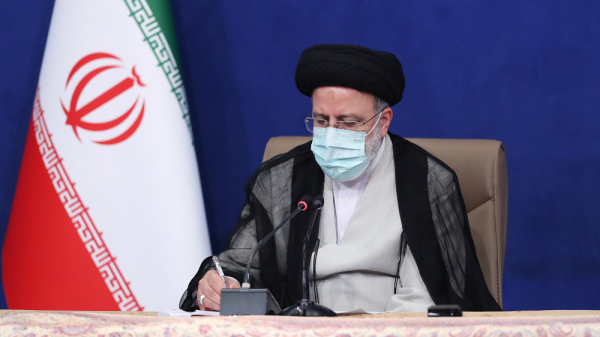
Iran’s President Ebrahim Raeisi has voiced concerns about the persistence of terrorist acts in neighboring Afghanistan, saying it is no secret that the growth of the Daesh terrorist group, which claimed responsibility for the latest terrorist act in Afghanistan, was a US job.
In a message released on Saturday, Raeisi condoled with the Afghan nation and the entire human society over the killing and injuring of a large number of innocent Afghans while they were praying in a sacred place.
“It is no secret to anyone that the growth of this Takfiri terrorist movement has taken place with the supports and plans of the US,” he said. “In recent years, the United States has facilitated further activities of Daesh criminals in Afghanistan and prevented their eradication.”
The statement came after an attack against Friday prayers at a Shia mosque in the northern Afghan city of Kunduz killed dozens of people.
The attack, claimed by Daesh, targeted the packed mosque, in an apparent attempt to stir conflict between Shias and Afghanistan’s Sunni majority.
The Unity Week, designated by the late founder of the Islamic Republic, Imam Khomeini, is commemorated among Muslims every year as a show of unity between the world’s Shias and Sunnis. According to the Sunni narrative, the birth date of the Prophet of Islam (PBUH) falls on the 12th of Rabi' al-Awwal while the Shias consider the 17th of Rabi' al-Awwal as the exact birth date. The week in between is celebrated and commemorated among Muslims as the “Unity Week.”
The Iranian president said the recent terrorist act in Afghanistan is aimed at sowing discord among Muslims and is committed by those whose “inhumane and anti-religion nature is obvious to everyone.”
“I hereby express my concern over the continuation of terrorist acts and coupling acts of religious sedition with ethnic provocation, which is part of the new US security project for Afghanistan, and stress that the Islamic Republic of Iran, as in the past, is ready to provide full support to our Afghan brothers and sisters, and we hope that with the vigilance of Afghan groups and the formation of an inclusive government, a large part of this plot will be thwarted and, God willing, the Afghan people will be able to experience peace,” he added.
Daesh has maintained a foothold in eastern and northern Afghanistan following the United States’ hasty withdrawal from the country, which led to the collapse of the Afghan government in mid-August.
The terrorist group has claimed responsibility for several attacks against the Taliban recently. It has also targeted Shias in Syria and Iraq in the past.
Controlling almost the entire Afghanistan, the Taliban have vowed to eradicate Daesh.