zarezadeh
Israel fumes as UK bars its officials from London arms fair amid Gaza genocide

The British government has barred Israeli authorities from attending a major London arms fair in September amid the ongoing campaign of genocide in the besieged Gaza Strip.
“We can confirm that no Israeli government delegation will be invited to attend DSEI UK 2025,” the British Ministry of Defense said in a statement on Friday.
“The Israeli government’s decision to further escalate its military operation in Gaza is wrong,” the statement read.
“There must be a diplomatic solution to end this war now, with an immediate ceasefire, the return of the captives and a surge in humanitarian aid to the people of Gaza.”
The DSEI arms fair, running from September 9-12, traditionally hosts senior delegations alongside private arms contractors.
Israeli arms companies will still be permitted to take part in the event, but without an official regime presence or pavilion.
In a show of defiance, Israel’s ministry of military affairs said it would withdraw from the exhibition entirely.
Accordingly, the Israeli ministry will withdraw from the exhibition and will not establish a pavilion.
Israeli media reported that Britain had said the ban could be reversed if Israel committed to “upholding international law in the occupied Palestinian territories."
A recent report found that British firms have continued to export military items to Israel despite a government partial suspension in September 2024.
The decision follows London’s suspension of some weapons export licenses to Israel, the freezing of free trade negotiations, and sanctions imposed on two far-right Israeli ministers over the assault on Gaza.
European Union foreign ministers are set to discuss further sanctions against Israel at a meeting in Copenhagen on Saturday, with Sweden and the Netherlands leading calls for tougher action.
British Prime Minister Keir Starmer has pledged to recognize a Palestinian state in September if Israel refuses to agree to a truce and take concrete steps towards ending its occupation.
In May, France, another key ally of the Tel Aviv regime, barred Israeli arms manufacturers from displaying “offensive weapons” at the Paris Air Show.
Also in May, Spain was reportedly spearheading a coordinated initiative aimed at persuading the European Union to eliminate Israel from all continental sports competitions.
Calls to exclude Israel from international sports events have indeed increased recently due to its relentless aggression against Gaza.
More than 62,600 Palestinians, mostly women and children, have been killed by Israel in its nearly two-year aggression on Gaza and at least 157,600 have been wounded, according to the health ministry of Gaza.
Press TV’s website
Five more Palestinians including children, die of starvation amid Israel's aid blockade
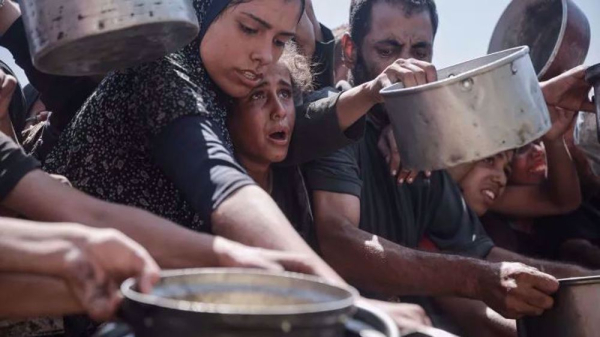
The Gaza Health Ministry has announced that five more Palestinians, including children, have died of starvation due to Israel’s blockade of the strip.
On Friday, the ministry reported five deaths “due to famine and malnutrition” in the past 24 hours, including two children.
The latest casualties bring the total number of hunger-related deaths in the strip to 322, including 121 children.
This follows the official declaration of famine in Gaza by the Integrated Food Security Phase Classification (IPC) – the UN-backed global hunger monitor – which has so far not led to any significant increase in aid to the territory.
Amjad Shawa, the director of the Palestinian Non-Governmental Organizations Network (PNGO), said, “There’s no improvement of the Gaza famine case, no real effort that we could see on the ground to deal with this famine situation.”
“We were expecting that there would be real interventions, pressure from the international community to lift the blockade,” he told the Qatar-based al-Jazeera.
Shawa added that the amount of aid allowed into Gaza was still “very limited " and covered only approximately 10 percent of the population’s needs.
The realities of the Jeddah meeting
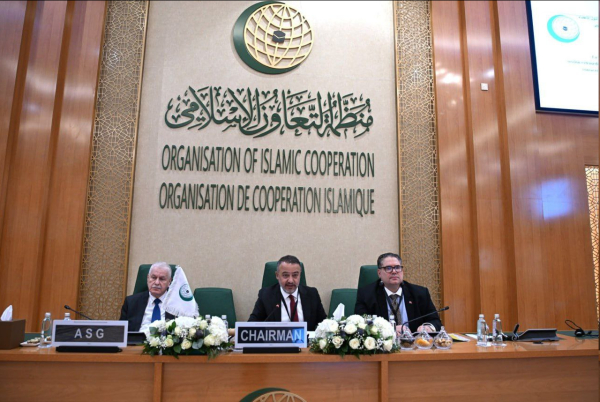
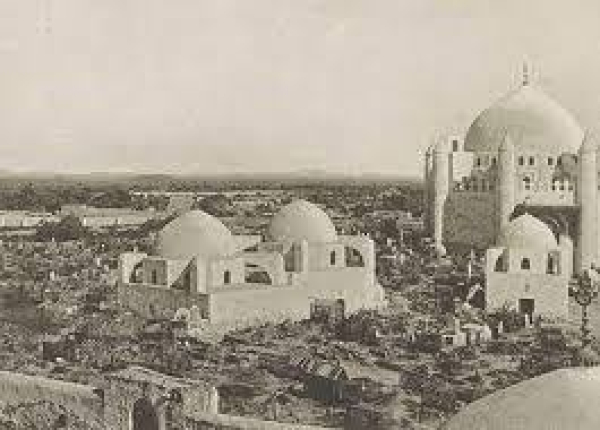
The Jeddah meeting is the result of the Islamic and Arab countries’ sense of danger from Israel: The possibility of forming joint military and security mechanisms among the regional governments
Reza Mirabian, an expert on regional issues, referring to the capacity of the Organization of Islamic Cooperation meeting in Jeddah to address the Gaza crisis, said in an interview with ILNA: The difference between this meeting and previous meetings is that the countries of the region (especially Saudi Arabia, Egypt, Jordan, and even Turkey) feel the danger of Israel much closer than before. For example, if you look closely at the recent visit of Egyptian President Abdel Fattah al-Sisi to Saudi Arabia and his meeting with Mohammed bin Salman, the country’s crown prince, you will see that this trip was made in this direction; because today the flame of Israeli expansionism and the Gaza issue directly threatens the countries of the region. Even the attack that targeted the Islamic Republic of Iran is a warning that shows that this fire can spread to others at any moment.
Netanyahu’s recent statements have also added to these concerns by emphasizing his ideological belief in the creation of a “Greater Israel.” As a result, the current OIC summit is significantly different from the past, in that the countries of the region now see the possibility of danger closer than ever and seem to be taking more serious action this time. For example, Abdel Fattah al-Sisi has explicitly stated that Egypt will not accept the transfer of Gazans to the Sinai Desert under any circumstances, and his previous visit to Saudi Arabia can also be interpreted in this context. He continued: “On the other hand, developments in the political discourse of the region are also evident. For example, the recent interview with CNN by Turki al-Faisal, the former head of Saudi intelligence, was an important point against Israel. He declared that I have done my time; if I don’t say these things now, then when should I say them?” These words are very meaningful from someone whose father, King Faisal, played a role in the wars of 1967 and 1973 and was eventually assassinated by foreign agents, specifically the Israelis. This change in language shows that the countries of the region today feel the fire of the Israeli and American conspiracy much closer than in the past. For this reason, it seems that the results of this summit could go beyond simply issuing a statement. Although its media part will probably be limited to the same usual statements, the decisions behind the scenes could lead to practical and serious actions. An example is Egypt, whose army is on full alert, because it considers the transfer of Gaza residents to the Sinai Desert a direct threat to its national security; a threat that could cause serious problems given the presence of Salafi and Takfiri groups in Sinai. The political analyst clarified: Saudi Arabia is also under direct threat. In his “Greater Israel” plan, Netanyahu claims that part of this territory should include areas in Saudi Arabia; areas that have historical and religious significance, such as Medina and Islamic sanctuaries. Naturally, such claims have aroused Riyadh’s sensitivity. Therefore, even if they are not explicitly stated in official statements, we can expect that more serious measures are being formed behind the scenes. The reality of the matter is that today the countries of the region have reached a decision point. The continuation of Israel’s expansionism endangers the existence and security of all of them. The key question is whether these countries will move towards the formation of a collective security pact or not? There are signs of this possibility. Al-Sisi’s urgent and very important trip to Saudi Arabia is one of these signs. On the other hand, given the mood and atmosphere prevailing in the Egyptian army, such a move does not seem very unlikely.
He concluded by saying: "In the current situation, the countries in the region have realized that Iran acts as a barrier and obstacle against Israel. If it were not for the Iranian resistance, perhaps today it would be the turn of Saudi Arabia, Egypt, Jordan or Turkey. For this reason, unlike in the past when some Arab countries had their backs to America and Israel, they now see Iran at the forefront of the confrontation with Israel and are aware of its role. Overall, the consolidation of these interactions can be considered a serious change in the equations of the region. Although it may not bring tangible results in the short term, in the long term this process can be assessed as positive and forward-looking. The possibility of the formation of joint security mechanisms between the countries of the region, even at the military level, no longer seems unlikely. These developments are a sign that Arab and Islamic countries feel the danger of Israel closer to them than ever before and for this reason they are forced to move towards measures beyond issuing a statement."
Twin Israeli airstrikes on Gaza hospitals kill 20, including 4 journalists
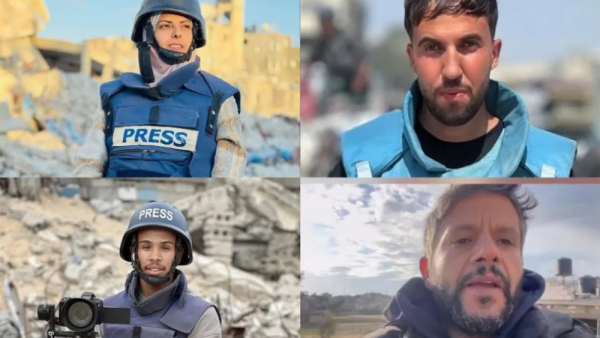
The Israeli military has killed at least 20 people, including four journalists serving international outlets, during back-to-back strikes against an overstretched hospital in the southern Gaza Strip.
On Monday, the regime carried out an airstrike against the Nasser Hospital in the city of Khan Yunis before backing it up with another raid, when civil defense and ambulance teams had scrambled to the site to help out the victims.
Various outlets, including resistance media channels, identified four of the fatalities as cameraman Hussam al-Masri, a contractor for the Reuters news agency, Mohammad Salama of the Al Jazeera television network, Mariam Abu Daqa, who used to report for The Independent Arabia and the Associated Press, and Moaz Abu Taha of the NBC.
Photographer Hatem Khaled, al-Masri’s fellow Reuters contractor, was also wounded in the attacks.
‘Systematic targeting’
Gaza’s government media office said the deaths had brought to 244 the number of journalists that had perished as a result of Israeli bloodletting throughout the coastal sliver since October 2023, when the regime started bringing the Palestinian territory under a wholesale war of genocide.
The office condemned the “systematic targeting of Palestinian journalists,” holding the regime as well as its main allies – the United States, the UK, Germany, and France – responsible.
It also called for international action to protect journalists in the war-battered territory.
The assassination spree followed hot on the heels of the regime’s targeted killing strikes against Al Jazeera’s media team in Gaza City, which claimed the lives of five media personnel, including heroic and celebrated journalist Anas al-Sharif.
Right up to his untimely demise, Sharif would provide the world with rare insights into the Israeli- and Western-created Palestinian plight through years-long untiring, and death-defying struggle.
Still reporting on the Monday strikes, Gaza’s civil defense apparatus announced that firefighter Imad Abdel Hakim al-Shaer was also among the fatalities of the attacks that also wounded seven other members of the apparatus’s Khan Younis chapter.
The massacre evoked reactions from international figures such as Francesca Albanese, an outspoken United Nations rapporteur, who has faced United States sanctions for her vociferous criticism of the regime.
“Scenes like this unfold every moment in Gaza, often unseen, largely undocumented. I beg STATES: How much more must be witnessed before you act to stop this carnage?” she asked in a post on X.
She advised the international community to break the regime’s near-total blockade of Gaza and slap it with an arms embargo and sanctions, while denouncing rescuers being “killed in line of duty.”
Gaza’s health ministry has, meanwhile, reported numerous injuries.
The genocide has so far claimed the lives of around 62,600 Palestinians, mostly women and children. In addition to incessant military attacks, it has been deploying starvation as a weapon of war towards what observers call maximizing suffering and casualties.
Press TV’s website
‘Brutal war crime’: Iran condemns Israel’s deadly bombing of Gaza hospital
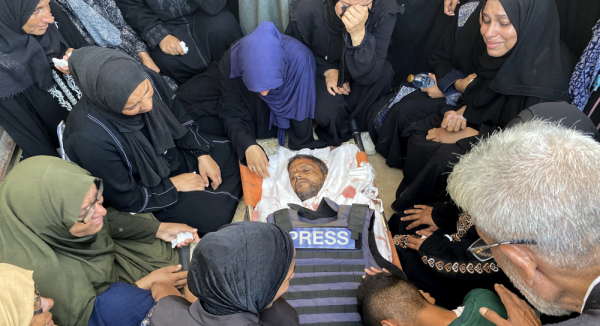
The Iranian Foreign Ministry spokesman has strongly condemned Israel’s recent heinous crime in the Gaza Strip, where the regime bombed the only operating hospital in the territory’s south and killed at least 20 Palestinians.
Esmaeil Baghaei made the remarks on Monday, hours after the Israeli military conducted double-tap strikes on the Nasser Medical Complex in the city of Khan Yunis. The victims included five journalists, along with patients, health workers, and emergency responders who had rushed to the scene after the initial strike.
Referring to the heavy death toll from Israel’s “savage bombing” of the hospital, Baghaei said the Zionist regime committed the “brutal war crime” as part of its genocide plan and with the intent of erasing Palestine as a nation and identity.
He also described as “shameful” the continued inaction of international organizations and self-proclaimed rights advocates regarding Israel’s gross violations of human rights and humanitarian law in the besieged Gaza and the occupied West Bank.
The spokesman said all governments bear legal and moral responsibility for “stopping the genocide and punishing the Nazi and racist Zionist criminals."
“The military and political supporters of the occupying regime, especially the United States, must be held accountable before the international community as accomplices and partners in the heinous crimes committed against the Palestinian people," he added.
The Palestinian Presidency condemned the attack as “a new war crime,” saying it adds to a long series of crimes and massacres committed by the Israeli occupation to silence the Palestinian media and the voice of truth.
Imam Riza:Personality and Characteristics
Generally speaking, an Emam enjoys a unique personality and distinctive characteristics, in as far as Shi'a followers of the Emams are concerned; therefore, he is not permitted to do what others are, such as falling into error, or getting confused about a matter. Rather, infallibility is essential in him since he conveys on behalf of the Prophet (S.A.W.) what seems to others to be obscure of the Message and its intricacies. Just as we proved the infallibility of the Prophet (S.A.W.), we, by the same token, prove infallibility for the Emam as well with one exception: the Emam conveys on behalf of the Prophet (S.A.W.), whereas the Prophet conveys on behalf of the Almighty God. The wisdom in this argument is that should falling into error be accepted and expected from the Prophet (S.A.W.) or the Emam, then doubt will result regarding the reliability of what they convey to people of jurisdic rules and regulations and other such matters since they are liable to err in their judgement or get confused about a particular issue. Although the believers are not held accountable for doing what they are not supposed to be doing due to such error of judgement, the assumption of the error of judgement itself collides with the very wisdom behind the reason why prophets were sent to people at all which is to clarify to people, according to the way God Almighty intended them to, without any error or confusion, what His Will is.
The topic of infallibility is a vast one the discussion of which has no room here and which requires a dedicated research I may be able one day to tackle. What I have to same fa here is that Emamate is characterized by certain distinctive aspects such as infallibility which we cannot discuss by itself with others except after both parties agree on the basis from which it emerged; otherwise, our case would be like one who discusses the necessity of performing the ritual prayers (salat) with someone who does not believe in the message of the Prophet (S.A.W.).
The basic point upon which we have first and foremost to agree is the definition of general Emamate, then the distinctions it requires and, finally, the proofs which testify to these distinctions. It is only then that disagreeing parties can conduct a reasonable discussion. Having been convinced by unequivocal proofs of such infallibility, and having seen the Twelve Emams (A.S.) to be fully qualified to be the only ones in whom such infallibility could be observed, we became fully convinced of their unshakable superiority over all others, and that they were the ones adorned with absolute human perfection.
An Emam, according to this viewpoint, has got to be the most learned among people and the most aware of the general needs of people such as knowledge or other necessities of life, and that he has to be the most pious, the most ascetic, the most perfect in personal conduct and norms of behaviour. In other words, in order to be qualified for Emamate, one has to be superior to everyone else in all aspects of perfection and its requirements which all raise him to his position of leadership. On this basis, the character of Emam al-Rida (A.S.), who is one of these Twelve Emams, becomes clearly distinctive due to its merits. But this is not the limit of the scope of this research; rather, we shall attempt to research his personality and the qualities which distinguished him from all others by our sifting into the legacy history has preserved for us of his conduct while still alive, and from the stances taken by the men of knowledge and by contemporary caliphs towards him.
Imam Riza and his children
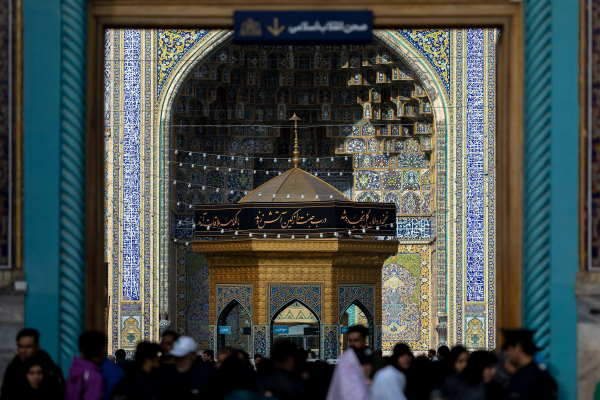
Disputes exist also regarding the number of his offspring and their names. A group of scholars say that they were five sons and one daughter, and that they were: Muhammad al-Qani', al-Hassan, Ja'fer, Ibrahim, al-Husayn, and 'Ayesha.
Sabt ibn al-Jawzi, in his work Tadhkiratul-Khawass, says that the sons were only four, dropping the name of Husayn from the list. Al-Mufid inclines to believe that the Emam did not have any son other than Emam Muhammad al-Jawad (A.S.), and Ibn Shahr Ashoob emphatically states so, and so does al-Tibrisi in his A'lam al-Wara. Al-'Udad al-Qawiyya states that he had two sons, Muhammad and Mousa, and that he did not have any other offspring. In his claim, he is supported by Qurb al-Asnad in which the author says that al-Bazanti asked al-Rida, "For years I have been asking you who your successor is and you keep telling me that it is your son even when you had no son at all, but since God has now blessed you with two sons, which one of them is he?" 'Uyoon Akhbar al-Rida indicates that he had a daughter named Fatima.
We are not in the process of investigating, researching and pinpointing with accuracy the number of his offspring and their names, but what seems to be more reasonable is what al-Mufid states. What is established as a fact with us is that Emam Muhammad al-Jawad (A.S.) was his son; as regarding his other sons, nobody seems to be able to prove any facts regarding them, and God knows best.
Imam Riza and his mother
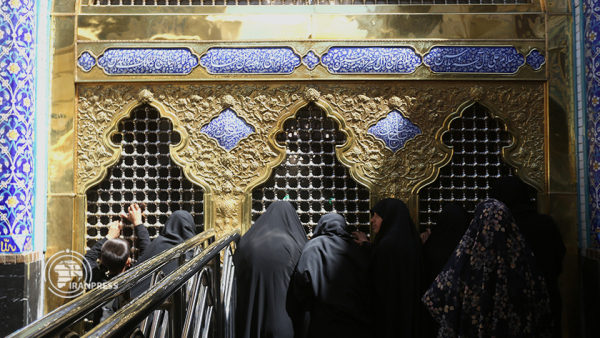
There is a great deal of dispute regarding the name of his mother. Some say she was called al-Khayzaran; others say she was Arwi and that her nickname was "the blonde of Nubia," while others say she was Najma and her nickname was "Ummul-Baneen." Others say she was called Sekan the Nubian; still others say she was called Takattam as may be proven from the poetry in his praise which said:
The best in self and parenthood,
In offspring and in ancestry,
Is Ali al-Muaddam,
Eighth in series of the knowledgeable
and the clement,
An Emam descending from the Proof of God,
that is Takattam.
Imam Riza, Birth and Demise
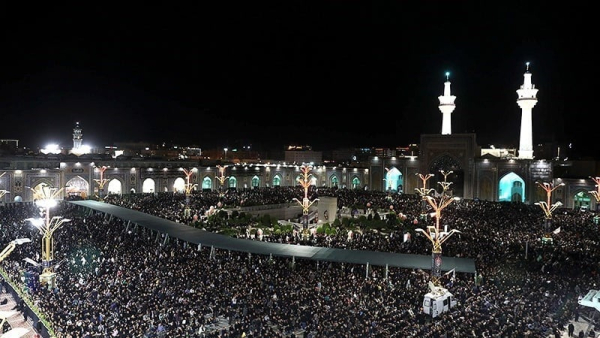
Historians disagree a great deal about the year of his birth and even in determining the month as well, and they also disagree about determining the year and the month of his death. Their disagreements are not confined to the limit of a short span of time but they may be five years apart, and the disagreement is so confusing that it is very difficult to determine clearly such matters; however, we shall point out the statements recorded in this regard without favouring any of them due to the lack of purpose of such favouring which naturally requires research and investigation and a proof for selecting what seems to be the most accurate.
He was born in Medina on Friday, or Thursday, Dhul-Hijja 11, or Dhul-Qi'da, or Rabi'ul-Awwal, of the Hijri year 148 or the year 153. He died on Friday, or Monday, near the end of the month of Safar, or the 17th of Safar, or Ramadan 21, or Jumada I 18, or Dhul-Qi'da 23, or the end of Dhul-Qi'da, of the year 202 or 203 or 206. In his 'Uyoon Akhbar al-Rida, al-Saduq states: "What is accurate is that he died on the 13th of Ramadan, on a Friday, in the year 203."
What is most likely is that his death took place in the year 203 as stated by al-Saduq. It is the same year in which al-Mamoon marched towards Iraq. To say that he died in 206 is not to agree with the truth because al-Mamoon marched towards Baghdad in the year 204, and the Emam died while he was heading in the same direction.
30th Safar Martyrdom Anniversary of Imam Reza
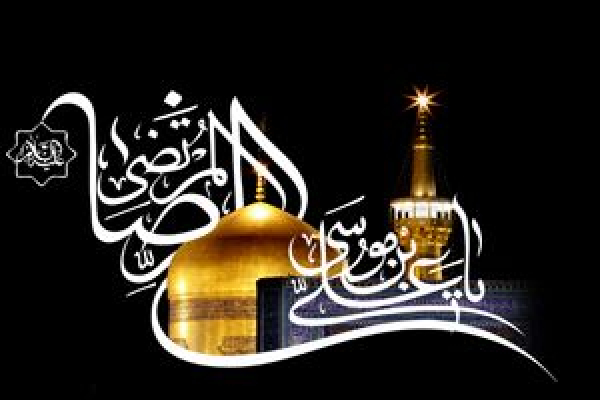
On the Sad and Mourning occasion of the martyrdom anniversary of Holy Prophet of Islam Hadrat Muhammad Mustafa (S.A.W.), Imam Hasan Mujtaba(A.S.) and Imam Reza(A.S.) we extend our Heartfelt Grief and Condolences to the Millions Muslims and all the lovers of the Holy Ahlul Bayt(A.S.) in the world.
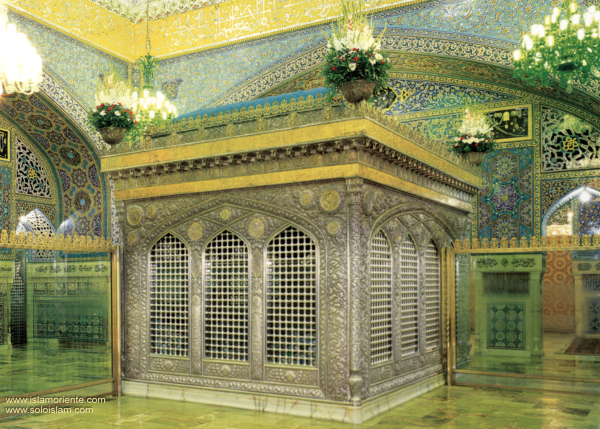
He is Ali son of Mousa son of Ja'fer son of Muhammad son of Ali son of al-Husayn son of Ali son of Abu Talib (A.S.), eighth in the series of the Emams belonging to the Ahl al-Bayt (A.S.). His birthplace is Medina, and his resting place is Toos (Iran).