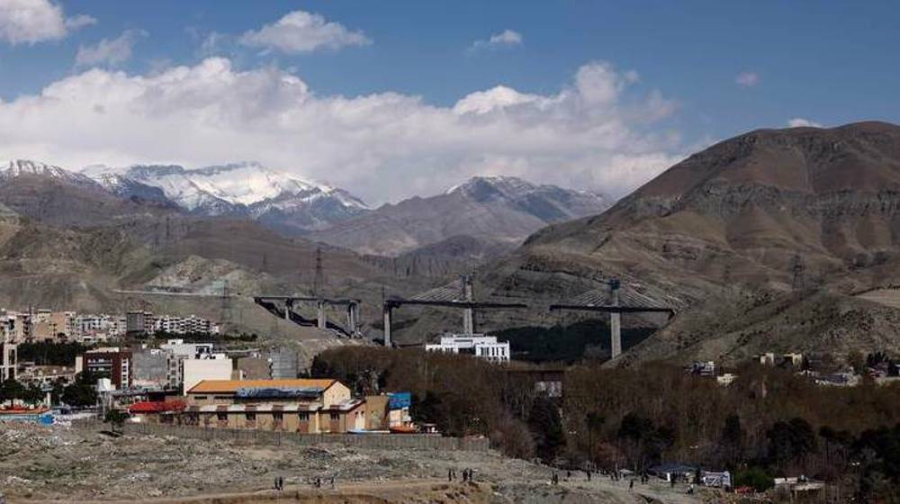
In a shocking act of aggression, the US launched an airstrike that destroyed the B1 Bridge in Karaj, a monumental feat of engineering that stood as a testament to Iran's self-reliance and technological prowess.
The attack, which occurred on April 2 in two separate bombings, was a deliberate strike aimed at undermining Iran's national pride and progress.
This cowardly act of terrorism, targeting a purely civilian project, exposes the hypocrisy of global powers that claim to uphold peace and development while committing acts of violence against nations working to build a better future for their people.
The B1 Bridge, a remarkable achievement in Iranian engineering, was a part of the ongoing development of the Northern Karaj Freeway, a project that began in 2017.
Stretching 1,050 meters in length and standing at a height of 130 meters, the overpass had already become an iconic symbol of Iran’s growing capabilities in the field of civil engineering.
The bridge, located on the Beylaqan River, was to be the tallest in West Asia, an engineering marvel built entirely by Iranian specialists.
Unlike many large-scale projects that rely on foreign expertise, the construction was the product of homegrown talent and innovation, designed, financed, and built without a single foreign consultant.
The bridge, alongside the rest of the Northern Karaj Freeway, was a response to the severe traffic congestion on Tehran-Karaj highways, an issue that had been a burden on millions of commuters and residents.
The project, expected to be completed by May, was a vital part of Iran's infrastructure strategy, intended to reduce traffic by 40% on the Tehran-Karaj route, significantly improving daily commute times and economic efficiency for the 14 western provinces.
It was a long-awaited solution to a pressing national problem, offering both economic benefits and environmental advantages by reducing fuel consumption and air pollution.
However, this triumph of Iranian engineering and determination was met with barbaric opposition. On the afternoon of March 30, two US fighter jets targeted the bridge in a brutal airstrike that shattered the central portion of the structure.
The attack occurred during the celebration of Sizdah Bedar, an Iranian national holiday that marks the end of the Nowruz or Persian New Year festivities.
Innocent civilians, many of them families enjoying the holiday near the bridge, were killed or wounded. In total, 13 people were martyred, and over 90 others were injured in the deliberate act of terror.
The United States, in a statement, claimed that the airstrike was aimed at preventing the transfer of military assets. However, this was a blatant falsehood.
The B1 Bridge was a civilian structure, part of a large-scale, non-military infrastructure project. No military assets were being moved through the bridge, and no military installations existed in the vicinity.
Millions of Iranians who have traveled to the north, a popular weekend getaway, know too well that US leaders are lying.
Just like the writer of this article, they can testify that the structure was not yet operational, and they had been eagerly awaiting its completion, hoping it would reduce their travel time.
Before the attack, US President Donald Trump had declared, “We’ll hit some bridges, got a couple of nice bridges in mind.” Later, on his Truth Social platform, he gloated, “The biggest bridge in Iran comes tumbling down, never to be used again—much more to follow!"
The horror of the airstrike, however, must be understood within the broader context of Trump’s "Stone Age" rhetoric. Just days before the bombing, Trump had threatened to send Iran "back to the Stone Age."
But while the attack was undoubtedly a blow to Iran’s infrastructure, it also revealed the unbreakable resolve of the Iranian people.
The destruction of the B1 Bridge will not stop Iran from advancing its capabilities; rather, it will fuel the nation’s determination to continue building.
Just as previous generations rebuilt after war, natural disasters, and foreign intervention, the Iranian people will rise again to rebuild and improve upon what has been lost.
Iran’s history is rich with examples of engineering ingenuity and self-sufficiency.
From the Qanat system, which dates back thousands of years and revolutionized irrigation in Iran’s arid regions, to the Shushtar Hydraulic System, a masterpiece of ancient engineering that is still a UNESCO World Heritage Site today, Iranian engineers have long been at the forefront of innovation.
These historical achievements laid the groundwork for the nation’s modern engineering marvels.
In the contemporary era, Iran has continued to build on this legacy. The country’s rapid industrialization after the 1979 Islamic Revolution has seen the development of some of the most advanced infrastructure projects in the region.
Iran's national railway system, hydroelectric dams, and road networks have significantly boosted the country’s connectivity and energy production, contributing to both its industrial and economic growth.
Iranian engineers, working in some of the most challenging conditions, have managed to execute large-scale projects that rival those of much wealthier and technologically advanced nations.
The B1 Bridge was part of this legacy of innovation, a product of years of technical development and a symbol of Iran’s commitment to self-reliance.
The attack was a deliberate attempt to disrupt Iran’s progress and to hinder the country’s ability to overcome the challenges of urbanization and traffic congestion.
By targeting such a vital project, the US sought to slow Iran’s economic development, but this act of terrorism will have the opposite effect. It will only embolden Iran’s engineers, architects, and builders to work harder and smarter to achieve their goals.
They will rebuild, they will innovate, and they will continue to push the boundaries of what is possible in the realm of civil engineering. The B1 Bridge, like so many other projects before it, will be rebuilt stronger and more resilient than ever.
The attack on infrastructure, alongside Trump’s threat to send Iran back to the "Stone Age," reveals the depth of depravity and moral decay of America's leaders.
The Stone Age does not refer to a return to stone and wood; rather, it is an era where the corrupt Western rulers, with utter cruelty, have slaughtered humanity and become accustomed to child-killing, wallowing in it.
The civilized nation of Iran, with faith, patience, and unity, continues its path of prosperity.
Press TV’s website