zarezadeh
Matridiyya Sect
Abu Mansur Matridi of Samarqand (d. 333 AH) in the 4th century
Matridiyya: Adoption of the name of the founder of the sect
• Credibility for evidence
• Preference for reason over narration
Matridiyya generally relies on arguments that other theologians also refer to in order to prove God and discuss monotheism, such as the proof of creation, the proof of necessity and possibility, and the proof of order. One interesting argument that Matridi objects to is the proof of evil. He uses this argument, which is usually used to deny God, to prove the existence of a Creator: “If the world had come into being by itself, everything would have brought into being the best and most virtuous qualities and states for itself, and in that case there would be no evil and ugliness, and the existence of these is evidence that the world did not come into being by itself, but rather came into being by a means other than itself.”
Matridiyya believe in moderate determinism, which is a middle ground between the Ash’ari and Mu’tazilite views. According to the Matridians, man has a kind of agency and his voluntary action is carried out with power and freedom. Unlike the Ash'arites, the Matridians believe that the act and the object are different, and that the act of man is different from the act of God, and that there is no creation and structure unlike the act of God. For example, they believe that sitting and standing are human actions, but the creation of them is the act of God, that is, the principle of sitting and standing is the creation of God, but sitting and standing are human actions; but in fact, sitting and standing are human actions. An action that a person achieves. The Matridians believe that if a person does not intend to do a good or bad action, God does not create the power to do that action in him. The criterion and standard of reward and punishment, according to the Matridians, is not the action itself, but the intention and intention of the action on the part of the person; the intention to do a good and virtuous action is rewarded, and the evil intention and intention of sin are punished because: "Indeed, the action is from the intention."
Unlike the Ash'arites, the Maturidis believe that God does not obligate someone who does not have the power and ability to do something, and demanding something from someone who cannot do it is contrary to God's justice and wisdom.
Islamic theologians agree that God has attributes such as knowledge, power, and life. The Mu'tazilites and the Imamites believe that the essential attributes of the Lord of the universe are His essence, and God is in a state of perfection and beauty, whose essence is complete in knowledge and power. The Ash'arites consider these attributes to be additional to the essence and believe that the attributes of the essence are eternal and the attributes of the act are possible, while the Maturidis accept the objectivity of the essence and attributes, and in the issue of God's attributes, they consider both the attributes of the essence to be in line with the essence, and the attributes of the essence to be in line with the essence, and the attributes of the essence to be in line with the essence. Imamites and the Mu'tazilites. Regarding the rational possibility of God punishing obedient and righteous servants, the Ash'arites accept the rational possibility that God is capable of any action, but at the same time, considering the evidence of the narrations in this regard, they believe that this is not possible from a religious perspective (and God does not punish a righteous servant in the Hereafter without reason). The Matridis believe in rational good and evil, that is, they accept the judgment of reason about whether something is worthy of praise and reward or worthy of blame and punishment, and they believe that through the judgment of reason, the divine judgment can also be discovered. This means that there is no confirmation from reason and reason is essentially the discoverer of a real truth. Accordingly, and according to the judgment of reason, God is just and it is impossible for Him to be unjust and oppressive, just as it is not permissible for Him to punish the obedient. And thus, God does not punish obedient servants either from a religious or a rational perspective.
Waqfiyyah Sect
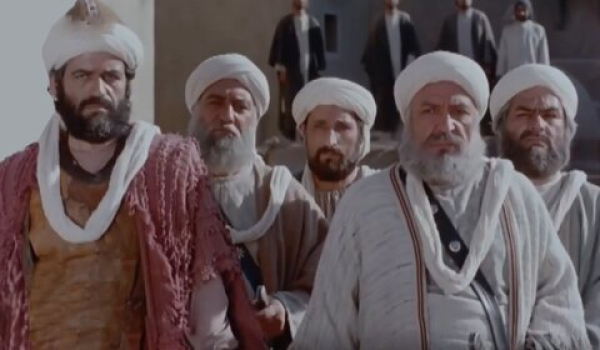
Waqfiyyah Sect
This sect is one of the deviant tendencies in Islam.
Founders: Ali ibn Abi Hamzah al-Bataiyni (d. 200 AH), Ziyad ibn Marwan al-Qandi, and Uthman ibn Isa al-Rawasi (d. 203 AH)
183 AH in Iraq and Medina
Waqfiyyah means stopping the Imamate of Imam Musa al-Kazim (a.s). The elders of this sect denied the Imamate of Imam Reza (a.s) because they had a large amount of religious money in trust and did not want to give this money to Imam Reza (a.s), so they said that Imam Musa (a.s) is alive and will reappear.
Their belief:
The end of the Imamate with Musa al-Kazim
The Mahdism and Occultation of Musa al-Kazim
Moral and mystical instructions
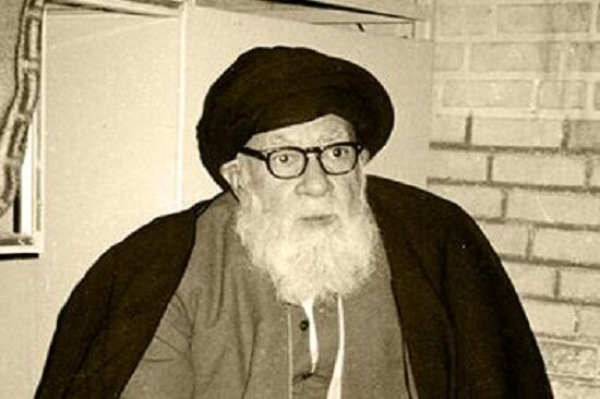
The son of Ayatollah Seyyed Reza Baha' al-Din says: When young people asked their father for guidance, he would emphasize not lying and would say to abandon forbidden things and be active in obligatory things.
Simplicity in life
He lived a simple life and lived for 50 years in a house that did not have the slightest facilities, but with this simplicity, whenever a guest came and people came to visit him, he would welcome them with open arms.
He had a small charcoal samovar, and when a guest came, he would sit by the samovar himself and pour tea for the guest, no matter who it was, and if they had any questions, he would answer them with an open arm.
The remembrance of blessings for the dead is very special. Sometimes I say Salawat to Ahlul-Bayt and I saw strange effects. I dreamed that a person was suffering from several types of torment. I gave him some blessings. I saw him again in my dream, and Alhamdulillah, the blessings saved him. Someone said: My mother died a few years ago, one night I saw her in a dream, she said: My son! Nothing makes my soul happy like salawat; the best gift you can give me is this remembrance.
What was the reason for the King of Jordan's anxiety about Trump?

Trump's narcissistic personality is the most fundamental element and component of his decision-making. For this reason, various countries and actors today are trying in various ways to both protect themselves from him and to take it into account in opposing Trump and gaining his approval to a large extent.
According to Khabar Online, Khorasan Newspaper wrote: Putin has also found Trump's sleeping vein, and his words about American policies are usually focused on praising Trump.
The press conference with the King of Jordan a few days ago is another indication of this claim. Although Abdullah II emphasized his country's position of "definitely" opposing the displacement of Palestinians both before and after the trip, he appeared somewhat flustered in front of the cameras in this press conference and did not openly oppose Trump's plan, and was concerned about taking a clear position that would anger Trump in front of the cameras.
The reason is that Trump's unpredictability is truly frightening to many, and this is what makes some behave so cautiously, lest they, for example, show disrespect to Trump in front of the camera or adopt a passive reaction and position that would be very costly for a country like Jordan. For this reason, it seems that the King of Jordan has preferred not to show any direct opposition to Trump himself, lest the bully host become passive in front of the world and be forced to take a tough stance that would later be impossible to reverse.
This double caution made Abdullah II appear weak, agitated, and distraught; to the point that Trump answered some of the media's questions about his guest.
It should not be forgotten that in this "distress", the King of Jordan's rhetoric was, in a way, that the most Jordan would accept was to accept 2,000 Palestinian children with cancer and injuries for treatment, not to force them to migrate. After the meeting, in several posts on X Network in English and Arabic, he again expressed his country's "strong opposition" to the displacement of Palestinians, and his prime minister and foreign minister also took a strong stance.
interrupting Tawaf due to impurity
What is the duty of a pilgrim in interrupting Tawaf due to impurity of the body or clothes?
Answer:
If the impurity occurs after the fourth round, he should purify himself and perform Tawaf from there. If the impurity occurs before the fourth round, he should complete Tawaf after purifying himself and repeat it later.
Where is the Mataf during the crowded time?
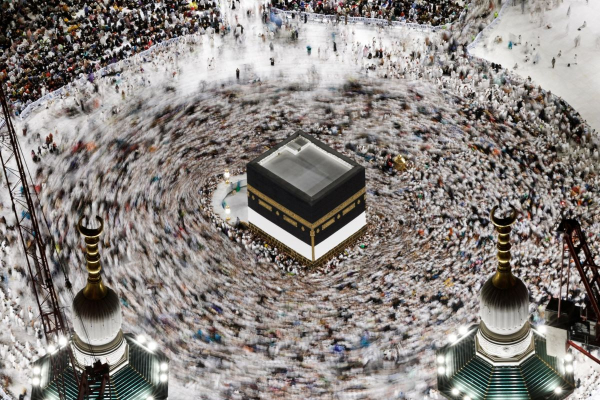
During the obligatory Hajj, the number of pilgrims is large and it is difficult to circumambulate the Kaaba. Is it possible to circumambulate from a distance further away or from behind the Maqam of Prophet Ibrahim?
A:
The Tawaf must be between the Maqam of Ibrahim and the Kaaba, but in case of hardship or hardship, outside it is also not a problem.
Can God be seen?

Brief answer
According to the judgment of reason and the law of God Almighty, - neither in this world nor in the Hereafter - it cannot be seen with the eye of the head, but it can be seen with the eye of the heart. Hearts perceive and understand Him to the extent of their existential capacity, through inner intuition, after the inner purity and purification of the soul through the purification of the soul and the purity of the soul through the blessings of religious worship and austerities.
Detailed answer
If what is meant by seeing is seeing outwardly and with the eyes, then God cannot be seen, both according to the judgment of reason and according to the statement of the law.
However, according to the judgment of reason; the operation of seeing and seeing takes place through the encounter of an external object with the eye and the light vibrations of sending and reflecting light waves; that is, first: it must be an external object; second: the encounter and alignment of the external object with the eye; Therefore, our eyes do not see the objects behind the head, while God is neither a body nor has the characteristics and characteristics of a body (such as facing); therefore, He will never be seen with the eyes of the head.
However, according to the Sharia: The Quran and the narrations clearly consider it impossible to see God.
a) The Quran:
He said: “You will never see me”;[1] O Moses, you will never be able to see me.
“La tadrakah al-absara”;[2] The eyes do not see Him.
b) The narrations: “And He withheld Himself from the eye of the All-Seeing”;[3] meaning, God never appears before the eyes of the All-Seeing.
“Lama tarka al-a’yun”;[4] The eyes have not seen You.
“Lat takrah al-a’yun bi-mashhadah al-a’yun”;[5] The eyes will never see Him clearly.
But if what is meant by seeing is inner seeing and knowledge, knowledge and witnessing the names and attributes of God Almighty, then of course, it is inner seeing to the extent of the capacity, aptitude and ability of humans. As Ali (AS) said: “But the understanding of the hearts”;[6] hearts and minds understand Him.
And in another hadith, Imam Ali (AS) said to Dhul-Abb: And O you, the eyes do not see Him, but the hearts do see Him.[7]
[1]. Al-A’raf, 143.
[2]. An’am, 103.
[3]. Sayyid Razi, Muhammad ibn Husayn, Nahjul-Balagha, Mohaqiq, Subhi Salih, p. 87, Qom, Hijrat, first edition, 1414 AH.
[4]. Ibid., p. 158.
[5]. Ibid., p. 258.
[6]. Ibid., p. 258.
[7]. Kulayni, Muhammad ibn Yaqub, Kafi, researcher, corrector, Ghaffari, Ali Akbar, Akhundi, Muhammad, vol. 1, p. 138, Tehran, Dar al-Kutub al-Islamiyya, fourth edition, 1407 AH.
God is self-sufficient, so why has He commanded us to worship Him?

Answer:
The Quran says: “O people! You are all in need of God. God alone is self-sufficient and worthy of all praise and adoration.”(1)
Therefore, God is absolutely self-sufficient and all His creatures are in need of Him. He is the One who fulfills all the needs of His creatures.
God does not need our worship, rather we need His worship so that we may attain eternal blessings through His service. The Quran says: “Whoever disbelieves and abandons Hajj, has indeed harmed his own soul. God is self-sufficient.”(2)
In another verse, He said: “Whoever strives and strives, strives for his own soul; for God is self-sufficient.” (3)
In another place, He says: “Whoever does a good deed, does it for his own good, and whoever does an evil deed, does it for his own harm. Then to your Lord you will all return.”(4)
In another verse, He says: “Whoever chooses purity, it is for his own good.”(5)
As a result, man develops in the light of good deeds and flies to the heaven of nearness to God and reaches eternal happiness. And he falls due to crime and sin and is caught in eternal misery.
Worship of God is doing any act that brings man close to God and keeps him away from evil.
Obviously, worship of God is not limited to prayer. Sincere service to people, helping people and helping the weak and needy, politeness and respect, restraining the hands, tongue and ears, etc. are all acts of worship. Doing any act that is recommended in the verses and narrations is worship.
God made prayer obligatory so that man, by remembering God, would abandon the desires of Satan and would come out of immorality and evil (7); therefore, its benefit is for man himself. For this reason, all divine prophets and heavenly books have called man to prayer. What was said was only a brief reference to the individual philosophy of prayer, and prayer and other acts of worship have profound wisdom from various social, cultural, political, and other aspects.
Prayer practically brings about solidarity among Muslims and a sense of one spirit among them; because they all pray for the same problem and towards the same Qiblah, and this will have valuable consequences.
On the other hand, we reach perfection by performing acts of worship, but it should be known that: the relationship between perfection and worship is not a situational and conventional relationship; rather, it is an essential and evolutionary relationship. Just as a cold body heats up due to the proximity of hot bodies, man also moves towards perfection in the light of connection and intimacy with absolute perfection.
Here, it is necessary to state a few introductions:
1. There is no absolute perfection other than God.
2. Perfection cannot be achieved except in the shadow of a relationship with absolute perfection.
3. Relationship with absolute perfection has its own specific ways, the best of which God has expressed in the form of acts of worship.
As a result, it becomes clear that by other than these ways, achieving perfection will be nothing more than a dream and an illusion.
In the Islamic perspective, all divine commands are in accordance with the interests and corruptions of the self-commanding self; that is, if, for example, the command to pray is given with specific details and conditions, it is all for the sake of the real interests in which the action is hidden and man is in dire need of it on the path to perfection and eternal happiness and without it he will be at a disadvantage. Of course, in some cases there are alternative solutions, but these cases are also specified in the divine religion, not by using one's own reason.
Furthermore, worship and relationship with God have two sides:
1. God, who is worshipped and is the object of praise and prayer.
2. A worshipper and a prayerful person.
Also, the most basic thing that a person needs on the path of worship and finding the path to God are two things:
Theology; that is, first, he must have a relatively correct knowledge of Him and know who he is facing.
Pathology; that is, he must know how he can establish a relationship with Him and what is the best, closest, most accepted, and safest path to Him?
Now the question arises: does God - who is absolute knowledge - know Himself and the best path for man to Himself better? Or does man, who has not yet properly known not only God, but even himself? So if He knows better and has placed the best path before man based on that and commanded him to follow it, what sound and solid logic would allow us to reject it and go to another path!
In short, the way of life - in all aspects, even in the worship of God - requires correct rules and laws, and violating them will only lead to going astray, decline, and destruction. There is no rule or law that can guide a person to his perfection except the law of God: (And who is better than God in judgment for a people who are certain) (8) because He is the Creator of all beings and the world of existence, and He Himself knows best what He has created and, based on the purposefulness of the world of creation (according to His wisdom), in which direction and in what manner it should go and follow the path and conduct. Therefore, turning away from the divine law - which is conveyed by the prophets - and turning to any rule or law other than God is considered the "approach of ignorance" (9).
Footnotes:
1. Fatir (35), verse 15.
2. Al-Imran (3), verse 97
3. Ankabut (28), verse 6.
4. Fajr (89), verses 27-30.
5. Dhariyat (51), verse 56.
6. Mu'minun, verse 2.
7. Ankabut (29), verse 45.
8. Al-Ma'idah (5), verse 50.
9. Ibid.
Evidence for the Quran's immunity from distortion from the Shiite perspective
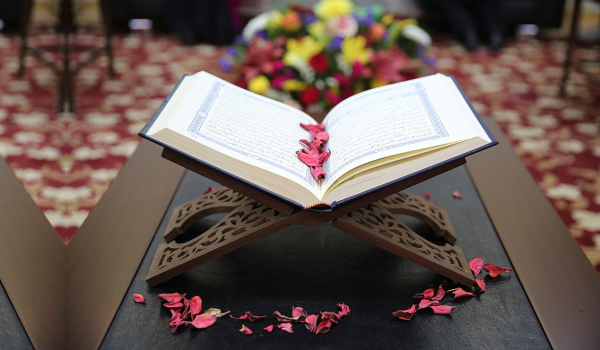
Do Shiites believe that the Quran of Muhammad (peace be upon him) has been distorted? How can it be proven that the Quran has not been distorted?
The Shiite claim that the Quran has been distorted is completely baseless because the Shiites consider the Quran to be a complete divine book, immune to any change or distortion, and have complete trust in it.
Answer:
Short answer:
The Shiite claim that the Quran has been distorted is completely baseless and contradicts the Quranic, narrational, and rational evidence, and the views of the great Shiite scholars. The Shiites consider the Quran to be a complete divine book, immune to any change or distortion, and have complete trust in it. Such a belief is not only rooted in Shiite religious teachings, but is also consistent with Muslim consensus and the divine promise to preserve the Quran. Therefore, it is necessary for every fair-minded Muslim to avoid repeating this baseless suspicion and strengthen the unity of the Islamic Ummah on the basis of the Holy Quran.
Detailed Answer
For a long time, one of the suspicions that some opponents of the Shiite religion have raised is the claim that the Shiites believe in the distortion of the Holy Quran. This claim is made contrary to the fundamental teachings of the Shiites and the statements of the great scholars of this religion and is often the result of misunderstanding or selective narrations. The Imamiyya Shiites, as one of the largest Islamic sects, have always considered the Holy Quran to be a preserved divine book, immune to any change or distortion, and have presented solid evidence to prove this. This article attempts to show, using Quranic, narrational, and rational evidence and the views of Shiite scholars, that the Shiites do not believe in the distortion of the Quran and that the Quran that we now have in our hands is the same Quran that was revealed to the Prophet without any addition or omission.
Evidence for the Quran's immunity from distortion
The evidence for the Quran's immunity from distortion falls into two basic categories: rational and narrative evidence.
Rational Evidence
A. The Necessity of the Completeness of the Proof and the Immunity of the Quran from Distortion
Communicating divine commands and completing the proof are among the duties of the prophets, which the Quran also emphasizes, and the heavenly books complete the proof for people by conveying divine commands and prohibitions. The Quran, due to its universality and eternity and the finality of the Prophet (peace and blessings of Allaah be upon him and his family), must remain unchanged throughout all ages. The possibility of the Quran being distorted would undermine its authenticity and guidance, and by deleting part of the divine message, the Quran would no longer be a complete proof. In this case, the finality of the Prophet (peace and blessings of Allaah be upon him and his family) would be questioned, and a new prophet and book would be needed, which contradicts the principle of finality. Therefore, demonstrative reason dictates that the Quran’s immunity from any distortion is a prerequisite for its completion of the proof and guidance, along with the finality of the Prophet (peace and blessings of Allaah be upon him and his family).(1)
B. The Miracle of the Quran is Associated with the Incorruptibility of the Quran
The miracle of the Quran is proven by its consistency and is accepted by Muslims. Reason dictates that the miracle of the Quran is associated with its lack of distortion; because if distortion occurs in abundance, it means that people have been able to produce words identical to the Quran, in a way that is not recognizable. This causes the collapse of the challenge and negation of the miracle of the Quran, which is impossible; because so far no one has been able to produce words identical to the verses of the Quran; therefore, the miracle of the Quran requires its immunity from any distortion.(2)
Traditional evidence
A. The Quran
The strongest traditional evidence for the purity of divine revelation from distortion is the Wise Quran itself; which clearly indicates the Quran’s immunity from distortion, including the verse of preservation(3) which clearly shows that the Quran is protected from distortion and that God will defend it and that no power can change or distort it. Also, the verse of negation of falsehood(4) which considers the Quran to be free from any falsehood, including distortion, and introduces it as being free from any change or transformation; and also the verse of divine observation(5) which negates the possibility of any addition or omission in all stages of the Quran’s perception, memorization, dictation and transmission until the Quran reaches the people in all ages.(6)
B. Tradition
The second reason after the Quran among the narrated reasons for the Quran’s purity from distortion is the tradition; among the narrations that indicate the Quran’s purity from distortion is the Hadith of Al-Thaqalayn; This hadith guarantees the constant companionship of the Quran and the progeny until the Day of Judgment and considers adherence to them as a barrier to misguidance. Since a distorted book cannot be a guide, the immunity of the Quran from distortion until the Day of Judgment is a definite result of this narration. (7) Also, narrations of the presentation of the Quran, narrations of referring to the Quran during seditions, etc. are among the narrations that indicate this issue, and addressing all of them requires another opportunity. For further study in this field, refer to the book: Javadi Amoli, Abdullah, The Purity of the Quran from Tahrif, Qom-Iran, Israa Publishing, p. 101
Conclusion:
The claim that the Shia believe in the distortion of the Quran is not only baseless, but also contrary to the fundamental teachings of this school and the consensus of its scholars. Rational reasons, such as the necessity of the completion of the proof and the association of miracles with the immunity of the Quran, show that the Quran is immune from any distortion due to its universality and eternity. Also, narrations, including verses of the Quran, such as the verse of preservation, the verse of negation of falsehood, and the verse of divine observation, and narrations such as the Hadith of Thaqalain, clearly indicate the integrity of the Quran.
In addition, great Shiite scholars, including Sheikh Saduq, Sheikh Mufid, Sayyid Murtaza, Sheikh Tusi, Allama Tabataba'i, Imam Khomeini, and Ayatollah Khoei, have explicitly rejected any distortion of the Quran and considered it to be contrary to the continuity and authenticity of the Quran. This broad consensus shows that the belief in the immunity of the Quran from any change and distortion is one of the fundamental principles of the Shiite religion.
Footnotes
1. See: Javadi Amoli, Abdullah, The Purity of the Quran from Tahrif, Qom-Iran, Israa Publishing, p. 44
2. Ibid., p. 48
3. Surah Al-Hijr, verse 9
4. Surah Al-Fussilat, verses 41 and 42
5. Surah Al-Jinn, verses 26-28
6. See: Javadi Amoli, Abdullah, The Purity of the Quran from Distortion, Qom-Iran, Israa Publishing House, p. 49
7. See: Javadi Amoli, Abdullah, The Purity of the Qur
Shia scholars' views on the distortion of the Quran
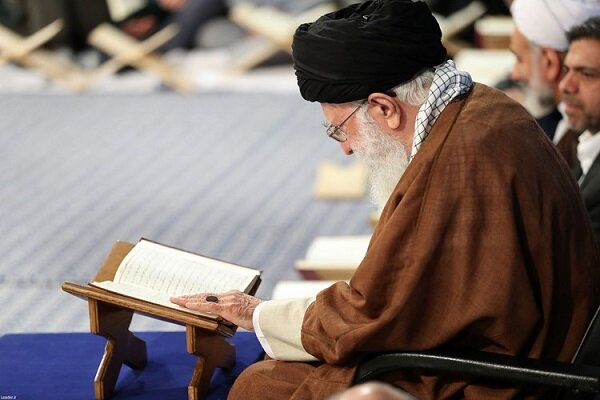
The issue of the absence of distortion of the Quran has reached a point of consensus among Shia and Sunni scholars, and the claim of distortion has been raised only by a small and unreliable minority. Shia elders, including Sheikh Saduq, Sheikh Mufid, Sayyid Murtaza, Sheikh Tusi, and Allama Tabarsi, have explicitly emphasized the authenticity and soundness of the Quran. Sheikh Saduq considers the existing Quran to be complete and without flaws, and Sheikh Mufid has described the narrations indicating distortion as isolated and unreliable news.(1) Sayyid Murtaza has also rejected any claim of distortion, citing the repetition of the Quran and the relentless efforts of Muslims to preserve it.(2) Sheikh Tusi and Allama Tabarsi also emphasize that the correct Imamiyyah doctrine is based on the denial of any change or deficiency in the Quran.(3) Other Shiite scholars such as Allama Hilli, Mohaqiq Ardabili, Kashif Al-Ghita, Mohaqiq Thani, as well as the great men of the time, Hazrat Ustad Allama Tabataba'i, Imam Khomeini (Quds Al-Sirrah), and Ayatollah Khu'i have explicitly rejected the claim of distortion, whether excessive or deficient. The clear views of these scholars throughout the history of Shiism reject any attribution of distortion to the Quran by the Shiites.(4)
1. Mufid, Muhammad ibn Muhammad, Al-Masā’il al-Sarwiyah, Qom-Iran, Al-Al-Mufār al-Alīfah al-Shaykh al-Mufīd, p. 82
2. Quoted from Tabarsi, Fadl ibn Hassan, Majma’ al-Bayān, Beirut-Lebanon, Al-Alamī Institute, 1415 AH, first edition, vol. 1, p. 43
3. Tusi, Muhammad ibn Hassan, Al-Tabyān, Beirut-Lebanon, Dar Ihya’ al-Turat al-Arabī, vol. 1, p. 3; Tabarsi, Fadl ibn Hassan, Majma’ al-Bayān, Beirut-Lebanon, Al-Alamī Institute, 1415 AH, first edition, vol. 1, p. 42
4. See: Javadi Amoli, Abdullah, The Purity of the Quran from Tahrif, Qom-Iran, Isra’ Publishing House, p. 110