zarezadeh
Strange confession of Brzezinski, former National Security Advisor of the United States of America
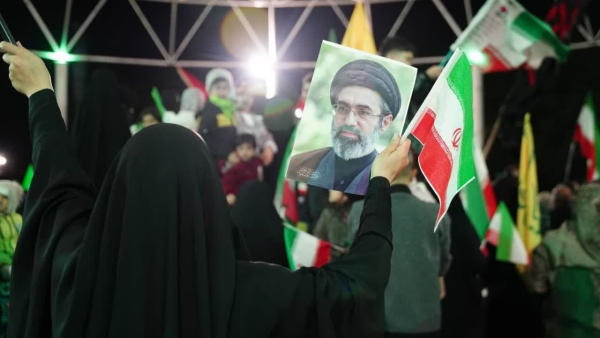
Today, the leaders of the world's superpowers must make an appointment with Iranian officials to protect their security.
As I have repeatedly stated, a country that has been under the most severe pressures and sanctions is now ranked 17th in the world economy despite all these problems.
It has developed nuclear science, is among the vanguard of the world in fundamental cells, and has the fifth largest army and armed forces in the world.
The Middle East is completely under their influence and control, and I firmly believe that this country, with these capacities and indigenous power, will revive the great Iranian Islamic civilization desired by Ayatollah Khomeini in the not too distant future.
British Defense Analyst: US War in Iran Unwinnable
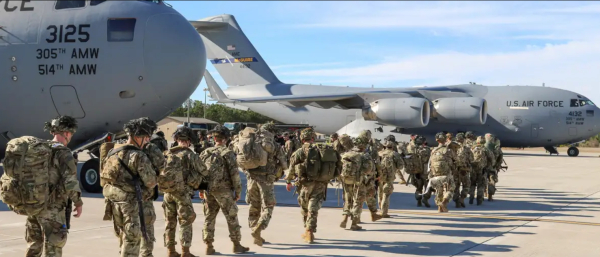
The US will emerge from this war with a massive strategic defeat, failing to change the regime or destroy the nuclear program.
The British military wants absolutely no part in this disaster.
An Israeli Citizen's Opinion on War
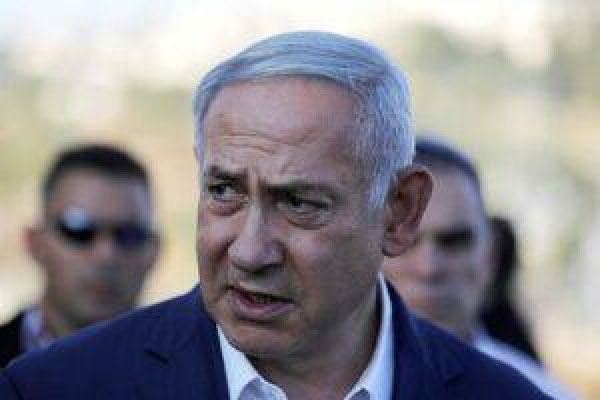
I'm in Israel. I haven't slept for two days. Do you know why? Because our corrupt Prime Minister just wants to stay in power. He just wants to stay Prime Minister and not go to prison. He will even start a world war if necessary.
He doesn't care about Israelis, Israeli women, or even Iranian women
Financial Times: Iran war will leave lasting scars on global economy
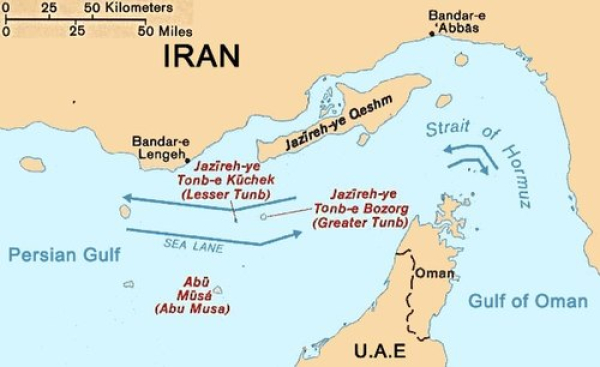
The longer the war drags on, the worse the shortages, price spikes and supply chain disruptions will become.
Even if the war ends sooner than expected, doubts and questions about the security of the waterway will remain.
Iran and its backers could use Hormuz as a weapon again whenever tensions with the US and Israel return.
Trade, shipping and investment in the Gulf will never be the same again.
New York Times: Israel's plan to overthrow the Iranian government has failed
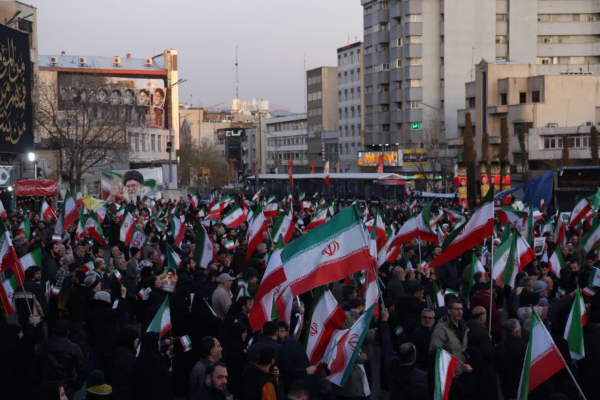
The New York Times reported that the US and Israeli strategy was to ignite a nationwide uprising in Iran and overthrow the government with their attacks, but this strategy has failed.
Informed sources have confirmed that, contrary to the expectations of the planners of these attacks, not only did the predicted wave of popular unrest not occur, but US intelligence officials had serious doubts from the very beginning about the success of this approach.
According to this report, alternative options, including the use of Kurdish forces, have also been removed from the agenda and are no longer being pursued.
Currently, the final assessment of intelligence agencies and analysts of regional issues indicates that the most likely scenario ahead is the survival of the current regime in Iran and its continued political life.
Senate Democratic Leader: Trump is a real idiot
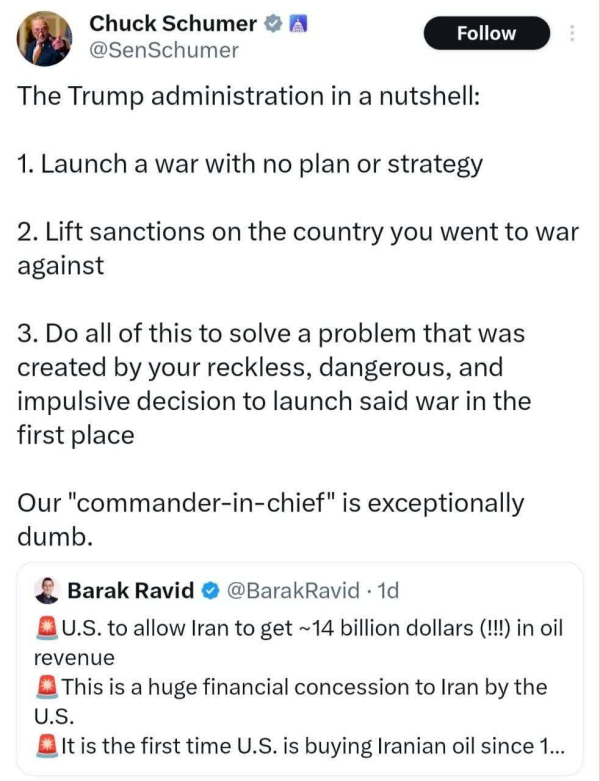
Chuck Schumer wrote on his page:
A summary of the Trump administration's performance:
1. Launching a war without a plan or strategy.
2. Lifting sanctions on the country you are at war with.
3. Doing all of this to solve a problem that was created in the first place by your own reckless and dangerous decision to start that same war.
Our commander-in-chief is exceptionally stupid.
New developments regarding the Strait of Hormuz
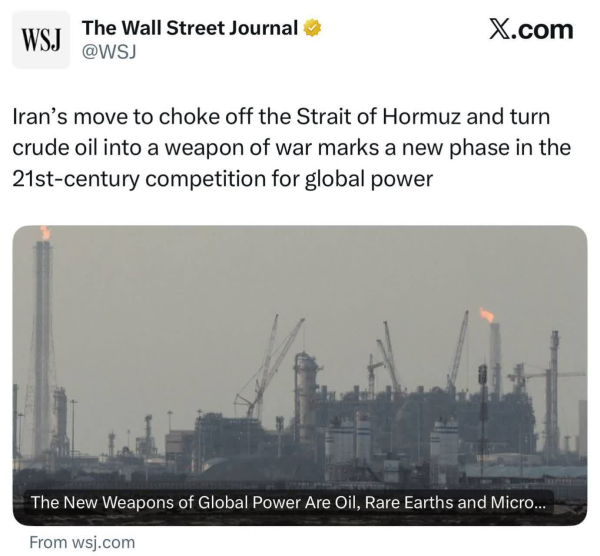
Wall Street Journal: Iran’s move to close the Strait of Hormuz and turn crude oil into a weapon of war marks a new phase in the competition for global power in the 21st century.
Why is the idea of “guaranteeing non-aggression” meaningless?
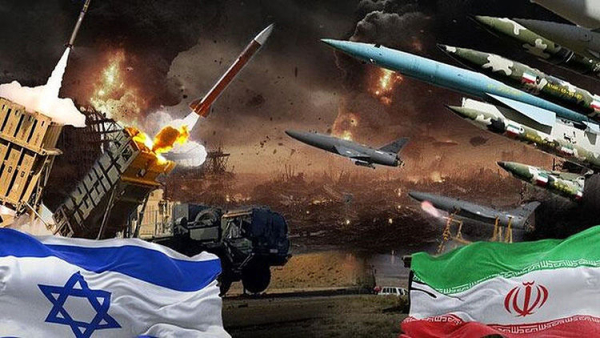
Why is the idea of “guaranteeing non-aggression” meaningless?
In the midst of the direct confrontation between the United States and the Zionist regime with Iran, some political activists have proposed the idea of “obtaining a guarantee of non-aggression.” This idea, more than being a considered strategy, is a reflection of an inaccurate understanding of the logic governing international politics. In the international system, commitments are not based on legal or moral will, but on the balance of power. Any agreement is valid only as long as the balance of power supports it; with a change in this balance, commitments also practically lose their function. Therefore, wars are essentially a means of redefining the balance of power, and it is the victorious side that ultimately determines not only the outcome of the battlefield, but also the rules of order that follow.
Washington and Tel Aviv entered this confrontation with the assumption that the space was fully prepared for the Iranian people to revolt against the government and change the political system. Why, their economic influencers had prepared the ground for public discontent and social revolt by increasing the price of currency and energy, and the disaster of January made the enemy greedy (we will discuss the role of economic influencers in the martyrdom of our beloved leader in detail at the appropriate time). Therefore, they implemented the policy of decapitation and assassination of political and military officials with the aim of creating a vacuum at the top of the government.
However, the exemplary insight of the people and their unprecedented presence in the streets in support of the regime did not allow the nuclei of chaos to become active, and the project was nipped in the bud. The courage and wisdom of the nation's experts in appointing the new Supreme Leader disappointed the enemy on another level.
In the current situation, the United States has neither defined achievable operational goals with clarity, nor does it have a reliable "image of victory," nor an exit strategy that can justify the costs of this conflict. This situation is a sign of disruption at the strategic level of the other side.
In contrast, Iran has managed to shift the logic of the confrontation from the level of direct military conflict to a broader and more complex level; a level in which the costs for the other side increase exponentially and the hardware superiority is not the only determining factor in this war. Iran’s superiority is not unidimensional, but rather the result of the synergy of several key components: social cohesion and the effective presence of the people as a strategic support, the rapid consolidation of the leadership structure and the continuation of the decision-making capacity, the continuation of targeted strikes on the enemy’s vital interests and infrastructure, and the use of energy and global trade bottlenecks as leverage. This shift in the level of play has significantly changed the equation of war.
In such a framework, raising issues such as a “ceasefire” or obtaining “guarantees” before establishing superiority not only lacks real support, but can also lead to a standstill at a point that has not yet led to a lasting change in the balance of power. The experience of the ceasefire after the 12-day war shows that in the absence of imposing decisive costs and a tangible change in the balance, any commitment by the other side will be tactical and temporary in nature and can be quickly violated. Perhaps if Iran had not accepted the ceasefire at the end of the 12-day war and had defined and offensive the battlefront in the same dimensions as it is now, many things would not have happened.
The strategic logic of the current situation requires that Iran’s goals be defined explicitly and at a level that targets the roots of the reproduction of the threat. In this framework, the end of the US military presence in the region can be proposed as a central goal; because the continuation of this presence provides a structural basis for the continuation of insecurity and intervention. The US withdrawal from the region is not simply a political demand, but a prerequisite for the formation of a new order in the Middle East; an order in which the rules of the game will be written by the new hegemon of the region (i.e. Iran) and its allies.
Accordingly, the main issue is not simply the end of an ongoing conflict, but rather the determination of the shape and rules of the order that follows. Any haste in accepting arrangements that lack support in the balance of power could lead to the reproduction of the threat cycle in the future. In contrast, consolidating superiority and defining strategic goals at a structural level will allow the formation of a more stable order based on the new realities of power.
Seyyed Yasser Jabraili
Report: US F-35 among 20 aircraft hit by Iran, pilot injured
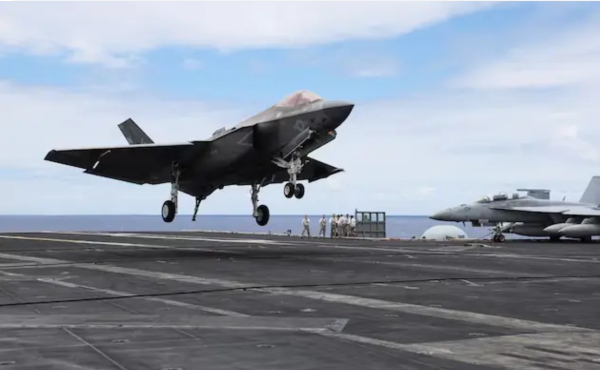
Details have emerged on a US Air Force F-35A that was severely damaged by a surface-to-air missile over Iran on March 19, marking it as one of approximately 20 US aircraft known to have been damaged or destroyed in the nearly three-week-old war.
Air & Space Forces Magazine, the official journal of US Air Force, cited sources familiar with the incident as saying that the aircraft was most likely damaged by a surface-to-air missile, given the altitude at which the F-35 typically operates.
Although US Central Command (CENTCOM) has not provided further details, the incident is reportedly under investigation by military officials.
Iran has developed air defense systems that can use passive infrared sensors rather than radar to target aircraft, a solution that previously proved effective in Yemen when employed by Ansarullah, which downed around half a dozen MQ-9 Reapers during Operation Rough Rider last year.
The F-35 reportedly made an emergency landing at an airbase in the region, and the pilot was injured by shrapnel. CENTCOM reportedly declined to comment further when asked about the incident on March 22.
On the same day, Iran’s Islamic Revolution Guards Corps (IRGC) posted a video showing an F-35 being targeted and struck by an Iranian air defense system.
The IRGC said to have “severely damaged” the F-35. Iran's air defense systems, which use passive infrared sensors to target aircraft, have proved effective in previous engagements, such as when downing multiple MQ-9 Reaper drones.
The F-35, designed to evade radar detection, remains vulnerable to infrared targeting, which homing systems use to track heat signatures.
The incident marks one of about 20 US Air Force aircraft that have been damaged or destroyed during the ongoing terrorist war on Iran, which began nearly three weeks ago.
On March 2, three F-15E Strike Eagles were shot down over the Persian Gulf. A KC-135 Stratotanker also crashed in western Iraq on March 12, killing all six crew members aboard, while another KC-135 sustained severe tail damage but was able to land.
President Donald Trump later acknowledged that at least one KC-135 had been damaged during Iranian attacks on Saudi Arabia.
Additionally, about a dozen MQ-9 Reaper drones have been lost in the war, some of which were damaged on the ground by Iranian forces. These losses have not been publicly disclosed.
Press TV’s website
Iran warns US: Do not call your retreat an agreement
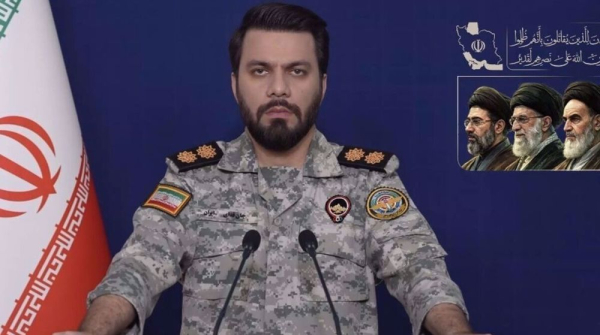
Spokesman for the Khatam al-Anbiya Central Headquarters Lieutenant-Colonel Ebrahim Zolfaqari
Spokesman for the Khatam al-Anbiya Central Headquarters, Lieutenant Colonel Ebrahim Zolfaqari, says the strategic power that the enemy boasted about has “turned into a strategic defeat.”
“If the self-proclaimed superpower of the world could have escaped this predicament, it would have done so by now. Do not call your defeat an agreement,” he said on Wednesday.
This comes as US President Donald Trump backed away from his 48-hour ultimatum to strike Iran’s power plants after the Islamic Republic warned that all energy and power installations in the region would be targeted in retaliation.
Trump claimed in a post on his Truth Social media platform that the US and Iran have had “very good and constructive conversations over the past two days regarding a complete and total resolution of our hostilities in [West Asia].”
A source familiar with internal discussions in Tehran said Monday that there has been no official contact between Tehran and Washington.
“The era of your promises is over. Today, there are only two fronts in the world: truth and falsehood. And every freedom-seeking pursuer of truth will not be deceived by your media waves,” Zolfaqari said.