zarezadeh
Precise Stages of Human Embryonic Development

Qur’anic Verse (Arabic):
﴿ثُمَّ خَلَقْنَا النُّطْفَةَ عَلَقَةً فَخَلَقْنَا الْعَلَقَةَ مُضْغَةً﴾
(Surah Al-Mu’minun, 23:14)
English Translation:
“Then We made the sperm-drop into a clinging form, and We made the clinging form into a lump.”
Scientific Significance:
The Qur’an accurately outlines the sequential stages of embryonic development, describing forms that closely match modern embryological findings. The term ‘alaqah’ reflects the embryo’s clinging nature to the uterine wall, while ‘mudghah’ resembles a chewed-like structure. These precise descriptions appeared over a thousand years before modern microscopes, strongly suggesting divine origin.
The Invisible Barrier Between Seas

Qur’anic Verse (Arabic):
﴿مَرَجَ الْبَحْرَيْنِ يَلْتَقِيَانِ بَيْنَهُمَا بَرْزَخٌ لَّا يَبْغِيَانِ﴾
(Surah Ar-Rahman, 55:19–20)
English Translation:
“He released the two seas, meeting side by side; between them is a barrier they do not transgress.”
Scientific Significance:
Ocean science confirms that bodies of water with different salinity, temperature, and density can meet while maintaining a distinct boundary known as a halocline. This invisible barrier prevents complete mixing. The Qur’an’s mention of such a phenomenon reflects precise natural observation that was scientifically verified centuries later, highlighting its extraordinary descriptive accuracy.
Layered Darkness in the Deep Oceans

Qur’anic Verse (Arabic):
﴿أَوْ كَظُلُمَاتٍ فِي بَحْرٍ لُّجِّيٍّ... ظُلُمَاتٌ بَعْضُهَا فَوْقَ بَعْضٍ﴾
(Surah An-Nur, 24:40)
English Translation:
“Or like darknesses within a deep sea, covered by waves, upon which are waves, over which are clouds—darknesses, some of them upon others.”
Scientific Significance:
Modern oceanography has shown that deep seas contain multiple layers of darkness caused by light absorption, internal waves, and surface conditions. Human beings were unable to explore such depths until the invention of submarines. The Qur’an’s detailed depiction of layered darkness in deep oceans is scientifically accurate and considered a powerful example of knowledge beyond human reach at the time.
The Continuous Expansion of the Universe

Qur’anic Verse (Arabic):
﴿وَالسَّمَاءَ بَنَيْنَاهَا بِأَيْدٍ وَإِنَّا لَمُوسِعُونَ﴾
(Surah Adh-Dhariyat, 51:47)
English Translation:
“And the heaven We constructed with strength, and indeed, We are expanding it.”
Scientific Significance:
This verse explicitly states that the universe is expanding, a fact scientifically confirmed in the 20th century by Edwin Hubble. The use of the active participle “lamūsiʿūn” implies an ongoing process, not a completed action. This linguistic precision is astonishing, as the concept of an expanding universe was unknown until modern astronomy, reinforcing the Qur’an’s claim of divine knowledge.
The Origin of the Universe from a Single Entity

Qur’anic Verse (Arabic):
﴿أَوَلَمْ يَرَ الَّذِينَ كَفَرُوا أَنَّ السَّمَاوَاتِ وَالْأَرْضَ كَانَتَا رَتْقًا فَفَتَقْنَاهُمَا﴾
(Surah Al-Anbiya, 21:30)
English Translation:
“Have those who disbelieved not considered that the heavens and the earth were once a joined entity, and We separated them?”
Scientific Significance:
This verse remarkably aligns with the modern Big Bang theory, which states that the universe originated from a single, extremely dense point before expanding. At the time of the Qur’an’s revelation, the idea of a unified cosmic origin was unimaginable. The verse’s precise wording suggests separation after unity, a concept that strongly resonates with contemporary cosmology and is considered by many scholars as a sign of Qur’anic scientific insight.
Imam al-Baqir (AS): A Model of Ethics, Worship, and Social Responsibility

The life of Imam al-Baqir (AS) was not limited to teaching knowledge; rather, he was a complete practical model of Islamic ethics. Humility in dealing with people, patience in the face of hardships, and special care for the poor and needy were among his most prominent moral traits. Through sincere worship and a deep connection with God, Imam al-Baqir (AS) taught Muslims that knowledge, ethics, and devotion must coexist and that believers bear a responsibility toward the well-being of society.
Narration:
«أَشَدُّ العِبادَةِ التَّواضُعُ»
“The greatest and most demanding form of worship is humility.”
This narration perfectly reflects the moral spirit and practical conduct of Imam al-Baqir (AS).
Imam al-Baqir (AS) and the Explanation of the Concept of Imamate

One of the main missions of Imam al-Baqir (AS) was to clarify the true concept of Imamate within the Muslim community. At a time when ruling powers claimed to be the rightful successors of the Prophet (PBUH), Imam al-Baqir (AS) demonstrated—through Qur’anic and traditional reasoning—that Imamate is a divine position based on spiritual, intellectual, and moral qualifications. He defined the role of the Imam as the intellectual and spiritual guide of society and raised public awareness about the deviations present in the leadership of his time.
Narration:
«الإِمامُ واحِدُ دَهرِهِ، لا يُدانِيهِ أَحَدٌ»
“The Imam is the unique one of his era; no one can be compared to him.”
This narration clearly highlights the exclusive and divinely appointed status of the Imam in guiding the community.
Imam al-Baqir (AS) as the Pioneer of the Scientific Movement in the Islamic World

Imam Muhammad al-Baqir (AS) lived during a critical period in Islamic history. Due to the political oppression of the Umayyad rule and the aftermath of the tragedy of Karbala, many authentic Islamic teachings were neglected or distorted. Taking advantage of the limited opportunities available, Imam al-Baqir (AS) devoted himself to spreading religious knowledge and educating numerous students, thereby laying the foundations of a broad scientific and intellectual movement. He systematically explained various fields such as Qur’anic exegesis, jurisprudence, Hadith, and ethics, paving the way for the establishment of the scholarly school of the Ahl al-Bayt (AS).
Narration:
«تَعَلَّمُوا العِلمَ، فَإِنَّ تَعَلُّمَهُ حَسَنٌ، وَطَلَبَهُ عِبادَةٌ»
“Seek knowledge, for learning it is good, and pursuing knowledge is an act of worship.”
This narration reflects the central role of knowledge in Imam al-Baqir’s (AS) vision and explains the foundation of his scientific movement.
Birth of Imam Muhammad al-Baqir (AS)
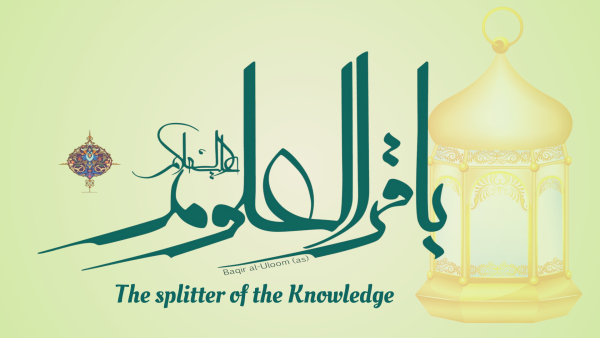
Imam Muhammad al-Baqir (AS), the fifth Imam of the Shiites, was born on the first day of the month of Rajab in the year 57 AH in the city of Medina.
Lineage and Family
His noble father was Imam Zayn al-Abidin (AS), and his mother was Fatimah, daughter of Imam Hasan al-Mujtaba (AS). Therefore, Imam al-Baqir (AS) is descended from Imam Husayn (AS) through his father and from Imam Hasan (AS) through his mother. He is the first Imam whose lineage connects to Lady Fatimah al-Zahra (SA) from both sides.
Meaning of the Title “Al-Baqir”
The honored title “Al-Baqir” means “the one who splits open knowledge.” This title reflects his unique role in expanding and explaining Islamic sciences. During a period that allowed greater opportunity for teaching, he clearly explained the Qur’an, Islamic jurisprudence, and the teachings of the Ahl al-Bayt, laying strong scholarly foundations for Shiite thought.
Historical Context of His Birth
Imam al-Baqir (AS) was born during a time when the Muslim community, following the tragedy of Karbala, was facing severe political oppression and intellectual deviation. Nevertheless, his birth marked the beginning of a new era for reviving authentic Islamic knowledge and understanding.
The Blessings of His Birth
The birth of Imam al-Baqir (AS) initiated a great scientific and intellectual movement that later reached its peak during the time of his son, Imam Ja‘far al-Sadiq (AS). A significant portion of Shiite jurisprudential and theological teachings today is the result of Imam al-Baqir’s scholarly efforts.
May the birth of this noble Imam be blessed upon all lovers of the Ahl al-Bayt (AS).
The Role of Differences in Understanding in the Formation of Islamic Schools

One of the most important factors in the formation of Islamic schools of thought is differences in understanding and interpreting religious texts. These differences do not arise from disagreement over the essence of Islam, but rather from variations in scholarly capacity, methodological approaches to interpretation (ijtihād), and historical and cultural contexts during the early centuries of Islam.
1. Differences in Understanding as a Natural Phenomenon
The Qur’an and the Sunnah contain:
General and specific expressions
Absolute and qualified rulings
Concise and detailed statements
Understanding these nuances depends on the scholarly abilities of jurists and scholars. Therefore, diversity in interpretation is natural and unavoidable.
2. Differences in Methodological Approaches
In interpreting religious texts:
Some scholars emphasized the literal meaning of the texts
Others gave greater weight to rational analysis and the objectives of Islamic law (maqāṣid al-sharīʿah)
These methodological differences led to the development of distinct legal schools.
3. The Influence of Time and Place
Living in different regions (such as Madinah, Kufa, and Syria):
Produced different legal and social challenges
Shaped scholars’ interpretations of religious rulings
As a result, legal opinions evolved in response to specific historical and geographical contexts.
4. Differences as a Source of Enrichment, Not Division
In Islamic thought:
Differences in understanding secondary issues are considered a source of mercy and flexibility
As long as they remain within the framework of the Qur’an and the Sunnah, they are not condemned
? The Prophet ﷺ is reported to have said:
“The differences among my community are a mercy” (reported in meaning).
5. Conclusion
Islamic schools of thought are the product of legitimate diversity in understanding the religion, not evidence of division in Islam itself. Differences in interpretation have contributed to the intellectual richness, adaptability, and enduring vitality of Islamic law.