zarezadeh
martyrdom anniversary of Imam Ali al-Hadi (p)

Imam al-Hadi (peace be upon him), the tenth Imam of the Shia, lived during the Abbasid caliphate under constant pressure and surveillance by the ruling authorities. He spent most of his life in the city of Samarra, where he was forced to reside by the Abbasid caliphs.
Eventually, Imam al-Hadi (PBUH) was martyred on the 3rd of Rajab in the year 254 AH, by poisoning on the order of al-Mu‘tazz al-‘Abbasi. His blessed body was buried in his own house in Samarra, the same place where the holy shrine of Imam al-Hadi and Imam Hasan al-Askari (peace be upon them) stands today.
His martyrdom is a symbol of the oppression faced by the Ahl al-Bayt and their steadfast resistance against injustice and deviation.
Mountains as Stabilizing Structures of the Earth

Qur’anic Verse (Arabic):
﴿وَأَلْقَىٰ فِي الْأَرْضِ رَوَاسِيَ أَن تَمِيدَ بِكُمْ﴾
(Surah An-Nahl, 16:15)
English Translation:
“And He placed firm mountains upon the earth lest it should shake with you.”
Scientific Significance:
Geology has revealed that mountains possess deep roots that stabilize tectonic plates, reducing seismic instability. The Qur’an’s analogy of mountains as stabilizers reflects this scientific reality. Such understanding of Earth’s internal structure was impossible at the time of revelation, making this verse another compelling example of Qur’anic scientific foresight.
Precise Stages of Human Embryonic Development

Qur’anic Verse (Arabic):
﴿ثُمَّ خَلَقْنَا النُّطْفَةَ عَلَقَةً فَخَلَقْنَا الْعَلَقَةَ مُضْغَةً﴾
(Surah Al-Mu’minun, 23:14)
English Translation:
“Then We made the sperm-drop into a clinging form, and We made the clinging form into a lump.”
Scientific Significance:
The Qur’an accurately outlines the sequential stages of embryonic development, describing forms that closely match modern embryological findings. The term ‘alaqah’ reflects the embryo’s clinging nature to the uterine wall, while ‘mudghah’ resembles a chewed-like structure. These precise descriptions appeared over a thousand years before modern microscopes, strongly suggesting divine origin.
The Invisible Barrier Between Seas

Qur’anic Verse (Arabic):
﴿مَرَجَ الْبَحْرَيْنِ يَلْتَقِيَانِ بَيْنَهُمَا بَرْزَخٌ لَّا يَبْغِيَانِ﴾
(Surah Ar-Rahman, 55:19–20)
English Translation:
“He released the two seas, meeting side by side; between them is a barrier they do not transgress.”
Scientific Significance:
Ocean science confirms that bodies of water with different salinity, temperature, and density can meet while maintaining a distinct boundary known as a halocline. This invisible barrier prevents complete mixing. The Qur’an’s mention of such a phenomenon reflects precise natural observation that was scientifically verified centuries later, highlighting its extraordinary descriptive accuracy.
Layered Darkness in the Deep Oceans

Qur’anic Verse (Arabic):
﴿أَوْ كَظُلُمَاتٍ فِي بَحْرٍ لُّجِّيٍّ... ظُلُمَاتٌ بَعْضُهَا فَوْقَ بَعْضٍ﴾
(Surah An-Nur, 24:40)
English Translation:
“Or like darknesses within a deep sea, covered by waves, upon which are waves, over which are clouds—darknesses, some of them upon others.”
Scientific Significance:
Modern oceanography has shown that deep seas contain multiple layers of darkness caused by light absorption, internal waves, and surface conditions. Human beings were unable to explore such depths until the invention of submarines. The Qur’an’s detailed depiction of layered darkness in deep oceans is scientifically accurate and considered a powerful example of knowledge beyond human reach at the time.
The Continuous Expansion of the Universe

Qur’anic Verse (Arabic):
﴿وَالسَّمَاءَ بَنَيْنَاهَا بِأَيْدٍ وَإِنَّا لَمُوسِعُونَ﴾
(Surah Adh-Dhariyat, 51:47)
English Translation:
“And the heaven We constructed with strength, and indeed, We are expanding it.”
Scientific Significance:
This verse explicitly states that the universe is expanding, a fact scientifically confirmed in the 20th century by Edwin Hubble. The use of the active participle “lamūsiʿūn” implies an ongoing process, not a completed action. This linguistic precision is astonishing, as the concept of an expanding universe was unknown until modern astronomy, reinforcing the Qur’an’s claim of divine knowledge.
The Origin of the Universe from a Single Entity

Qur’anic Verse (Arabic):
﴿أَوَلَمْ يَرَ الَّذِينَ كَفَرُوا أَنَّ السَّمَاوَاتِ وَالْأَرْضَ كَانَتَا رَتْقًا فَفَتَقْنَاهُمَا﴾
(Surah Al-Anbiya, 21:30)
English Translation:
“Have those who disbelieved not considered that the heavens and the earth were once a joined entity, and We separated them?”
Scientific Significance:
This verse remarkably aligns with the modern Big Bang theory, which states that the universe originated from a single, extremely dense point before expanding. At the time of the Qur’an’s revelation, the idea of a unified cosmic origin was unimaginable. The verse’s precise wording suggests separation after unity, a concept that strongly resonates with contemporary cosmology and is considered by many scholars as a sign of Qur’anic scientific insight.
Imam al-Baqir (AS): A Model of Ethics, Worship, and Social Responsibility

The life of Imam al-Baqir (AS) was not limited to teaching knowledge; rather, he was a complete practical model of Islamic ethics. Humility in dealing with people, patience in the face of hardships, and special care for the poor and needy were among his most prominent moral traits. Through sincere worship and a deep connection with God, Imam al-Baqir (AS) taught Muslims that knowledge, ethics, and devotion must coexist and that believers bear a responsibility toward the well-being of society.
Narration:
«أَشَدُّ العِبادَةِ التَّواضُعُ»
“The greatest and most demanding form of worship is humility.”
This narration perfectly reflects the moral spirit and practical conduct of Imam al-Baqir (AS).
Imam al-Baqir (AS) and the Explanation of the Concept of Imamate

One of the main missions of Imam al-Baqir (AS) was to clarify the true concept of Imamate within the Muslim community. At a time when ruling powers claimed to be the rightful successors of the Prophet (PBUH), Imam al-Baqir (AS) demonstrated—through Qur’anic and traditional reasoning—that Imamate is a divine position based on spiritual, intellectual, and moral qualifications. He defined the role of the Imam as the intellectual and spiritual guide of society and raised public awareness about the deviations present in the leadership of his time.
Narration:
«الإِمامُ واحِدُ دَهرِهِ، لا يُدانِيهِ أَحَدٌ»
“The Imam is the unique one of his era; no one can be compared to him.”
This narration clearly highlights the exclusive and divinely appointed status of the Imam in guiding the community.
Imam al-Baqir (AS) as the Pioneer of the Scientific Movement in the Islamic World
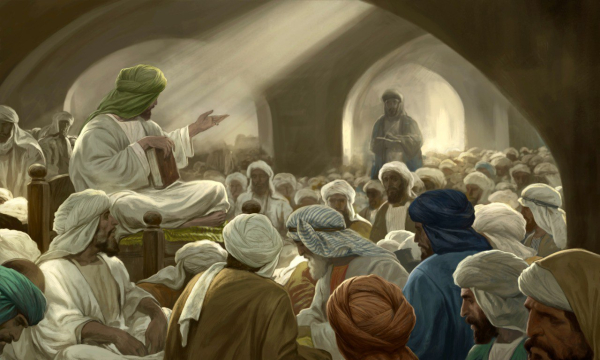
Imam Muhammad al-Baqir (AS) lived during a critical period in Islamic history. Due to the political oppression of the Umayyad rule and the aftermath of the tragedy of Karbala, many authentic Islamic teachings were neglected or distorted. Taking advantage of the limited opportunities available, Imam al-Baqir (AS) devoted himself to spreading religious knowledge and educating numerous students, thereby laying the foundations of a broad scientific and intellectual movement. He systematically explained various fields such as Qur’anic exegesis, jurisprudence, Hadith, and ethics, paving the way for the establishment of the scholarly school of the Ahl al-Bayt (AS).
Narration:
«تَعَلَّمُوا العِلمَ، فَإِنَّ تَعَلُّمَهُ حَسَنٌ، وَطَلَبَهُ عِبادَةٌ»
“Seek knowledge, for learning it is good, and pursuing knowledge is an act of worship.”
This narration reflects the central role of knowledge in Imam al-Baqir’s (AS) vision and explains the foundation of his scientific movement.